
You bought an NFT on Ethereum. Now you want it on Solana. Or maybe you minted something on Polygon and want to sell it on a marketplace that only supports Base. This is a real problem a lot of people run into, and the solution is not as complicated as it sounds.
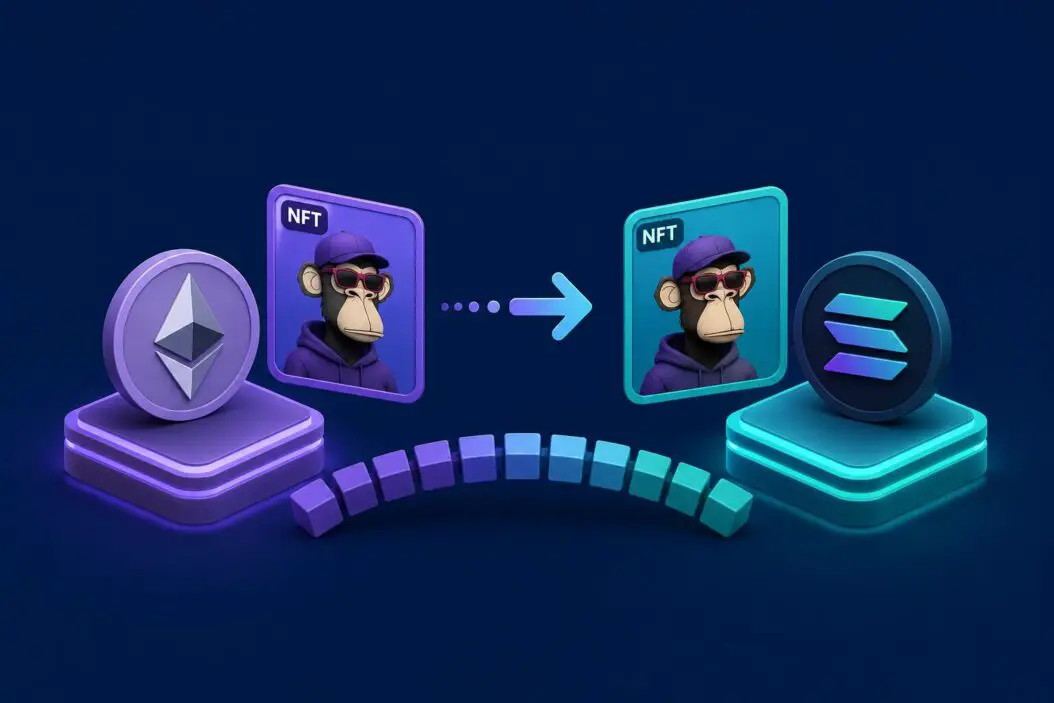
Moving NFTs between blockchains is called bridging. You use a bridge protocol that locks your NFT on the source chain and mints a wrapped or equivalent version on the destination chain. Some newer solutions actually burn and redeploy the NFT natively. Either way, your NFT moves.
What Bridging an NFT Actually Means
NFTs are not files you can copy and paste across networks. They live as smart contracts on a specific blockchain. Moving them requires a protocol that can communicate across chains.
There are two main approaches used today:
Lock and Mint: Your original NFT gets locked in a smart contract on Chain A. A wrapped copy is minted on Chain B. The metadata and token ID stay intact. If you bridge back, the copy on Chain B gets burned and your original unlocks.
Burn and Mint: Your NFT is permanently burned on Chain A and a new native version is minted on Chain B. This is cleaner and increasingly preferred because it avoids fragmented liquidity.
Most serious bridge protocols in 2026 use burn and mint. Lock and mint is older and creates wrapped tokens that sometimes lose value or marketplace support.
Blockchains People Most Commonly Bridge NFTs Between
Before picking a tool, know which chains you are working with. Not every bridge supports every chain.
| Source Chain | Common Destination | Recommended Bridge |
|---|---|---|
| Ethereum | Polygon | Polygon Bridge, Hop Protocol |
| Ethereum | Base | Superbridge, Base Bridge |
| Ethereum | Arbitrum | Arbitrum Bridge |
| Solana | Ethereum | Wormhole |
| Polygon | Ethereum | Polygon Bridge |
| Avalanche | Ethereum | Wormhole, LayerZero |
| BNB Chain | Ethereum | Multichain (check status) |
Step-by-Step: How to Bridge an NFT
I will walk you through a real example using Wormhole, which supports the widest range of chains and is one of the most battle-tested NFT bridge protocols available right now.
Step 1: Confirm Your NFT Is Bridgeable
Not every NFT collection supports cross-chain movement. Check these first:
- Visit the official collection page or Discord and confirm bridge support
- Make sure you own the NFT in a self-custody wallet, not on an exchange
- Check if the collection uses a custom bridge (many major collections like DeGods built their own)
Step 2: Choose the Right Bridge
For most users in 2026, these are the go-to options:
Wormhole Portal: Best for Solana to Ethereum and multi-chain routes. Go to portalbridge.com and connect your wallet.
LayerZero + Stargate: Best for EVM-to-EVM moves (Ethereum, Arbitrum, Optimism, Base, Polygon). Many NFT projects now use Omnichain NFT (ONFT) standard built on LayerZero.
Polygon Bridge: The official and cheapest option specifically for Ethereum to Polygon moves.
Step 3: Set Up Both Wallets
You need a wallet that supports both chains. MetaMask works for all EVM chains. If you are bridging to Solana, you also need Phantom or Backpack wallet open.
Make sure you have:
- Enough native token for gas on the source chain (ETH, SOL, MATIC)
- A small amount of gas on the destination chain to receive and interact with the NFT
Many bridges will tell you upfront how much you need. Do not skip this step. Running out of gas mid-transaction is a headache.
Step 4: Initiate the Bridge Transaction
On Wormhole Portal:
- Select source chain and destination chain
- Connect your source chain wallet
- Select the NFT you want to bridge
- Click “Next” and review the estimated fees
- Approve the transaction in your wallet
- Wait for the source chain to confirm (can take 2 to 15 minutes depending on the chain)
- Switch to your destination wallet
- Click “Redeem” on the portal to claim your NFT on the new chain
The redeem step is important. On most bridges, your NFT is not automatically sent to you. You have to go back to the portal and claim it after the source chain confirms.
Step 5: Verify the NFT on the Destination Chain
After claiming, check your wallet or go to the destination chain’s explorer to confirm receipt. Then check a marketplace on that chain to see if the NFT shows up correctly with metadata.
OpenSea, Blur, and Magic Eden all support multiple chains now, so this is a quick way to verify.
Fees Involved in NFT Bridging
Bridging is not free. Here is what you are actually paying for:
Source chain gas: Approving and locking or burning your NFT. On Ethereum mainnet this can cost $5 to $50+ depending on congestion.
Bridge protocol fee: Wormhole and LayerZero charge a small fee for cross-chain message passing. Usually $1 to $5.
Destination chain gas: Minting or redeeming on the other side. Chains like Polygon, Base, and Arbitrum are cheap here, often under $0.10.
If you are bridging Ethereum to Ethereum L2s, the total cost is usually $10 to $60. Bridging between two L2s is far cheaper.
Collection-Specific Bridges Worth Knowing
Some major NFT collections built their own bridge infrastructure. If your NFT is from one of these, use their official bridge, not a third-party one.
DeGods / y00ts: Moved from Solana to Ethereum using a custom migration tool. This was a full burn-and-mint process handled by the team.
Pudgy Penguins: Launched Pudgy Toys on multiple chains and uses a custom bridge for Lil Pudgys between Ethereum and zkSync.
Azuki: Uses Anichess OFC and has ERC-721 onchain mechanics tied to specific chains. Always check their official docs before bridging.
For any blue-chip collection, always verify the bridge in their official Discord or docs. Scam sites clone real bridge UIs constantly.
Common Mistakes to Avoid
I see people make these errors all the time:
Bridging to a chain with no liquidity: Your NFT arrives but no one is buying on that chain. Before bridging, check if there is active trading volume for that collection on the destination chain.
Using an unofficial bridge: Search “[collection name] official bridge” and verify the URL through their Discord. Do not Google it and click the first ad.
Forgetting destination gas: You cannot claim your NFT if you have zero tokens on the destination chain. Buy a small amount of the native token first.
Assuming metadata carries over perfectly: Sometimes attributes or images do not load correctly on the new chain’s marketplaces. Give it a few hours for indexers to pick it up.
Not checking bridge contract audits: Before using any bridge, look for their security audit. Reputable ones like Wormhole and LayerZero publish these openly. You can read more about bridge security standards at L2Beat’s bridge risk overview.
Is It Safe to Bridge NFTs?
It depends on the bridge. Cross-chain bridges are historically one of the most targeted areas in crypto. The Wormhole hack in 2022 lost $320 million. Since then, major bridges have upgraded security significantly.
Here is how to stay safe:
- Use bridges that have been audited and have a public bug bounty
- Never bridge your most valuable NFTs using a protocol you have not researched
- Check the bridge’s total value locked (TVL) as a rough proxy for trust
- Use the official URLs bookmarked from official project sources, not from Google searches
EVM vs Non-EVM Bridging: Key Differences
Moving NFTs between EVM chains (Ethereum, Polygon, Arbitrum, Base, Optimism) is easier because they share the same token standards. ERC-721 and ERC-1155 are universal across all of them.
Moving between EVM and non-EVM chains like Solana, Cosmos, or Near is harder. The token standards are completely different. Solana uses Metaplex standard. Cosmos uses IBC-native NFT modules. This means bridges have to do more translation work, and wrapped NFTs sometimes lack full marketplace support.
If you are bridging Solana to Ethereum specifically, Wormhole is currently your best option and has the most adoption on both sides.
When Bridging Is Not the Right Move
Sometimes bridging is not worth it. Think carefully before you bridge if:
- The NFT is worth less than the total gas cost of bridging
- You plan to bridge back soon (you will pay fees twice)
- The collection has no trading activity on the destination chain
- The project has explicitly advised against bridging due to ongoing smart contract updates
In these cases, it might be smarter to sell on the current chain and rebuy on the destination chain if a copy is available there.
Summary
Moving NFTs between blockchains in 2026 is doable but requires the right tools and a bit of preparation. Use burn-and-mint bridges when possible for cleaner results. Wormhole covers the widest range of chains. LayerZero is best for EVM-to-EVM. Always verify bridge URLs through official channels.
The core steps are simple: confirm your NFT supports bridging, set up both wallets with gas, initiate on the source chain, and redeem on the destination chain. The biggest risks are phishing sites and running out of gas on arrival.
Once you have done it once, the process feels straightforward. The first time just takes a bit of patience.
Frequently Asked Questions
Can I bridge any NFT to any blockchain?
Not always. The collection must either support a third-party bridge like Wormhole or have their own cross-chain infrastructure. Some NFT contracts are not designed to be bridged and have no corresponding contract on other chains. Always check the collection’s official channels before attempting to move it.
Do I lose my NFT if the bridge goes down mid-transaction?
On properly built bridges, no. Your NFT stays locked on the source chain until it is confirmed on the destination chain. If something fails midway, you can usually return to the bridge portal and either retry the redeem or reverse the transaction. Keep your transaction hash handy so you can troubleshoot with support.
Why does my bridged NFT not show up on marketplaces?
Marketplace indexers take time to recognize a newly arrived NFT. It can take anywhere from a few minutes to 48 hours. If it still does not appear after two days, check if the marketplace supports that NFT standard on that chain, or try manually importing it using the contract address.
Is bridging an NFT a taxable event?
In many jurisdictions, yes. Burning an NFT and minting a new one can be treated as a disposal and acquisition depending on your country’s tax rules. I would strongly recommend checking with a crypto-savvy accountant in your region before bridging high-value NFTs, especially if the wrapped version has a different market value.
What is the cheapest way to bridge an NFT between blockchains?
Bridge between two Layer 2 networks rather than involving Ethereum mainnet. Moving an NFT from Polygon to Base or Arbitrum to Optimism via a LayerZero-based bridge typically costs under $1 total. Ethereum mainnet as either the source or destination is where fees get expensive.
