
Electric cars (EVs) are better if you drive mostly short distances, have access to charging, and want zero emissions. Hybrids are better if you drive long distances, rarely have charging access, and want flexibility without buying a new car type. Neither is universally “best.” Your choice depends on your life, budget, and driving patterns.
What’s the Actual Difference?
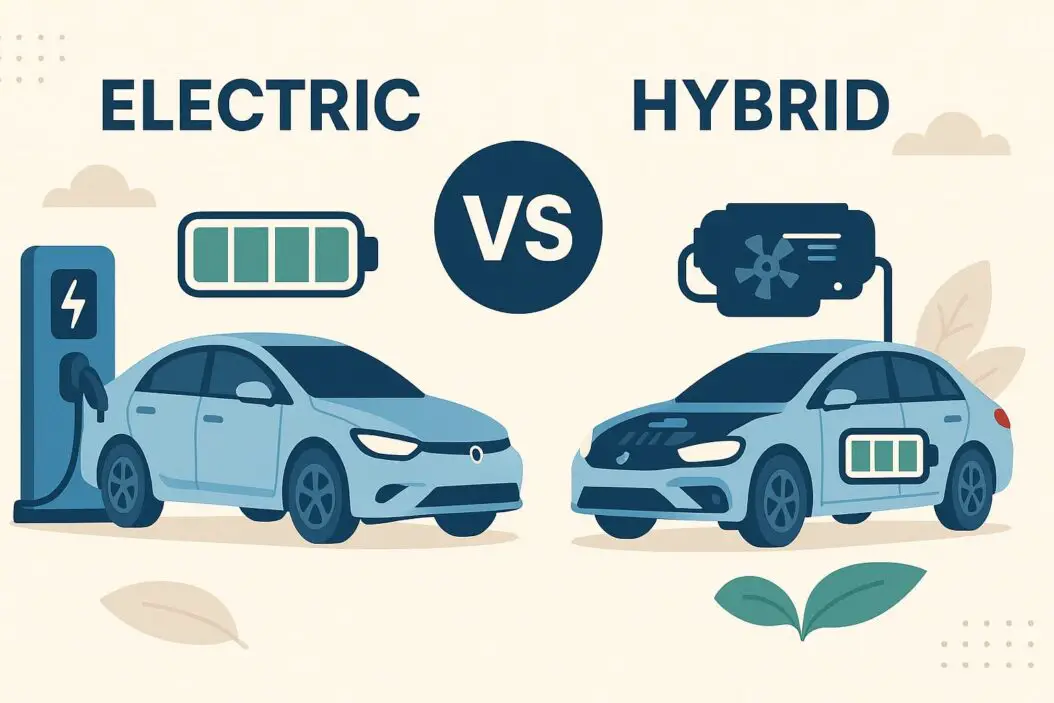
An electric car runs entirely on a rechargeable battery. No gas engine. You plug it in at home or a charging station. Tesla Model 3, Chevy Bolt, Nissan Leaf.
A hybrid car has both a gas engine and an electric motor. The battery recharges while you drive. You never plug it in (with standard hybrids). Toyota Prius, Honda CR-V Hybrid, Ford Escape Hybrid.
A plug-in hybrid (PHEV) is different. It has both systems and you can plug it in for shorter battery-only drives. Think of it as a middle ground between EVs and regular hybrids.
This article focuses on comparing electric and standard hybrids. This matters because your decision affects how you’ll actually use your car every day.
Understanding the Real Costs
Purchase Price
Electric cars typically cost 10,000 to 15,000 dollars more than similar gas cars. A new Tesla Model 3 starts around 40,000 dollars. A comparable Toyota Corolla starts around 27,000 dollars.
Hybrids usually cost 3,000 to 6,000 dollars more than their gas versions. A hybrid Corolla runs about 30,000 dollars.
Federal tax credits reduce this gap. In the US, you can get up to 7,500 dollars off an EV. Some states offer additional rebates. Check your local programs at fueleconomy.gov.
Over five years, the math often favors EVs if you drive typical miles. Lower fuel costs offset the higher purchase price.
| Comparison Factor | Electric Car | Hybrid Car |
|---|---|---|
| Purchase Price | Higher | Moderate |
| Federal Tax Credit (US) | Up to 7,500 dollars | Little to none |
| Cost per Mile | 3 to 4 cents | 10 to 12 cents |
| Oil Changes Needed | Zero | Every 6,000 to 10,000 miles |
Operating Costs
Charging an EV costs about 3 to 4 cents per mile with home electricity rates. Gas typically costs 10 to 12 cents per mile.
That’s roughly 1,500 dollars per year in electricity for a 15,000 mile driver versus 4,000 to 4,500 dollars in gas for a hybrid driver.
EVs have far fewer moving parts. No oil changes, transmission fluid, spark plugs, timing belts. Maintenance drops to tires, brakes, cabin filters, and windshield fluid.
Hybrids still need all traditional maintenance. The gas engine, however, works less hard because the electric motor assists. Engines last longer when they work easier.
Brake wear on EVs is lighter because of regenerative braking. The electric motor slows the car, capturing energy back to the battery. Your friction brakes barely touch daily traffic.
Battery replacement is rare before 150,000 to 200,000 miles on modern EVs. Warranty covers eight years or 100,000 miles in many cases. Real battery failure is uncommon for cars still in use.
Driving Range and Charging
Electric Vehicles
Modern EVs travel 200 to 350 miles per charge. Tesla Model 3 gets 310 miles. Chevy Bolt EV reaches 259 miles. Nissan Leaf offers 149 miles for the basic model.
Home charging overnight is the best scenario. A standard 120-volt outlet adds 2 to 3 miles per hour. A 240-volt home charger adds 25 to 30 miles per hour. Both are realistic for most people.
Public fast chargers add 150 to 200 miles in 25 to 30 minutes. You find them at shopping centers, highways, and restaurants.
The real question: does 200+ miles work for you? If you drive less than 40 miles daily and charge at home, EVs feel effortless. Road trips require planning. Many EV owners rent gas cars for long drives once or twice yearly.
Hybrid Vehicles
Hybrids travel 400 to 550 miles per tank of gas. No charging needed. You refuel wherever gas stations exist, which is everywhere.
This flexibility matters if you drive unpredictably, take spontaneous long trips, or live without reliable access to chargers.
Long-distance driving is simpler than EVs. No charging station hunting. No wait times. Fill up in five minutes and keep going.
For people who drive 100+ miles daily or take frequent road trips, hybrids solve real problems that EVs create.
Environmental Impact and Emissions
Electric Vehicles
EVs produce zero tailpipe emissions. The power plant might use fossil fuels, but batteries are still cleaner overall. Even in coal-heavy regions, EVs emit 50% fewer emissions than gas cars.
In areas with renewable electricity, the difference becomes massive. Pure renewable charging means near-zero emissions across your car’s lifetime.
Battery production does harm the environment. Mining lithium, cobalt, and nickel creates carbon emissions and uses water. A typical EV battery creates 1 to 2 tons of CO2 during manufacturing.
However, an EV pays back these emissions in about one to two years of driving. After that, they’re cleaner for their entire lifespan.
For real numbers: most EVs produce 60% fewer lifetime emissions than gas cars. The exact percentage depends on your electricity grid.
Hybrid Vehicles
Hybrids cut emissions roughly 30% to 50% compared to gas-only cars. You burn less fuel because the electric motor shares the load.
They don’t eliminate emissions, but they reduce them meaningfully. A Prius produces about half the emissions of a comparable gas sedan.
For people who can’t switch to EVs yet due to infrastructure or budget, hybrids provide real environmental benefits today.
Where You Live Matters
Charging Infrastructure
This is critical. Type the postcode into plugshare.com and see nearby chargers. If you find hundreds, EV life is easy. If you find ten, it’s complicated.
Apartment dwellers without dedicated parking struggle. Can’t install home charging. Depend on public networks. This works but takes planning.
Rural areas rarely have fast chargers. A 45-minute round trip to charge isn’t practical daily. Hybrids serve rural drivers better.
West Coast areas like California and Washington have dense networks. Middle America has fewer options, though this improves yearly.
Living matters as much as vehicle choice.
Home Charging Access
Having a garage or driveway changes everything. You install a charger and charge overnight effortlessly.
Without guaranteed parking, EV ownership requires public charging at known times. Doable but less convenient.
Renters should confirm charging options before choosing an EV.
Driving Habits Shape Your Decision
Short Daily Drives Under 40 Miles
Electric cars shine here. Charge at night. Drive all day. Repeat. The math beats hybrids completely.
Most Americans drive under 40 miles daily. For these drivers, EVs are ideal.
Medium Drives Between 40 to 100 Miles
Hybrids or plug-in hybrids make sense. An EV works if home charging exists, but you’ll see more of your charger than you want.
Long Daily Drives Over 100 Miles
Hybrids are safer. Less charging anxiety. No range concerns. Gas cars or hybrids handle this better than EVs.
Frequent Long Road Trips
Hybrids win clearly. Gas infrastructure beats charging networks everywhere. Five-minute fill-ups beat 30-minute charges.
If you drive to visit family 500 miles away quarterly, get a hybrid.
Predictable Routes
EVs work better for predictable drives. Same commute daily. You know range covers it. Charging becomes routine.
Unpredictable driving means hybrid simplicity.
Performance and Driving Experience
Acceleration and Torque
Electric motors deliver maximum torque immediately. EVs accelerate quickly, even modest ones. A Chevy Bolt feels brisk from zero to 30 mph.
Hybrids feel normal. The gas engine builds power gradually like most cars. Acceleration is smooth but less lively than EVs.
For daily driving, EV quickness feels nicer. You notice it in city traffic and on-ramps.
Noise and Smoothness
EVs are quiet. No engine rumble. The ride feels serene. Some people love this. Others find it odd.
Hybrids run quieter than gas cars but you hear the engine at full throttle. The gas engine engages for highway driving.
Noise preference is personal. Try both before choosing.
Handling and Braking
EV batteries sit low, centering weight. This improves handling. Cars feel planted in corners.
Regenerative braking feels different. The car slows when you lift off the accelerator, even without touching brakes. New EV drivers adjust to this within a week.
Regular brake feel in hybrids matches traditional cars exactly.
Reliability and Durability
Electric Vehicle Reliability
Modern EVs are reliable. Tesla cars rank well on Consumer Reports. Hyundai and Kia EVs have strong reliability ratings.
Battery degradation is slower than many feared. Most lose 5% to 10% capacity over 200,000 miles. Some lose less.
Early EVs like the Nissan Leaf showed more battery problems. Modern cooling systems prevent this. New batteries are tough.
Hybrid Reliability
Hybrids have decades of real-world data. Toyota hybrids run 200,000 miles regularly without major issues. They’re proven.
Batteries in hybrids are much smaller and less demanding than EV batteries. They rarely fail.
If you want the lowest breakdown risk, hybrids win based on sheer track record. They’ve been tested by millions of drivers since 2000.
Resale Value and Depreciation
EVs depreciate faster than hybrids currently. Your 40,000 dollar EV might be worth 25,000 dollars in five years. A 30,000 dollar hybrid might be worth 20,000 dollars.
The percentage loss is similar, but the dollar loss feels bigger on expensive EVs.
This gap narrows as EVs become more common. In five years, the resale difference will likely disappear.
Used EV inventory is growing. Buyers have more choices, which actually keeps prices reasonable.
Hybrids hold value predictably. Toyota hybrids hold particularly well. Honda too.
Government Incentives and Rebates
The federal tax credit of 7,500 dollars applies to most EVs under the current US policy. Requirements exist: final assembly in North America, purchase price limits, mineral requirements. Check fueleconomy.gov for your specific model.
Some states add rebates. California offers additional incentives. New York provides charging infrastructure support.
These change yearly. Research current programs before buying.
Hybrids receive minimal incentives federally, though some states offer small rebates.
The incentive gap matters. It can reduce EV purchase price closer to hybrid pricing.
Insurance, Registration, and Taxes
EV insurance costs 10% to 25% more than gas cars, typically. Repair costs are higher per incident, even though incidents are less frequent.
Hybrid insurance runs nearly identical to gas cars.
Some states offer registration discounts for EVs. This offsets some insurance increases.
Factor insurance into your total cost calculation. It matters more than many realize.
The Environmental Debate: EVs vs Hybrids
This gets complicated because it depends on your electricity source.
In coal-heavy regions, an EV is 50% cleaner over its lifetime. In renewable-heavy regions, an EV is 80% cleaner.
A hybrid in any region cuts emissions roughly 35%.
Neither is “perfect” environmentally. Both beat gas cars clearly.
If climate impact drives your decision, both win. EVs win more, but hybrids win significantly too.
The best car is the one you actually use and keep running long. Driving an old gas car 200,000 miles beats buying a new EV and scrapping your current car for emissions reasons.
Practical Scenario Examples
Sarah’s Situation: City Commuter
Sarah drives 35 miles daily. Her apartment has parking with scheduled charging. Drives mostly in the city. Weekend errands only within 50 miles.
Recommendation: Electric car. Her driving pattern is perfect for EVs. Charging is convenient. Cost savings are large over five years.
Michael’s Situation: Salesman with Long Routes
Michael drives 120 miles daily across three states. No home charging access. Takes spontaneous client meetings in remote areas. Road trips to regional offices twice monthly.
Recommendation: Hybrid. Range anxiety becomes real stress. Charging time cuts into productive hours. Hybrid simplicity solves his actual problem.
The Martinez Family: Suburban Multi-Use
They drive to work (25 miles), school runs (12 miles), weekend hiking (80 miles round trip). Have a garage and driveway. Kids play sports requiring spontaneous trips.
Recommendation: Plug-in hybrid or EV if camping trips weren’t frequent. For their variety, a plug-in hybrid provides both city efficiency and road trip flexibility.
Direct Head-to-Head Comparison
| Factor | Winner | Why |
|---|---|---|
| Short daily commutes | EV | Charging convenience beats fuel costs |
| Long daily drives | Hybrid | Range covers it all without charging |
| Road trips | Hybrid | Faster refueling, more stations |
| Environmental impact | EV | Lower lifetime emissions if charged cleanly |
| Purchase price | Hybrid | Lower upfront cost |
| Operating costs | EV | Electricity cheaper than gas |
| Home charging access | EV | Better if you have it |
| No home charging | Hybrid | More practical |
| Maintenance costs | EV | Fewer moving parts |
| Reliability history | Hybrid | Proven over 20+ years |
| Driving experience | EV | Smoother, quieter |
| Resale value | Hybrid | Holds value better currently |
Making Your Final Decision
Ask yourself these questions honestly:
- Do I have reliable home charging access? (Yes = EV becomes viable)
- Do I drive under 50 miles daily on average? (Yes = EV works well)
- Do I take long road trips monthly or more? (Yes = Hybrid needed)
- Am I driving in a place with good charging infrastructure? (Yes = EV realistic)
- Is my driving predictable or wildly variable? (Predictable = EV okay; Variable = Hybrid better)
Score toward EV: Questions 1, 2, 4 answered yes. Score toward Hybrid: Questions 3, 5 suggest hybrid.
Most people should answer honestly about question 3. Long road trips change the equation.
Summary
Electric cars beat hybrids for people with home charging, predictable daily driving under 50 miles, and access to charging infrastructure. Lower operating costs and environmental benefits add up over five years.
Hybrids beat electric cars for people who drive long distances, take frequent road trips, lack home charging access, or live in rural areas with sparse charging networks.
Neither is universally better. Your specific life determines the right choice. Don’t let marketing hype override what actually works for you.
An EV that sits in your driveway while you rent a gas car for every trip costs more in total than the hybrid you should have bought. Similarly, a hybrid sitting unused while you develop great work commute habits is inefficient.
Choose based on how you actually drive, where you actually live, and what actually charges your car reliably.
Frequently Asked Questions
Do electric cars work in cold weather?
Yes, but with reduced range. Cold weather decreases range by 20% to 40%. EVs heat the cabin and battery, which uses energy. Highways in snowy climates see more EV impact than hybrids. Plug-in hybrids solve this by switching to gas engines in extreme cold.
How long before charging networks become as common as gas stations?
Charging is expanding rapidly. In urban areas, it’s already dense. Rural areas will take 10 to 15 years for meaningful coverage. Hybrids remain more practical for rural drivers right now.
Is an EV cheaper than a hybrid over 10 years?
Usually yes, if you keep the car long and have home charging. Lower fuel and maintenance costs overcome the higher purchase price. Calculate for your specific situation at electriccarfacts.com or fueleconomy.gov.
Can I charge an EV at any charging station?
Not always. Different networks exist. Tesla has its own network. Electrify America, Charge Point, and others have their own equipment. Most new EVs come with adapters. This is improving as standards unify.
What about a plug-in hybrid as a middle ground?
Plug-in hybrids combine both benefits. They work great for people with home charging who still want gas range flexibility. They cost more upfront than either option alone, but some drivers find them ideal.
References for Further Reading
For detailed comparison tools and real-time data, visit fueleconomy.gov to calculate costs specific to your region’s electricity rates and gas prices. They provide EPA estimates and user reviews.
For finding charging stations and planning EV road trips, PlugShare shows real-time charger availability, pricing, and user feedback across North America and Europe.

- How to Enable Screen Sharing in Discord? – Guide - April 19, 2026
- How to Share Internet from Mobile to Mobile without Hotspot? - April 19, 2026
- 12 Best Janitor.Ai Alternatives (FREE) - April 18, 2026