
Cloud gaming is shifting from experimental technology to mainstream reality starting in 2026. Cloud gaming revenue is projected to reach $14 billion by 2027, with the market expanding at 44% annually through 2030. Cloud gaming is expected to reach 500 million players by 2027, growing at 40% year-over-year. The next phase isn’t about faster internet or more powerful servers. It’s about seamless access across every device you own. Your gaming will follow you from your phone to your TV to your car, picking up exactly where you left off. That’s what’s coming.
By 2026, the number of cloud gaming users is expected to hit over 480 million. This isn’t a niche anymore. This is the mainstream.
What Changes in 2026: The Shift From Device to Ecosystem
The End of “Pick One Platform”
In 2026, you had to choose: console, PC, or cloud. In 2026 and beyond, that choice disappears. Gaming ecosystems are becoming more important than individual devices, with cloud platforms, handhelds and cross-device systems expanding the definition of what a “primary gaming device” means.
This means you start playing a game on your phone during your commute. You dock at a station, and the game seamlessly moves to your tablet. You get home, and it continues on your TV with the same progress, same inventory, same saves. One unified experience across multiple screens. This infrastructure is being built right now for 2026 launch.
Studios are adopting cloud-enabled development practices that allow them to test and deliver experiences across multiple devices. Game developers aren’t building separate versions anymore. They’re building one game that runs everywhere.
Multi-Device Gaming Becomes Standard
Gaming ecosystems are now more important than individual boxes, with platforms like GeForce NOW, Amazon Luna and Nintendo Switch 2 growing fast, alongside multi-platform ecosystems built around Fortnite, Minecraft and Roblox. These three games already work across hundreds of devices. By 2026, that’s the expectation for most new releases.
Your living room TV is no longer just for Netflix. Smart TVs are turning into gaming entry points, with Xbox expanding cloud play across TVs, handhelds and everyday devices. You pick up a controller, and you’re in a AAA game without needing to own a console.
Gaming on Screens You Already Have
The hardware manufacturers know something important: you already own screens. You have a phone, a tablet, maybe a TV. Cloud gaming doesn’t require you to buy anything new. It just uses what you have.
This is why 2026 matters. Accessibility just doubled. A person who couldn’t afford a $500 console can now play the same games on a phone they already own. That’s transformative in developing regions and lower-income households.
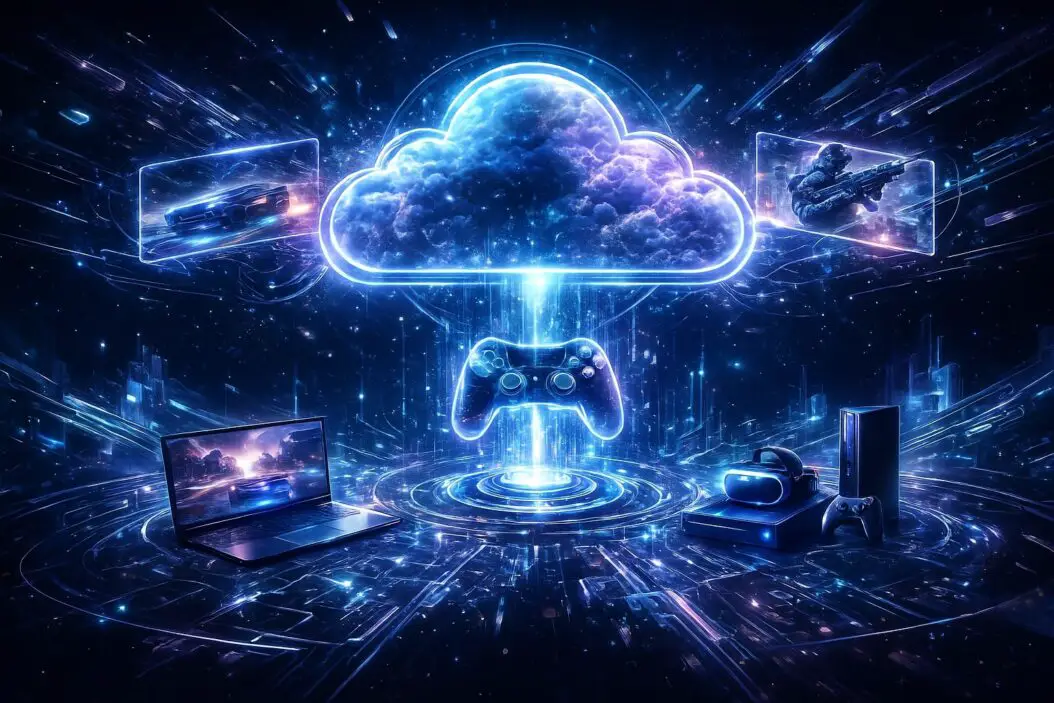
The Technology Getting You There
Edge Computing Gets Smarter
The latency problem is solved. Cloud gaming platforms are increasingly deploying GPU micro-clusters at the network edge, resulting in lag reductions of up to 50% for many users, with Multi-Access Edge Computing combined with 5G enabling input-to-display times that approach local consoles.
This means competitive gameplay becomes viable on cloud. Not professional esports level, but good enough for casual and intermediate players to enjoy fast-paced games without feeling disadvantaged by lag.
AI Adaptive Streaming
Instead of streaming the same quality to everyone, systems now adapt in real time. AI-driven adaptive streaming is expected to improve average bandwidth efficiency by 25% by 2027, cutting operational costs and improving quality of service. Your connection gets slower momentarily? The system adjusts quality before you notice. Your network improves? The system optimizes visuals instantly.
New adaptive rendering optimizers are reporting up to 24% higher perceived service quality and are able to support twice as many simultaneous users on the same GPU infrastructure. This means cheaper subscriptions and better reliability.
4K and HDR Streaming Becomes Standard
The next frontier in cloud gaming isn’t lower latency. It’s visual fidelity. 4K gaming (3840 x 2160 resolution) with HDR (High Dynamic Range) is coming as standard in 2026. Most current cloud games run at 1440p. By 2026, expect 4K with high refresh rates on fiber and 5G connections.
The compression technology that makes this possible is already here. The infrastructure to deliver it is being deployed now.
Quantum Computing Enters the Picture
This sounds like science fiction, but quantum computing is predicted to outperform classical computing in gaming physics calculations by 2027. What this means practically: games with massive worlds, millions of interactive objects, and complex physics that weren’t possible before.
Imagine a game world where every structure can collapse realistically, every vehicle has genuine weight and physics, and thousands of NPCs make independent decisions based on environmental factors. Quantum computing makes that scale of simulation viable.
Market Growth and What It Means
The numbers tell a clear story:
| Year | Market Size | Players | Revenue (USD) |
|---|---|---|---|
| 2024 | $3.13 billion | 300 million | Growing |
| 2025 | Estimated $5-6 billion | 400 million | $10.5-14B by 2027 |
| 2026 | Growing | 480 million | On track for $14B+ |
| 2027 | — | 500 million+ | $14 billion + |
| 2030 | — | Mainstream | $64 billion projected |
The cloud gaming market projects to expand by 44% CAGR through 2030, driven by rapidly improving high-speed internet infrastructure, evolving commercial models, and improved user experiences.
More importantly: Evidence suggests that average revenue per user (ARPU) for cloud games is rising and set to surpass all other gaming mediums apart from mobile by 2027. This matters because it means cloud gaming is actually becoming more profitable than traditional gaming. When profitability shifts, everything shifts.
What’s Happening to Traditional Gaming Hardware
Predictions expect that in 2026, both gaming consoles and PC hardware sales will decline, as consumers choose to spend instead on displays and streaming devices. This trend accelerates in 2026 and beyond.
People aren’t buying gaming consoles as the primary way to play. They’re buying TVs that support cloud gaming, better internet connections, and subscriptions to multiple services. The $500 investment goes to infrastructure, not hardware that becomes obsolete in 5 years.
This doesn’t mean consoles disappear. Hardcore collectors still buy them. But the center of gravity shifts toward access over ownership.
AI-Powered Personalization Coming in 2026
Imagine a game that knows you. Not creepily, but intelligently. Artificial Intelligence will play a pivotal role in personalizing gaming experiences, with games that adapt to your skill level and play style, creating unique experiences tailored just for you.
Games in 2026 won’t have a single difficulty curve. They’ll have algorithms that watch how you play and adjust in real time. Playing too conservatively? Enemies become more aggressive. Struggling with platforming? The system suggests a different approach. Dominating opponents? The challenge ramps up instantly.
This isn’t new technology. Machine learning in games exists now. But cloud infrastructure makes it viable at scale. Thousands of players experience personalized gameplay simultaneously on shared servers.
VR and AR Integration Without Expensive Hardware
Virtual reality and Augmented reality are being blended by companies like Sony and Microsoft to allow players to experience gaming in real-world spaces, with developers expecting this technology to be more widely adopted in esports where it can create immersive environments for spectators.
The barrier to VR has always been cost. A quality VR headset costs $300-800. A VR-capable PC costs $1,500+. Together, you’re looking at $2,000+ minimum.
Cloud VR changes this. The expensive processing happens on remote servers. The headset is just a display and input device. Standalone VR headsets that cost $200-300 can deliver high-quality VR games if they’re powered by cloud rendering.
By 2026, VR gaming becomes accessible to mainstream players for the first time.
Cross-Platform Play Becomes Non-Negotiable
Cross-platform play and game progress syncing unify gaming experiences across cloud and local devices, with advancements in streaming protocols and bandwidth expected by 2030 to minimize latency issues and blur lines between cloud and PC gaming.
A game launches in 2026. It works on:
- Cloud (any device with a screen and controller)
- PC (traditional download)
- Console (if it supports the ecosystem)
- Mobile (cloud streaming)
Your saves sync across all of them. Your friends on different platforms can play together. Your achievement list is unified.
This isn’t optional anymore. Developers who don’t support cross-platform play lose players to competitors who do.
Sustainability Becomes a Selling Point
Cloud gaming companies are committing to carbon-efficient operations, targeting a 40% reduction in data-center emissions by 2030 through adoption of renewable energy, liquid-cooling, and optimized utilization.
This matters for two reasons. First, cloud gaming is actually more efficient than local gaming when done right. One powerful server serving hundreds of players uses less total energy than hundreds of people running expensive local hardware.
Second, environmentally conscious players care about this. Major providers will advertise their renewable energy use and efficiency metrics. “Play guilt-free” becomes a marketing message.
Subscription Consolidation and Price Stability
Right now, you need multiple subscriptions to access all games. Xbox Game Pass, PlayStation Plus, NVIDIA GeForce Now, Amazon Luna. By 2026, this starts consolidating.
Bigger players absorb smaller ones. Pricing stabilizes around $15-20 per month for premium tiers. Free-to-play options expand with ad-supported models. Family plans become standard.
The Netflix model is the template. Multiple services exist, but most people subscribe to 2-3 of them. Cloud gaming reaches the same equilibrium.
What Hasn’t Changed
Internet Requirements Are Still Real
Cloud gaming needs 15-25 Mbps for 1080p. 50+ Mbps for 4K. That’s reality in 2026. Rural areas with limited bandwidth still face barriers. Data caps still matter. Unstable connections still cause problems.
Infrastructure improvements are happening, but they’re not universal. Urban centers get served first. Rural adoption lags years behind.
You Still Don’t Own Games
Subscriptions remain rentals. When you stop paying, access ends. If a game leaves the service, it’s gone. This fundamental fact doesn’t change in 2026. Some players accept this. Others never will.
Competitive Gaming Still Prefers Local Hardware
Professional esports players will keep gaming PCs and consoles. The latency advantage, even if small, matters at that level. Cloud gaming remains viable for casual and intermediate competitive play, but not professional.
What You Should Prepare For in 2026
Get your internet tested now. Run a speed test at speedtest.net. Cloud gaming needs minimum 15 Mbps, ideally 25+. If you have less, start planning an upgrade. Fiber is becoming available in more areas.
Try cloud gaming services before committing. Most offer free trials. Xbox Game Pass Ultimate, NVIDIA GeForce Now free tier, and Amazon Luna have free options. Spend 30 minutes testing on your actual internet connection.
Think about your primary devices. Which screens will you use most for gaming? TV, laptop, phone, tablet? Choose services that work best on those devices.
Budget for subscriptions, not hardware. Assume $15-20 monthly for one quality service. Add $10 for a second if you want more game variety. Over five years, that’s $900-1,200. Compare to a $500-800 console purchase plus games at $60 each.
Understand what you’re buying. You’re buying access to a game library, not ownership. This is a convenience trade. Understand whether it works for you.
The Developer Perspective in 2026
Game developers have already started building for cloud-first infrastructure. By 2026, this is standard practice.
Key changes:
- Games are designed to handle variable network conditions, not assume perfect local processing
- Save systems use cloud storage as primary (not optional)
- Graphics are optimized for streaming compression, not raw resolution
- Latency budgets account for network round-trip times
- Analytics track engagement across multiple devices
Developers who adapted early gain competitive advantage. Those who wait face pressure to rebuild.
Competitive Gaming in the Cloud Era
Fast-paced competitive games work better in 2026 than 2025. Input latency is down to 30-40 milliseconds on edge-computed servers. That’s still higher than local gaming (16 ms), but it’s acceptable for most players.
Casual competitive gaming, turn-based games, and asynchronous multiplayer work perfectly. Precision shooters and fighting games still favor local hardware at the professional level.
But for millions of casual players? Cloud-based competitive gaming becomes their primary experience.
FAQs:
Will cloud gaming completely replace console and PC gaming?
No. Collectors will still buy hardware. Professionals will still need local systems. But cloud will become the primary choice for most players. By 2030, maybe 70% of gaming is cloud-based, with 30% remaining traditional hardware.
What if internet goes down? Can I play offline?
Cloud gaming requires an active connection. No internet means no play. This is the fundamental trade-off. If reliability matters more than convenience, traditional gaming stays better.
How much does cloud gaming cost?
Subscriptions range from free (limited) to $20 monthly. Most people pay $10-15 for a quality service. That’s $120-180 yearly. Compare to buying 2-3 games at $60 each, and cloud saves money.
Can I play competitive ranked matches on cloud?
Yes, increasingly. Latency is good enough for most competitive games. Professional esports will stay on local hardware, but casual ranked play works fine on cloud in 2026.
What’s the difference between cloud gaming in 2025 vs 2026?
The jump is in device integration and cross-platform play. In 2025, cloud gaming works. In 2026, it becomes transparent. You don’t think about which device you’re using. Games just follow you.
Conclusion
The future of cloud gaming isn’t uncertain anymore. It’s being built right now for 2026 launch. The infrastructure exists. The games are being ported. The players are ready.
What’s changing in 2026 and beyond isn’t whether cloud gaming works. It’s whether you use it as your primary way to play. For most people, the answer will be yes by 2028.
The shift from hardware ownership to access is complete. The gaming industry is becoming a service industry. This is already happening. The next 12 months just make it unavoidable.
If you’ve been waiting to see whether cloud gaming is “ready,” it is. The question now is whether it fits your life. That’s an individual choice, not a technological one.
