
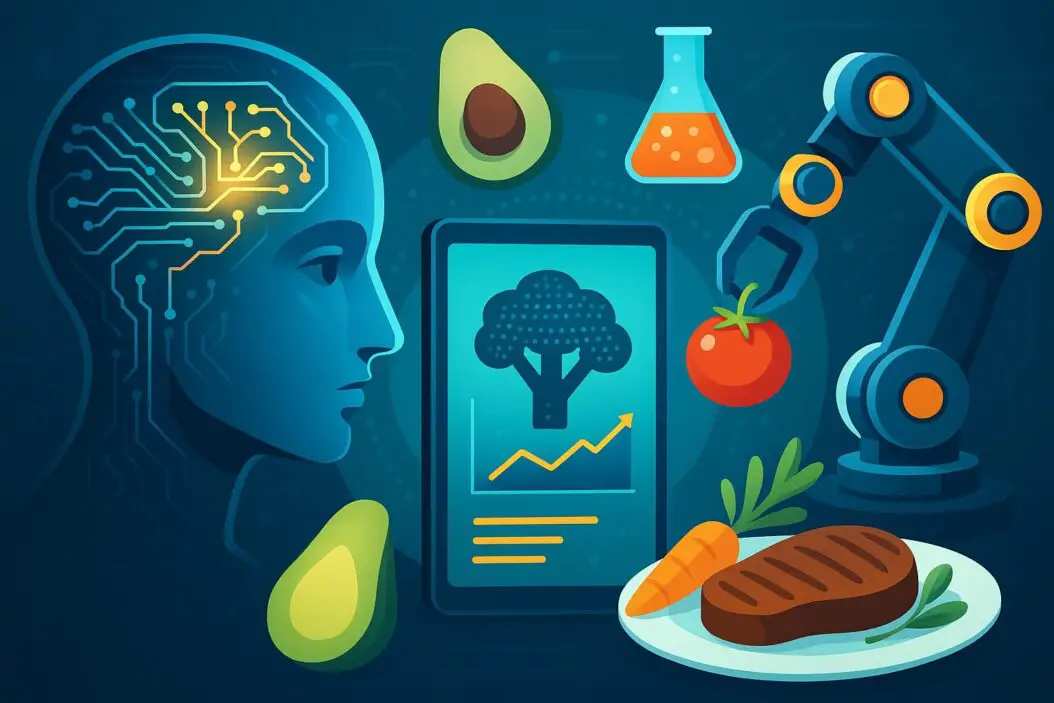
Artificial intelligence is reshaping food science technology across production, safety, and sustainability. In December 2025, AI has moved from experimental projects to essential operations in major food companies. Factories are now using machine learning algorithms to predict equipment failures before they happen, computer vision systems to spot quality issues in seconds, and data analytics to forecast demand with remarkable accuracy. The result? Manufacturers are cutting waste by 15-40%, reducing defects, and operating more sustainably than ever before.
If you work in food manufacturing, distribution, or innovation, you need to understand how AI is changing the industry. This shift affects hiring, investment decisions, and competitive advantage. Let’s break down what’s actually happening in food facilities today.
What Is AI in Food Science Technology?
Artificial intelligence in food science combines machine learning algorithms, computer vision systems, and data analytics to optimize how food is produced, processed, and distributed.
Think of it this way: Traditional manufacturing relies on humans and basic sensors to monitor production. Someone looks at a screen, sees data, and makes decisions. AI changes this completely. Machine learning models analyze thousands of data points simultaneously, spot patterns humans miss, and recommend or execute actions automatically.
Here’s what AI actually does in food facilities:
- Detects defects instantly using camera systems that examine thousands of products per minute
- Predicts maintenance needs by analyzing vibration patterns and equipment data before failure occurs
- Optimizes recipes by testing thousands of ingredient combinations digitally before physical production
- Manages inventory by forecasting demand based on weather, seasonality, and consumer behavior
- Ensures safety by tracing products through the supply chain and identifying contamination risks
- Reduces waste by matching production to actual demand rather than historical guesses
Companies like Mondelez, Nestlé, and PepsiCo are already deploying these systems. The global market for AI in the food industry is projected to grow from current levels to nearly $49 billion by 2029.
Why Food Companies Are Adopting AI Now
Three major pressures are driving rapid AI adoption in 2026:
1. Labor costs and workforce shortages. Finding skilled workers to operate production lines is harder and more expensive than ever. Facilities face chronic labor shortages in sorting, packaging, and quality control. AI-powered automation directly addresses this problem without requiring massive new infrastructure investments.
2. Food safety regulations becoming mandatory. The FDA’s Food Traceability Rule takes effect in January 2026. This requires companies to track products from source to store in real time. Manual tracking systems cannot handle this. AI and blockchain work together to make compliance automatic and auditable.
3. Sustainability expectations from consumers and investors. Reducing food waste, water consumption, and energy use is no longer optional. AI enables manufacturers to identify exactly where losses occur and adjust processes in real time. This converts sustainability from a cost center into a competitive advantage.
Companies that haven’t started integrating AI now will fall behind competitors in efficiency, quality, and cost control.
How AI Solves Real Production Problems
Quality Control and Defect Detection
A modern food facility processes thousands of items per minute. Human inspectors working eight-hour shifts cannot reliably catch defects in this volume. They get tired. They miss things.
AI vision systems work differently. Computer vision, combined with deep learning, examines every single product. These systems have been trained on millions of images of both perfect and defective items. They learn to spot cracks, color variations, size deviations, and contamination instantly.
The impact is measurable. Nestle and PepsiCo report that AI-powered food sorting systems achieve 99.9% accuracy while processing thousands of items per minute. A single system can replace 15-20 workers. More importantly, defect rates drop because human fatigue doesn’t affect machine performance.
Real-world example: A beverage company uses AI vision to inspect bottle fills and cap placement. The system detects underfilled bottles before they reach consumers, preventing recalls and brand damage. Detection happens in milliseconds as bottles pass on the production line.
Predictive Maintenance and Equipment Uptime
Food manufacturing equipment is complex and expensive. Production lines include mixers, pumps, conveyors, and packaging machinery. When equipment fails unexpectedly, the entire line stops. This costs money and disrupts delivery commitments.
Traditional maintenance uses a schedule. Equipment gets serviced on a calendar, whether it needs it or not. This wastes resources on unnecessary work.
AI predictive maintenance monitors equipment constantly. Vibration sensors, temperature readings, power consumption, and pressure data feed into machine learning models. These models have learned what normal operation looks like. When patterns deviate, AI flags the problem weeks in advance.
The advantage is clear. Manufacturers receive alerts before equipment actually breaks. They schedule maintenance during planned downtime, not emergency shutdowns. Facilities report 30-35% reductions in unplanned downtime and equipment failure costs.
Real-world example: A dairy processor monitors pump vibrations using AI. The system detects early bearing wear before catastrophic failure. Maintenance is scheduled during the next planned line shutdown. The company avoids a $50,000 emergency repair that would have halted production for days.
Production Planning and Capacity Optimization
Most food facilities still plan production using spreadsheets and historical data. A manager looks at last year’s sales, estimates this year’s demand, and tells the plant what to make. This approach causes problems.
In reality, demand fluctuates based on dozens of variables: weather, holidays, social media trends, competitor actions, economic conditions, even disease patterns. Spreadsheet-based planning misses these connections.
AI production planning systems ingest real-time data. They analyze current sales trends, inventory levels, equipment efficiency, supplier status, and external factors. They then create optimized production schedules down to 15-minute intervals. The system recommends which products to run, which equipment to use, and how many workers to staff.
The results are dramatic. Manufacturers report hitting peak efficiency levels consistently. Production bottlenecks disappear because AI sees constraints humans don’t notice. Waste drops because production matches actual demand rather than forecast guesses.
Real-world example: A snack company uses AI to plan weekly production. The system analyzes sales data, customer orders, inventory levels, and equipment availability. It recommends running three packaging lines on high-demand products and one line on specialty items. This recommendation reduces setup time, minimizes waste, and ensures products ship on schedule. Production efficiency improves by 22% in the first quarter of implementation.
Supply Chain Visibility and Waste Reduction
The food industry loses billions annually to spoilage, product damage, and inefficiency. Much of this waste happens in logistics and inventory management.
Traditional supply chains lack visibility. A manufacturer ships products to distributors, who ship to retailers. Tracking happens with paperwork and barcodes. If contamination occurs, tracing the source takes weeks. By then, damage is done.
AI supply chain systems create complete visibility. Combined with blockchain, they create an unchangeable record. Every product movement is tracked and logged. If a safety issue emerges, products are identified and removed within hours instead of weeks.
Beyond safety, AI optimizes transportation routes, warehouse inventory, and delivery timing. Machine learning models predict which products will sell quickly and which might spoil. This intelligence triggers smarter restocking decisions.
Real-world example: IBM partnered with olive oil producers to create an AI-blockchain traceability system. Consumers scan a QR code on a bottle and see the entire journey from grove to store. If contamination is discovered, the company identifies every affected batch in minutes. Products are recalled before they reach most consumers.
Recipe Development and Product Innovation
Testing new food products traditionally takes months. Chemists create formulations. Batches are made. Sensory panels taste them. If results are poor, the process repeats. Each cycle costs money and time.
AI accelerates this dramatically. Machine learning models can predict how ingredients interact. They test thousands of digital recipe variations before any physical batch is made. AI analyzes texture, flavor profiles, nutritional content, and consumer preferences simultaneously.
Beverage companies report that AI can compress formulation cycles from months to weeks. The company saves money and gets products to market faster. This creates competitive advantage because consumer food trends move quickly.
The Real Challenges Companies Face
Despite clear benefits, AI adoption faces obstacles.
Cost remains the biggest barrier. Sixty percent of food companies cite implementation cost as the top reason they haven’t adopted AI. Building AI systems requires hardware, software, training, and IT infrastructure. Small manufacturers struggle with this investment. Even large companies must justify ROI to boards and investors.
Data quality problems exist. AI learns from data. If data is incomplete, inconsistent, or inaccurate, the AI system produces poor results. Many older manufacturing facilities haven’t digitized their operations. Their data is scattered across incompatible systems.
Workforce training is critical and often insufficient. Employees need skills to implement, monitor, and maintain AI systems. Technical talent is scarce and expensive. Many companies don’t have the internal expertise to make AI work effectively.
Integration with existing systems is complex. Food facilities run on legacy equipment and software built over decades. Adding AI requires making new systems talk to old ones. This integration is technically difficult and time-consuming.
Ethical and privacy concerns arise. AI systems make decisions that affect people’s jobs. Data security is critical because production information is proprietary. Companies must address these concerns transparently.
Current AI Technologies in Food Science (2026 Status)
| Technology | How It Works | Real Impact |
|---|---|---|
| Computer Vision | Cameras combined with deep learning models examine products for defects | 99%+ accuracy in quality detection |
| Machine Learning | Algorithms analyze production data to identify patterns and predict outcomes | 30-40% improvement in efficiency |
| Demand Forecasting | AI models predict future demand based on sales history and external factors | Reduced waste, lower inventory costs |
| Predictive Maintenance | Algorithms analyze equipment data to forecast failures before they occur | Reduced downtime, lower maintenance costs |
| Supply Chain Optimization | AI optimizes routes, timing, and inventory in food logistics | 15-20% transportation cost reduction |
| Recipe Optimization | Machine learning tests digital recipe variations before production | 50% faster product development |
| Food Safety Traceability | Blockchain combined with AI creates product tracking from farm to store | Faster recalls, improved consumer safety |
| Robotics with AI | Intelligent robots handle sorting, packaging, and handling tasks | 24/7 production without human errors |
Why This Matters for Your Food Business
If you work in food manufacturing, distribution, or supply chain management, AI adoption directly affects your competitive position.
Companies that implement AI early gain:
Operational advantage. Better efficiency, lower waste, higher quality. Competitors notice when your costs are lower and products are better.
Regulatory readiness. January 2026 FDA compliance is mandatory. AI-based traceability systems meet these requirements automatically. Manual systems will struggle.
Labor competitiveness. Younger workers are technology-native. Companies with modern systems attract better talent. Manufacturing jobs that involve operating AI systems are more appealing than jobs involving routine physical work.
Investor confidence. Sustainability metrics matter to investors now. AI makes sustainability measurable and achievable. This improves company valuation.
Consumer trust. AI-enabled transparency builds brand loyalty. Consumers increasingly want to know where products come from and whether they’re safe. AI supply chain visibility delivers this.
Companies that wait risk being left behind. Competitors will capture market share through lower costs and better products.
What’s Next in Food Science AI
Looking at 2025 and into 2026, several developments are accelerating:
Autonomous manufacturing. The term “lights-out facilities” refers to factories operating 24/7 with no human workers on site. AI controls everything. These facilities operate at 99.9% quality rates and run continuously without human fatigue affecting performance.
Personalized nutrition at scale. AI will match individual genetic profiles, health data, and preferences to food products. This starts with premium products but will expand. Eventually, mass-market personalization becomes standard.
Climate-resilient agriculture. AI helps farmers adapt to climate change. Predictive models forecast extreme weather. Smart irrigation systems reduce water waste. These tools will become essential as climate disruption increases food production risks.
Regenerative agriculture technology. AI tracks soil health, predicts crop yields, and optimizes farming practices for long-term sustainability. Companies will shift toward regenerative methods driven by data rather than intuition.
Real-time food safety. Blockchain combined with AI sensors will create minute-by-minute food safety monitoring. Any contamination will be detected and isolated instantly.
Conclusion
Artificial intelligence in food science technology is no longer experimental. It’s a competitive necessity. In December 2025, food companies using AI operate more efficiently, produce higher-quality products, comply with safety regulations more easily, and achieve sustainability goals faster than competitors.
The barrier to entry is cost and technical complexity, not viability. AI works. It delivers measurable results. Companies that adopt AI now will have significant advantages in cost, quality, safety, and sustainability.
If your company hasn’t started the AI journey, starting soon is critical. Waiting another year puts you at a disadvantage. The food industry is shifting. AI adoption is accelerating. Competitive advantage belongs to leaders, not followers.
The choice is clear: invest in AI now or lose market share to competitors who do.
Frequently Asked Questions
How much does it cost to implement AI in a food manufacturing facility?
Implementation costs range from $100,000 to $5 million depending on facility size and complexity. Smaller projects focusing on quality control cost less. Comprehensive systems covering production, supply chain, and planning cost more. Most companies achieve ROI within 2-3 years through efficiency gains and waste reduction.
How long does it take to see results from AI implementation?
Quick wins appear within 3-6 months. Quality improvements and early defect detection show results fast. Broader optimization gains take 12-18 months as AI systems learn your specific operation and data quality improves.
What happens to workers when factories implement AI?
Jobs change rather than disappear. Workers move from routine tasks to monitoring AI systems, maintaining equipment, and handling exceptions. Companies report that workers who adapt to AI roles find them more engaging than manual production work. Training and clear communication about job transition are critical.
Is food produced by AI-controlled facilities as safe as traditionally produced food?
AI-controlled facilities are actually safer. AI detection of defects and contamination is more consistent and accurate than human inspection. Supply chain traceability through AI prevents contaminated products from reaching consumers.
How do I start implementing AI in my food business?
Start with a clear problem you want to solve (quality control, waste reduction, maintenance). Partner with AI vendors who have food industry experience. Begin with a pilot project on one production line. Learn from the pilot before expanding. Budget for employee training alongside technology investment.
Learn More:
- Visit the Institute of Food Technologists (IFT) for detailed research and industry guidance on food technology trends at https://www.ift.org
- Explore practical AI applications and case studies at Food Industry Executive for real-world implementation insights at https://foodindustryexecutive.com

- How to Improve Wi-Fi Signal on My Phone (2026 Guide) - March 17, 2026
- How to Enable MMS Messaging on iPhone (2026 Guide) - March 15, 2026
- 9 Best Software for Web Development in 2026 - March 15, 2026