
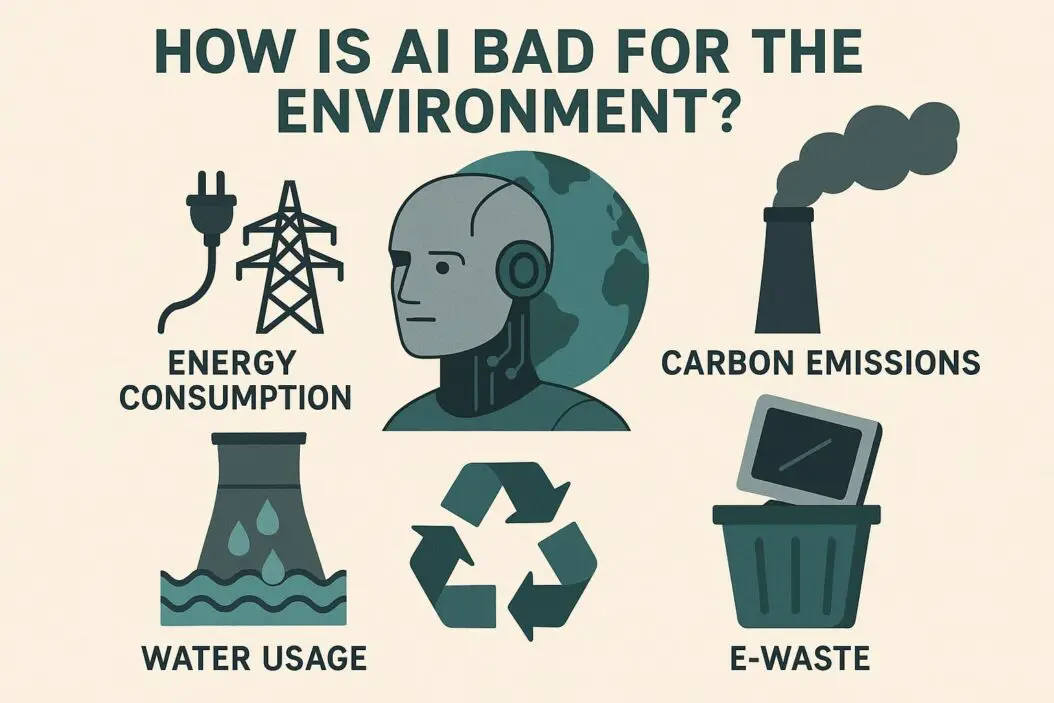
Artificial intelligence is harming the environment through massive energy consumption, water usage, and electronic waste. A single AI model can emit as much carbon as five cars produce over their entire lifetimes. Training one large language model uses enough electricity to power 120 US homes for a year.
This article explains exactly how AI damages our planet and what we can do about it.
Why AI’s Environmental Impact Matters Now
AI technology is growing faster than renewable energy adoption. Data centers that power AI already consume 1-2% of global electricity. By 2030, this could jump to 8%.
The problem isn’t just big tech companies. Every time you use ChatGPT, generate an image, or interact with AI chatbots, you’re contributing to environmental damage.
The Energy Problem: How Much Power Does AI Actually Use?
Training AI Models Consumes Massive Electricity
Training large AI models requires running thousands of powerful processors for weeks or months.
Here’s what the numbers look like:
| AI Model | Energy Consumption | Carbon Emissions |
|---|---|---|
| GPT-3 | 1,287 MWh | 552 tons CO2 |
| Large Transformer Model | 284 MWh | 125 tons CO2 |
| Single Image Generation Model | 11,250 kWh | 4.9 tons CO2 |
To put this in perspective, 284 MWh could power an average American home for 26 years.
Running AI Models Isn’t Much Better
Training gets attention, but inference (actually using AI) causes ongoing damage.
Every search query using AI consumes 10 times more energy than a regular Google search. ChatGPT uses about 0.3 watt-hours per query. That sounds small until you multiply it by millions of daily users.
According to research from the University of Massachusetts, AI models can consume more electricity during their operational lifetime than during training.
Data Centers Are Energy Hogs
AI requires specialized data centers filled with GPUs (graphics processing units). These facilities run 24/7 at full capacity.
A single GPU-powered data center can consume 200-500 megawatts continuously. That’s equivalent to powering 200,000 homes.
These centers need constant cooling. Cooling systems alone account for 40% of total data center energy use.
Water Usage: The Invisible Environmental Cost
AI Data Centers Drink Millions of Gallons
Water cools the servers that run AI. Without cooling, processors would overheat and fail within minutes.
Microsoft’s data centers consumed 1.7 billion gallons of water in 2021. Google used 4.3 billion gallons the same year. Both companies are heavily invested in AI development.
Training GPT-3 in Microsoft’s data centers consumed roughly 700,000 liters of clean freshwater. That’s enough drinking water for 1,000 people for a year.
Water Scarcity Makes This Worse
Many data centers sit in water-stressed regions. Arizona, Nevada, and parts of Texas face severe droughts yet host massive data centers.
When tech companies draw water for cooling, they compete with agriculture and residential use. This creates real harm in communities already facing water shortages.
Carbon Emissions: AI’s Growing Carbon Footprint
The Coal and Gas Problem
Most electricity still comes from fossil fuels. In the US, only 40% of electricity comes from renewable sources.
This means AI runs primarily on coal and natural gas. Every computation adds carbon dioxide to the atmosphere.
The carbon footprint of training a large AI model equals:
- Five cars’ lifetime emissions (including manufacturing)
- 125 round-trip flights between New York and Beijing
- What 11 average Americans produce in a year
Manufacturing and Supply Chain Emissions
Environmental damage starts before AI runs. Manufacturing GPUs and specialized AI chips requires:
- Rare earth mining that destroys ecosystems
- Energy-intensive chip fabrication
- Global shipping and logistics
- Specialized facilities using toxic chemicals
NVIDIA’s H100 GPU (designed for AI) requires 2-3 years of manufacturing lead time. The production process generates significant emissions before the chip even powers a single AI query.
Electronic Waste: When AI Hardware Becomes Garbage
Rapid Hardware Turnover
AI hardware becomes obsolete quickly. Companies replace GPUs every 2-3 years to stay competitive.
These components can’t be easily recycled. They contain:
- Toxic heavy metals
- Rare earth elements
- Complex composite materials
- Hazardous chemicals
Global e-waste reached 62 million tons in 2022. AI’s hardware demands are accelerating this growth.
The Recycling Gap
Only 17% of e-waste gets properly recycled globally. The rest ends up in landfills or gets shipped to developing countries.
Electronic waste leaches lead, mercury, and cadmium into soil and groundwater. These toxins persist for decades.
Specific AI Applications and Their Environmental Impact
Generative AI Is Particularly Harmful
Image generation, video creation, and large language models cause the most damage.
Generating one AI image uses as much energy as fully charging your smartphone. Creating a video with AI uses 10-20 times more energy than generating an image.
When millions of people generate images daily, the environmental cost compounds rapidly.
Cryptocurrency Mining Set a Precedent
Bitcoin mining showed us what happens when computational tasks scale globally. It now consumes more electricity than entire countries like Argentina or Norway.
AI follows a similar trajectory. The computational requirements keep growing, and so does energy consumption.
AI in Cloud Services Multiplies Impact
Every business adding AI features to their apps creates new environmental costs. Customer service chatbots, recommendation engines, and automated systems all run on energy-hungry servers.
The convenience of cloud AI hides its environmental price.
Why Current Solutions Aren’t Enough
Renewable Energy Is Growing Too Slowly
Tech companies promise to run on 100% renewable energy. But demand outpaces renewable energy supply.
Building solar farms and wind turbines takes years. AI development happens in months.
Many “renewable energy” claims involve purchasing carbon offsets rather than actually using clean energy. This accounting trick doesn’t reduce real emissions.
Efficiency Improvements Get Offset by Scale
Engineers do make AI more efficient. New models use less energy per computation.
But companies immediately deploy these efficient models at massive scale. Total energy consumption still increases.
This is called Jevons paradox: efficiency gains lead to increased consumption, not decreased environmental impact.
No Regulations Currently Exist
Unlike cars or power plants, AI has no emissions standards. Companies don’t need to report environmental impacts.
Without regulations, market forces push companies to prioritize speed and capability over efficiency.
What Actually Needs to Happen
Transparency and Reporting Requirements
Companies should disclose:
- Energy consumption per model
- Water usage for training
- Total carbon footprint
- Hardware lifecycle and e-waste
California recently proposed legislation requiring AI companies to report environmental impacts. Similar policies need global adoption.
Sustainable Hardware Design
Chip manufacturers need to prioritize:
- Energy efficiency over raw performance
- Longer hardware lifespans
- Recyclable materials
- Reduced water cooling requirements
Some research explores using renewable energy directly at data centers, including dedicated solar and wind installations.
Smarter AI Development Practices
Developers can reduce impact by:
- Training smaller, more efficient models
- Using pre-trained models instead of training from scratch
- Optimizing code to reduce unnecessary computations
- Choosing data centers powered by renewables
- Avoiding redundant model training
Research from Hugging Face shows that careful optimization can reduce training emissions by 80% without sacrificing performance.
Consumer Awareness and Choices
Users should understand that AI isn’t free environmentally. Consider:
- Is this AI query necessary?
- Could a traditional search work instead?
- Do I need to generate multiple AI images?
- What’s the environmental cost of this convenience?
Being mindful doesn’t mean avoiding AI entirely. It means using it thoughtfully.
The Broader Context: AI vs. Other Industries
How Does AI Compare?
Aviation produces 2-3% of global CO2 emissions. AI isn’t there yet, but it’s growing toward that level.
Data centers (including non-AI computing) already match aviation’s carbon footprint. AI represents the fastest-growing segment within data centers.
The Opportunity Cost
Resources spent on AI could fund:
- Clean energy infrastructure
- Climate research
- Sustainable agriculture
- Carbon capture technology
- Ecosystem restoration
Every dollar and megawatt dedicated to AI is a dollar and megawatt not used for solutions to climate change.
Looking Forward: Can AI Be Sustainable?
Technical Possibilities
Researchers are exploring:
- Neuromorphic computing (chips that mimic brain efficiency)
- Analog computing for AI
- Quantum computing (potentially)
- Liquid cooling using recycled water
- Direct liquid cooling that eliminates water evaporation
These technologies could reduce AI’s footprint by 90% or more. But they’re years away from widespread adoption.
Policy and Economic Pressures
Carbon pricing and environmental regulations could force change. If companies pay the true cost of emissions, they’ll prioritize efficiency.
Some countries are considering data center energy caps. Ireland already limits new data center construction due to grid constraints.
The AI Slowdown Debate
Some researchers argue we should pause large-scale AI development until sustainable infrastructure exists. Others say AI itself can solve climate problems.
The reality: current AI development priorities don’t align with environmental sustainability. Without intentional change, AI’s environmental damage will accelerate.
Summary: The Real Cost of Artificial Intelligence
AI harms the environment through three main channels:
Energy consumption: Training and running AI models requires massive electricity, most of which comes from fossil fuels. Data centers consume 1-2% of global electricity and growing.
Water usage: Cooling systems for AI data centers consume billions of gallons of freshwater annually, often in water-stressed regions.
Electronic waste: Rapid hardware turnover creates mountains of toxic e-waste that rarely gets recycled properly.
The problem is accelerating. AI adoption is growing faster than our ability to power it sustainably. Without significant changes to how we develop and deploy AI, the technology will become a major driver of climate change.
Solutions exist but require action from multiple stakeholders: companies must prioritize efficiency and transparency, policymakers need to establish regulations, developers should adopt sustainable practices, and users need to make informed choices.
The convenience of AI comes with real environmental costs. Understanding these costs is the first step toward addressing them.
Frequently Asked Questions
Is AI worse for the environment than cryptocurrency?
Currently, no. Bitcoin alone consumes more energy than all AI combined. However, AI is growing much faster. If current trends continue, AI could surpass cryptocurrency’s environmental impact within 5-10 years. The key difference is that AI’s energy needs are accelerating while cryptocurrency mining has somewhat stabilized.
Do all AI applications harm the environment equally?
No. Small, specialized AI models cause minimal harm. Large language models, generative AI (images and video), and systems requiring constant retraining cause the most damage. Running a simple spam filter uses negligible energy compared to generating AI images or having extended conversations with chatbots.
Can renewable energy solve AI’s environmental problems?
Partially. If all data centers ran on 100% renewable energy, AI’s carbon emissions would drop significantly. However, this doesn’t address water consumption, electronic waste, or the resource extraction needed to build renewable infrastructure and AI hardware. It’s part of the solution but not a complete fix.
Are tech companies doing anything to reduce AI’s environmental impact?
Some are making efforts. Google and Microsoft have carbon neutrality commitments and invest in renewable energy. However, their AI divisions continue growing faster than their sustainability initiatives. Many companies don’t disclose AI-specific environmental data, making it hard to verify their claims. According to reports, most improvements come from efficiency gains that get offset by increased scale.
Should we stop using AI to help the environment?
Not necessarily. The solution isn’t avoiding AI but using it responsibly. Choose traditional search over AI when possible. Avoid generating unnecessary AI content. Support companies that prioritize sustainable AI development. Advocate for transparency and regulation. Individual choices matter, but systemic change requires policy intervention and industry accountability.
