
Most people hear about Bitcoin and think it’s just for getting rich quick or for criminals. That misses the point entirely. Bitcoin exists to solve specific problems that traditional money can’t handle well. This article explains what Bitcoin actually does, who uses it, and why they do.
The core answer is simple: Bitcoin is a way to send money directly to someone without needing a bank in the middle. It’s digital cash that you control yourself. Beyond that basic function, Bitcoin has real-world applications that matter to certain people in certain situations.
Let’s break down the actual uses of Bitcoin so you understand when and why someone would actually use it.
What Bitcoin Actually Is (In Plain Terms)
Before diving into uses, you need to understand what you’re dealing with.
Bitcoin is a digital currency. You can send it to anyone in the world instantly. No bank approval needed. No middleman taking a cut. It exists on a network of computers that work together to keep track of who owns what.
Think of it like email for money. Just as you can email someone without going through a postmaster, you can send Bitcoin without going through a bank. The person receives it in minutes. They don’t need permission from anyone to accept it.
This matters because it’s fundamentally different from how regular money works. When you send money through a bank, the bank controls whether the transaction happens. With Bitcoin, the network controls it. The rules are built into the software, not decided by a company.
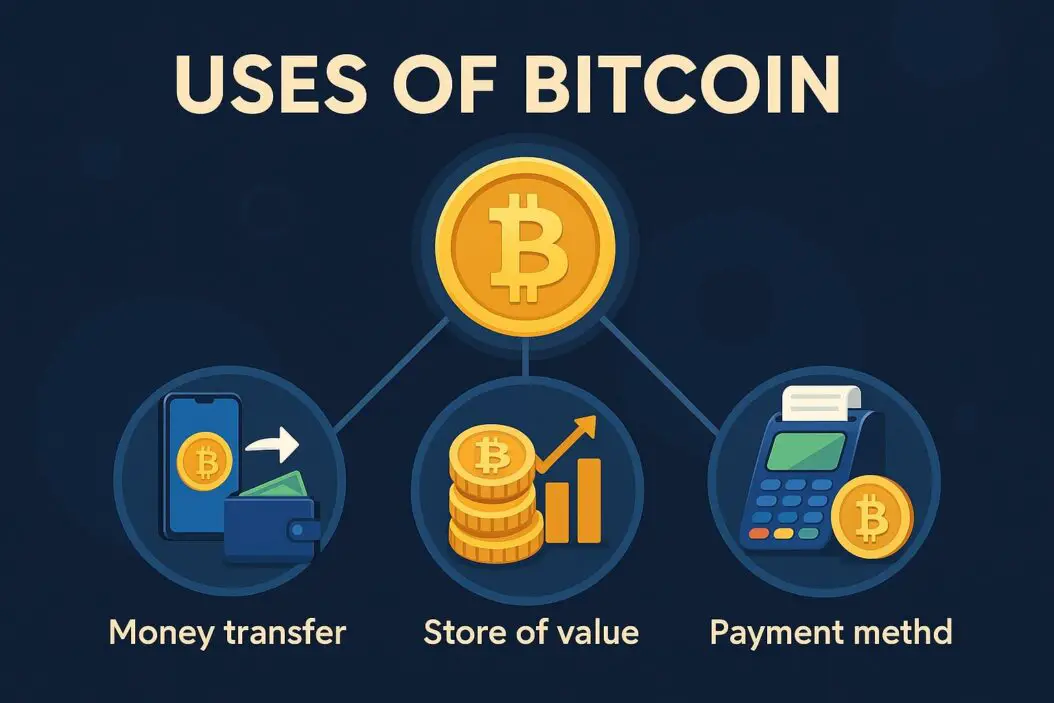
The Main Uses of Bitcoin Today
1. International Money Transfers
This is where Bitcoin solves a real, expensive problem.
If you need to send money to family in another country, traditional options are slow and costly. Wire transfers take 3 to 7 days. Banks charge anywhere from $15 to $50. Currency exchange rates are terrible. The middle banks take cuts.
Bitcoin is faster and cheaper.
You send Bitcoin. In 10 minutes, it arrives. The fee is usually $1 to $5, regardless of how much money you’re sending. Currency exchange happens at the actual market rate, not marked up by a bank.
This matters most to people who send money across borders regularly. Someone working in the United States sending money to parents in the Philippines. A freelancer in India receiving payments from clients worldwide. A business buying materials from overseas suppliers.
These people used to lose 7 to 10 percent of their money to fees and bad exchange rates. With Bitcoin, they lose maybe 1 to 2 percent.
The scale is significant. According to the World Bank, global remittances exceeded $700 billion in 2023, and traditional remittance services charge heavily for each transaction. Bitcoin and similar technology are eating into this market.
2. Censorship Resistance and Financial Independence
This use applies to fewer people, but the people it applies to really need it.
In some countries, governments control money. They can freeze your accounts. They can prevent you from sending money to certain people or places. They can seize your funds.
Bitcoin can’t be frozen by a government. No authority can revoke your access to your own money. You don’t need permission to send it. No government can prevent a transaction.
This matters to people living under authoritarian regimes. Journalists facing repressive governments have received donations in Bitcoin. Activists operating in countries with capital controls use Bitcoin to protect their funds. Hong Kong residents used Bitcoin during periods of political pressure. Ukrainians used Bitcoin to receive aid and protect savings during Russian invasion threats.
It also matters to people who distrust their national currency. Venezuela experienced severe currency inflation. People there moved savings to Bitcoin to preserve wealth. Zimbabwe’s currency collapsed multiple times. Bitcoin provided an alternative.
This isn’t the primary use, but it’s real and sometimes life-changing for the people who need it.
3. Storing Value and Hedging Against Inflation
Bitcoin behaves like digital gold for many holders.
There’s a fixed supply. Only 21 million Bitcoin will ever exist. This scarcity means Bitcoin can’t be inflated away like government currencies can. No central bank can print more when they want.
Some investors hold Bitcoin as insurance against currency devaluation. If you believe your country’s government will print too much money, you might move some wealth into Bitcoin. You’re betting that Bitcoin will maintain value while your currency loses purchasing power.
This matters to people in countries with high inflation. It also appeals to people who distrust central banks generally.
Some larger institutions now hold Bitcoin as part of their portfolio. Companies have added Bitcoin to their balance sheets. Some view it as digital gold in their reserves.
The actual performance varies. Bitcoin has periods of high growth and periods of decline. But the idea is stable: a scarce asset that no government controls.
4. Speculation and Investment
Yes, many people buy Bitcoin hoping the price goes up.
This isn’t solving a unique problem. You can speculate on stocks, real estate, or currencies. But Bitcoin is available 24/7, highly volatile (meaning big price swings), and appeals to people wanting exposure to a new asset class.
Some people have made substantial returns. Some have lost everything. The volatility is extreme compared to traditional investments.
This is the most visible use because speculators are the most vocal. But it’s not the most important use. Most genuine Bitcoin activity isn’t about making quick profits.
5. Smart Contracts and Applications (Advanced)
The newer Bitcoin updates enable more complex transactions.
You can create contracts that automatically execute when conditions are met. You can set up transactions with multiple signatures required. You can create digital agreements that no one can cheat on.
This is still early-stage, but it opens possibilities. Insurance claims that pay automatically when triggered. Escrow arrangements where funds release when both parties confirm. Supply chain verification.
This matters more to developers and technical people right now. The applications are still developing.
Who Actually Uses Bitcoin
Understanding the real user base helps clarify the real uses.
Freelancers and Remote Workers
Freelancers worldwide use Bitcoin to receive payments from clients. It’s often cheaper than traditional payment processors. A developer in Eastern Europe receives payment from a U.S. client. The money arrives in an hour. Fees are minimal. No payment processor taking 2.9 percent plus a fee.
Small Business Owners in Developing Countries
Shop owners in countries with unstable banks or high inflation sometimes accept Bitcoin. They convert it to local currency immediately if they want. Or they hold some Bitcoin as insurance against currency problems.
People in High-Inflation Economies
Venezuela, Argentina, Zimbabwe. Places where currency loses value rapidly. Bitcoin offers an escape. Even if Bitcoin is volatile, it’s more stable than a currency losing half its value annually.
Expats and Diaspora Communities
People living outside their home country often send money back. Bitcoin makes this cheaper than traditional remittance services.
Privacy-Conscious Individuals
Some people prefer Bitcoin because transactions are pseudonymous. Not anonymous (transactions are traceable if someone knows your Bitcoin address), but they’re not tied to your name by default.
Technologists and Early Adopters
Some people simply believe in the technology. They use Bitcoin because they think it’s the future of money. They’re testing it, building on it, learning from it.
Real Challenges and Limitations
Bitcoin has real constraints you should understand.
Price Volatility
Bitcoin price swings wildly. Up 20 percent in a week. Down 30 percent the next week. This makes Bitcoin unreliable as a stable store of value for most purposes. If you’re sending money to family, price swings don’t matter much. If you’re trying to hold stable savings, they matter a lot.
Transaction Speed
Bitcoin transactions take 10 to 30 minutes on average. This is slower than credit cards. It’s faster than bank transfers, but not instantaneous.
User Error
If you lose your Bitcoin password, you lose access to your funds forever. No “forgot password” button. No customer service to help. This is a feature (you control your money) but also a challenge (you must protect your access).
Regulatory Uncertainty
Governments are still deciding how to regulate Bitcoin. Some ban it. Some embrace it. Some are still figuring it out. This uncertainty affects adoption.
Technical Knowledge Required
Using Bitcoin requires more knowledge than using a bank. You need to understand wallets, addresses, private keys, and security. Mistakes are costly. This keeps many people away.
Bitcoin vs. Traditional Money Transfer Methods
| Method | Speed | Cost | Access | Reversibility |
|---|---|---|---|---|
| Bank Wire | 3 to 7 days | $15 to $50 | Banks only | Yes |
| Money Service (like Western Union) | 1 to 3 hours | 3 to 7 percent | Widespread | Limited |
| Bitcoin | 10 to 30 minutes | $1 to $5 | Anywhere with internet | No |
| PayPal/Wise | 1 to 3 hours | 1 to 2 percent | Online only | Yes |
| Stablecoin (on Ethereum) | 1 to 5 minutes | $0.50 to $2 | Anywhere with internet | No |
When Bitcoin Makes Sense
Bitcoin is the right choice when:
You’re sending money internationally and want to minimize fees.
You live in a country with severe currency inflation or capital controls.
You distrust your banking system and want financial control.
You want to receive payments as a global freelancer without paying processor fees.
You’re storing wealth in a form no government can freeze or devalue.
You’re willing to accept volatility for these benefits.
Bitcoin is probably not the right choice when:
You need price stability for everyday expenses.
You’re sending small amounts and don’t want to learn technology.
You need transaction reversibility (like with credit cards).
You’re in a country with stable currency and functioning banks.
You can’t accept losing access to your funds through your own mistake.
The Future of Bitcoin Uses
Several developments could expand Bitcoin’s practical uses.
Lightning Network technology allows faster Bitcoin transactions. Eventually this could make Bitcoin viable for everyday purchases.
Institutional adoption is increasing. More companies and funds are adding Bitcoin to reserves.
Regulatory clarity in some countries is allowing new business models.
Development of more complex applications on top of Bitcoin continues.
But Bitcoin may never become everyday spending money. The technology has trade-offs. Fast and convenient isn’t the same as decentralized and censorship-resistant.
Bitcoin might be most useful as a tool for specific problems rather than a replacement for all money.
Frequently Asked Questions
Can I use Bitcoin to buy things at regular stores?
Some stores accept Bitcoin, but it’s uncommon. Bitcoin works better for large payments or international transfers than for coffee. Some online retailers accept it. You can usually convert Bitcoin to regular currency at exchanges if you need to spend it in traditional ways.
Is Bitcoin anonymous?
No. Bitcoin transactions are pseudonymous. Your real name isn’t on the transaction, but if someone knows your Bitcoin address, they can see all transactions associated with it. Law enforcement has tracked Bitcoin transactions. It’s not a tool for hiding illegal activity.
Do I need to understand technology to use Bitcoin?
You need basic understanding. Think of it like email. You don’t need to know how internet protocol works to use email. Similarly, you don’t need to know blockchain technology to use Bitcoin. But you need to understand basic concepts like wallets, addresses, and private keys. It takes maybe an hour to learn.
What happens if Bitcoin prices crash?
If you’re holding Bitcoin as an investment, you lose money. If you’re using Bitcoin to send money and price crashes happen during your transaction, it doesn’t matter much. You send Bitcoin, it arrives as Bitcoin, the person receives it. Price movements only affect you if you’re holding it as a store of value.
Is Bitcoin legal?
Bitcoin is legal in most countries. Some countries ban it or heavily restrict it. Before using Bitcoin, check your country’s regulations. This is especially important for business use or large amounts.
Conclusion
Bitcoin’s real uses are narrower than the hype suggests but more important than skeptics claim.
It excels at international money transfer without expensive intermediaries. It provides financial freedom for people in countries with broken currencies or repressive governments. It offers censorship-resistant value storage.
It’s not good for everyday purchases. It’s not a solution to all money problems. It’s not an automatic path to wealth.
Bitcoin solves specific problems for specific people. If one of those problems applies to you, Bitcoin is a useful tool. If not, traditional money probably works fine.
Understanding Bitcoin’s actual uses helps separate reality from hype. It’s neither magical internet money nor worthless speculation. It’s a tool with genuine applications and real limitations.
The future will show whether these uses expand or whether Bitcoin remains a niche technology. Either way, it serves a purpose today for people who actually need it.
Additional Resources
For deeper learning on Bitcoin technology and use cases, explore Coindesk’s education section for news and analysis, and Andreas M. Antonopoulos’s work for technical and philosophical perspectives on Bitcoin’s role in financial systems.

- How to Improve Wi-Fi Signal on My Phone (2026 Guide) - March 17, 2026
- How to Enable MMS Messaging on iPhone (2026 Guide) - March 15, 2026
- 9 Best Software for Web Development in 2026 - March 15, 2026