
Choosing the right software project management methodology can make or break your project. The wrong approach leads to missed deadlines, budget overruns, and frustrated teams. The right one keeps everyone aligned and productive.
This guide explains the most effective methodologies, how they work, and which one fits your specific situation.
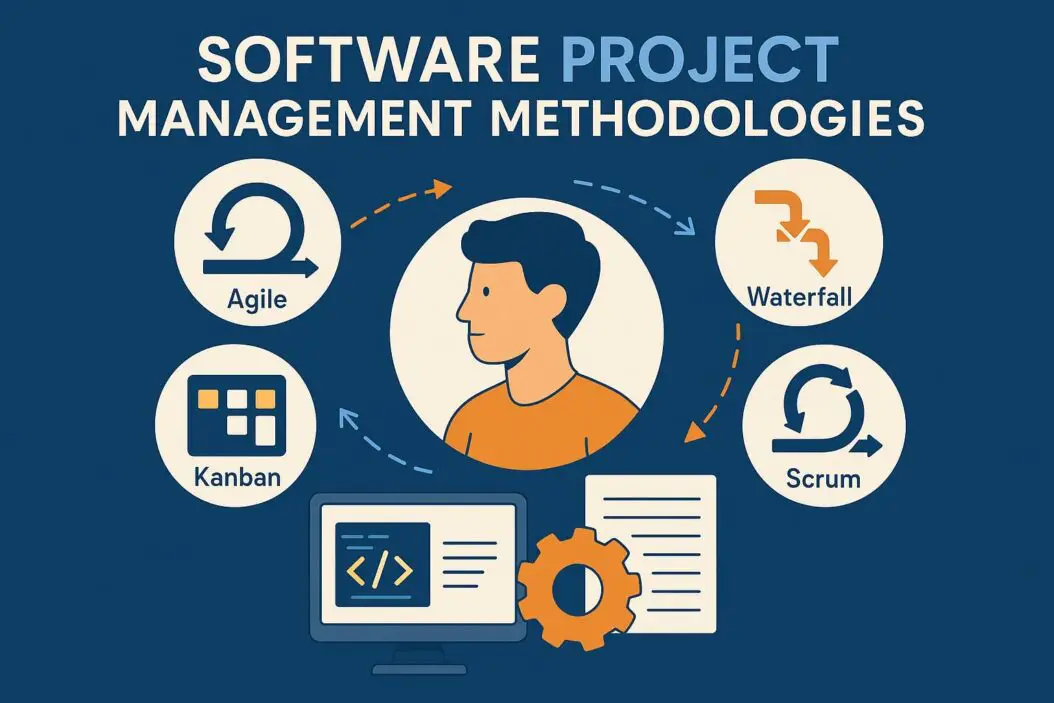
What Is a Software Project Management Methodology?
A software project management methodology is a structured framework that guides how teams plan, execute, and deliver software projects. It defines workflows, roles, communication patterns, and decision-making processes.
Think of it as a playbook. Without one, teams waste time figuring out who does what, when things happen, and how to handle changes.
Why Your Methodology Choice Matters
The methodology you choose affects:
- Delivery speed: Some methods ship features faster than others
- Team morale: Developers thrive in frameworks that match their work style
- Budget control: Different approaches handle scope changes differently
- Product quality: Testing and review processes vary significantly
- Client satisfaction: Visibility and feedback loops impact relationships
A 2024 study by the Project Management Institute found that organizations using appropriate methodologies complete 89% more projects successfully compared to those without structured approaches.
The Main Software Project Management Methodologies
Agile Methodology
Agile breaks work into short cycles called sprints, typically 1-4 weeks long. Teams deliver working software incrementally and adapt based on feedback.
How Agile Works:
- Break the project into user stories (small features)
- Prioritize stories in a backlog
- Plan a sprint with selected stories
- Build, test, and review during the sprint
- Demonstrate working software to stakeholders
- Gather feedback and adjust priorities
- Repeat
Best For:
- Projects with evolving requirements
- Teams that need frequent client feedback
- Products where speed to market matters
- Startups and innovative projects
Challenges:
- Requires active client participation
- Can lose sight of long-term architecture
- Hard to predict final timelines and costs upfront
- Documentation often suffers
Real Example: Spotify uses Agile with autonomous squads. Each squad owns a feature area and ships updates independently, allowing them to release improvements daily.
Scrum Framework
Scrum is the most popular Agile implementation. It adds specific roles, ceremonies, and artifacts to create structure.
Core Components:
| Element | Purpose |
|---|---|
| Product Owner | Prioritizes work and represents stakeholders |
| Scrum Master | Removes obstacles and facilitates process |
| Development Team | Builds and delivers the product |
| Sprint Planning | Team commits to sprint goals |
| Daily Standup | 15-minute sync on progress and blockers |
| Sprint Review | Demonstrate completed work |
| Sprint Retrospective | Improve team processes |
Best For:
- Teams of 5-9 people
- Projects needing regular delivery cadence
- Organizations wanting Agile with clear structure
- Teams new to Agile methods
Challenges:
- Ceremonies can feel like overhead for small teams
- Requires experienced Scrum Master
- Fixed sprint length can create artificial pressure
- Cross-functional teams are essential
Real Example: Microsoft transitioned thousands of engineers to Scrum in 2011. They found that teams using Scrum delivered features 30% faster than those using traditional methods.
Kanban Method
Kanban visualizes work on a board with columns representing stages. Teams pull work as capacity allows, focusing on continuous flow rather than fixed iterations.
How Kanban Works:
- Create a board with columns (To Do, In Progress, Testing, Done)
- Add work items as cards
- Set work-in-progress (WIP) limits per column
- Team members pull cards when they have capacity
- Move cards through stages until complete
- Continuously refine and improve flow
Best For:
- Support and maintenance teams
- Projects with unpredictable work arriving constantly
- Teams transitioning from traditional methods
- Operations work mixed with development
Challenges:
- Less structure can confuse new teams
- Requires discipline to maintain WIP limits
- No built-in planning ceremonies
- Can lack long-term visibility
Real Example: Zara uses Kanban to manage their supply chain software. The visual board helps coordinate between design, manufacturing, and retail systems teams across time zones.
Waterfall Methodology
Waterfall follows a linear sequence: requirements, design, implementation, testing, deployment, and maintenance. Each phase must complete before the next begins.
The Waterfall Phases:
- Requirements: Document everything the software must do
- Design: Create architecture and technical specifications
- Implementation: Write the code
- Testing: Verify everything works as specified
- Deployment: Release to production
- Maintenance: Fix bugs and make minor updates
Best For:
- Projects with fixed, well-understood requirements
- Regulated industries (healthcare, finance, aerospace)
- Hardware-dependent software with high change costs
- Government contracts with strict documentation needs
Challenges:
- Cannot adapt to changing requirements easily
- Users don’t see working software until late
- Testing happens too late to influence design
- High risk if initial requirements are wrong
Real Example: NASA uses Waterfall for spacecraft software. When code changes cost millions and lives depend on it, thorough upfront planning makes sense.
Lean Software Development
Lean eliminates waste and optimizes flow. It comes from Toyota’s manufacturing principles adapted for software.
Seven Lean Principles:
- Eliminate waste: Remove anything not adding customer value
- Build quality in: Catch defects immediately, not later
- Create knowledge: Document learnings as you go
- Defer commitment: Make decisions at the last responsible moment
- Deliver fast: Reduce cycle time aggressively
- Respect people: Trust teams to solve problems
- Optimize the whole: Look at entire value stream, not pieces
Best For:
- Mature teams seeking optimization
- Organizations focused on efficiency
- Startups with limited resources
- Products with clear value metrics
Challenges:
- Requires systems thinking skills
- Can over-optimize prematurely
- Needs metrics and measurement discipline
- Abstract principles need practical translation
Real Example: Facebook applies Lean principles by deploying code multiple times per day. Their “move fast” culture eliminates review waste while automated testing builds quality in.
Extreme Programming (XP)
XP emphasizes technical excellence through specific engineering practices. It’s Agile focused on code quality.
Core XP Practices:
- Pair programming: Two developers, one computer
- Test-driven development: Write tests before code
- Continuous integration: Merge code multiple times daily
- Refactoring: Improve code structure continuously
- Simple design: Build only what’s needed now
- Collective code ownership: Anyone can improve any code
- Sustainable pace: No overtime culture
Best For:
- Teams prioritizing code quality
- Products requiring long-term maintenance
- Complex technical domains
- Teams comfortable with close collaboration
Challenges:
- Pair programming feels slow initially
- Requires discipline and practice
- Not all developers enjoy constant pairing
- Can seem inefficient to management
Real Example: Pivotal Labs built their entire consulting business around XP. Clients pay premium rates because the code quality and knowledge transfer exceed traditional approaches.
DevOps Methodology
DevOps breaks down walls between development and operations teams. It emphasizes automation, monitoring, and continuous delivery.
Key DevOps Practices:
| Practice | Impact |
|---|---|
| Continuous Integration | Code merges multiple times daily |
| Continuous Delivery | Automated deployments to production |
| Infrastructure as Code | Servers managed through version control |
| Automated Testing | Fast feedback on code quality |
| Monitoring & Logging | Real-time production visibility |
| Collaborative Culture | Shared responsibility for uptime |
Best For:
- Web applications and cloud services
- Teams deploying frequently
- Organizations wanting faster time-to-market
- Products requiring high availability
Challenges:
- Requires significant automation investment
- Cultural change is difficult
- Security can be overlooked initially
- On-call responsibilities increase stress
Real Example: Amazon deploys code every 11.7 seconds on average. Their DevOps practices allow thousands of developers to work independently without breaking production.
The DevOps Institute offers comprehensive resources on implementation.
Hybrid Approaches
Many organizations blend methodologies to fit their unique needs.
Common Hybrid Combinations:
- Agile-Waterfall: Waterfall for planning phase, Agile for execution
- Scrumban: Scrum ceremonies with Kanban flow
- Wagile: Waterfall structure with Agile team practices
- SAFe (Scaled Agile): Agile practices across large organizations
Best For:
- Large enterprises with diverse team needs
- Transitioning from traditional to Agile
- Organizations with mixed project types
- Teams needing flexibility
Challenges:
- Can become “worst of both worlds”
- Requires clear guidelines on what goes where
- More complex to explain and teach
- Easy to make excuses for skipping practices
How to Choose the Right Methodology
Step 1: Assess Your Project Characteristics
Ask these questions:
- Are requirements stable or changing?
- How large is the team (3 people vs 300)?
- What’s the project duration (weeks vs years)?
- How involved will stakeholders be?
- What are the compliance requirements?
- What’s your team’s experience level?
Step 2: Evaluate Your Organization
Consider your company culture, structure, and constraints.
Organizational Factors:
- Culture: Hierarchical or flat?
- Risk tolerance: Conservative or experimental?
- Customer access: Can you get frequent feedback?
- Budget flexibility: Fixed or adjustable?
- Team location: Co-located or distributed?
Step 3: Match Methodology to Situation
| If Your Project Is… | Consider… |
|---|---|
| Unclear requirements, innovation focus | Agile or Scrum |
| Continuous support work | Kanban |
| Fixed scope, regulated industry | Waterfall |
| Emphasis on code quality | Extreme Programming |
| Rapid deployment needs | DevOps |
| Waste reduction priority | Lean |
| Large organization scaling | Hybrid/SAFe |
Step 4: Start Small and Adapt
Don’t transform overnight. Pick one team and one project. Run it for 3-6 months. Measure results. Adjust based on what works.
Key Metrics to Track:
- Delivery frequency (how often you ship)
- Lead time (idea to production)
- Defect rates (quality measures)
- Team satisfaction (survey scores)
- Customer satisfaction (NPS or similar)
Common Implementation Mistakes
Mistake 1: Following the Methodology Religiously
Methodologies are guidelines, not laws. Adapt practices to your context. If daily standups don’t help your remote team, try async check-ins instead.
Mistake 2: Skipping Training
Teams fail when they don’t understand the “why” behind practices. Invest in proper training and coaching. Reading a book isn’t enough.
Mistake 3: Ignoring Team Feedback
The people doing the work know what’s broken. Listen when they say a practice isn’t working. Adjust together.
Mistake 4: Changing Too Much at Once
Adopt practices incrementally. Master one before adding another. Overwhelming teams leads to abandoning everything.
Mistake 5: Measuring Activity Instead of Outcomes
Don’t count story points or velocity as success. Measure customer value delivered, quality improvements, and team happiness.
Tools That Support Different Methodologies
Agile/Scrum Tools:
- Jira (most comprehensive)
- Azure DevOps (Microsoft ecosystem)
- Linear (modern, fast interface)
- Monday.com (visual, flexible)
Kanban Tools:
- Trello (simple, visual)
- Kanbanize (advanced analytics)
- Jira with Kanban boards
- GitHub Projects (developer-focused)
Waterfall Tools:
- Microsoft Project (traditional PM)
- Smartsheet (spreadsheet-based)
- Wrike (enterprise features)
DevOps Tools:
- GitLab (complete DevOps platform)
- Jenkins (CI/CD automation)
- CircleCI (cloud-based pipelines)
Collaboration Tools (All Methodologies):
- Slack or Microsoft Teams (communication)
- Confluence (documentation)
- Miro (virtual whiteboarding)
- Zoom (video meetings)
Choose tools that match your methodology, but remember: tools don’t fix broken processes.
Scaling Methodologies for Large Organizations
Small teams can use methodologies as-is. Large organizations need frameworks for coordination.
Scaled Agile Framework (SAFe)
SAFe provides structure for 50-500+ people working on related products. It organizes teams into “Agile Release Trains” that deliver together on fixed schedules.
SAFe Levels:
- Team level: Individual Scrum teams
- Program level: 5-12 teams coordinated
- Portfolio level: Strategic alignment across programs
Best for: Large enterprises, regulated industries, hardware-software products
LeSS (Large-Scale Scrum)
LeSS keeps things simple. Multiple teams work from one product backlog with one Product Owner. It’s Scrum principles applied across teams.
Best for: Organizations wanting to scale without heavy process
Spotify Model
Autonomous squads (small teams) aligned in tribes (related squads). Guilds share knowledge across tribes. Chapters group people with similar skills.
Best for: Tech companies with product culture, distributed autonomy needs
Transitioning Between Methodologies
Moving from one methodology to another requires planning.
From Waterfall to Agile
Transition Steps:
- Start with pilot team, not entire organization
- Bring in experienced Agile coach
- Focus on delivering working software in sprints
- Build product backlog from existing requirements
- Train stakeholders on new involvement expectations
- Celebrate early wins to build momentum
- Gradually expand to more teams
Timeline: 6-18 months for full organizational change
From Agile to DevOps
Transition Steps:
- Invest in automated testing infrastructure
- Set up continuous integration pipeline
- Automate deployment to staging environments
- Implement monitoring and logging
- Gradually reduce deployment cycle time
- Add production deployment automation
- Establish on-call rotation and incident response
Timeline: 3-12 months depending on current automation
The Future of Project Management Methodologies
Emerging Trends:
- AI-assisted planning: Tools predict timelines and identify risks
- Remote-first practices: Async communication over meetings
- Continuous discovery: User research integrated into development
- Platform engineering: Internal tools teams supporting product teams
- Value stream management: Optimizing entire product lifecycle
The trend is toward less rigid structure and more team autonomy, with technology enabling better coordination without heavy process.
Summary
Software project management methodologies provide structure for delivering projects successfully. Agile works for changing requirements. Scrum adds ceremony to Agile. Kanban handles continuous flow. Waterfall fits fixed-scope projects. Lean eliminates waste. XP emphasizes technical practices. DevOps connects development and operations.
Choose based on your project characteristics, organizational culture, and team capabilities. Start small, measure results, and adapt continuously. No methodology is perfect for every situation.
The best methodology is the one your team actually follows and improves over time.
Frequently Asked Questions
Can I mix different methodologies on the same project?
Yes. Many teams use hybrid approaches. For example, you might use Waterfall for initial planning but Agile for development phases. Just ensure everyone understands which practices apply when, or you’ll create confusion.
How long does it take to implement a new methodology?
For a single team, expect 3-6 months to feel comfortable with new practices. For organizational transformation, plan 12-24 months. Quick adoption usually means superficial implementation that won’t stick.
Is Agile always better than Waterfall?
No. Agile works brilliantly for uncertain, innovative projects. Waterfall makes sense for fixed-scope, regulated, or safety-critical systems where changes are expensive. Choose based on your context, not popularity.
What’s the most important factor for methodology success?
Team buy-in. If your team doesn’t believe in the approach or understand why practices matter, no methodology will work. Invest in education and listen to feedback.
Do I need expensive tools to use these methodologies?
No. Scrum works with sticky notes on a wall. Kanban works with a whiteboard. Tools help with distributed teams and reporting, but they’re not required. Start simple and add tools when you feel actual pain they’ll solve.

- How to Delete Lock Screen Password on Windows 10/11 in 2026 - April 5, 2026
- How to Reset Network Settings on iPhone: Step-by-Step Guide 2026 - April 5, 2026
- DXGI_ERROR_DEVICE_REMOVED: The Complete Fix Guide for Windows Users in 2026 - April 5, 2026