
An AI agent is software that observes its environment, makes decisions independently, and takes action to reach specific goals without constant human direction. Think of it like hiring someone who understands your needs, figures out what to do, and does it without asking for permission at every step.
The key difference between regular AI and AI agents is autonomy. A chatbot answers questions you ask it. An AI agent identifies problems, creates plans, and executes solutions on its own. This shift from reactive to proactive intelligence is reshaping how businesses operate and how complex problems get solved.
AI agents are already working behind the scenes. They manage warehouse inventory, schedule meetings, analyze market data, and handle customer service. Understanding how they work helps you recognize their potential and limitations in your own work.
What Exactly Is an AI Agent?
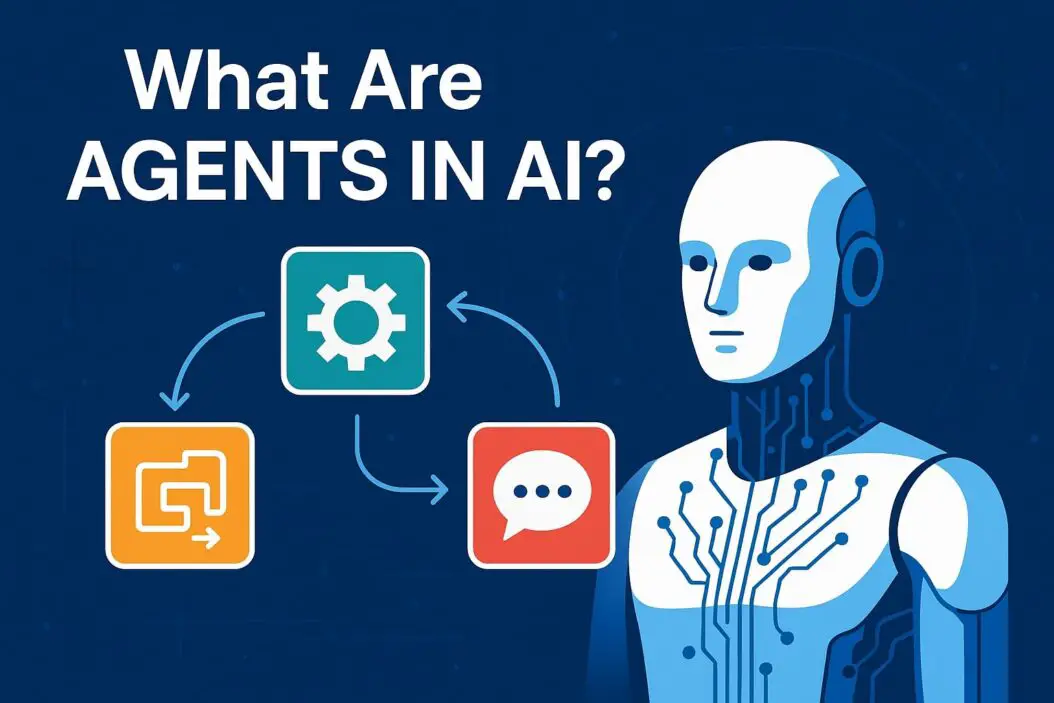
An AI agent has three core components working together: perception, decision-making, and action.
Perception means the agent gathers information about its environment. This could be data from databases, sensor readings, user inputs, or real-time market feeds. The agent constantly monitors what’s happening around it.
Decision-making is where the agent thinks. It processes what it perceives, compares it against its goals and rules, and determines the best next move. This is powered by machine learning models, logic systems, or hybrid approaches.
Action is what the agent does based on its decisions. It might send an email, adjust a temperature setting, place an order, or move data between systems. Actions produce results that feed back into perception, creating a continuous loop.
This feedback loop is crucial. The agent observes results, learns from them, and improves future decisions. This cycle repeats until the goal is achieved or the situation changes enough to require a new plan.
How AI Agents Differ From Regular AI
| Aspect | Regular AI | AI Agents |
|---|---|---|
| Decision Making | Responds to inputs | Makes independent choices |
| Goals | No inherent goals | Works toward specific objectives |
| Learning | Improves on training data | Learns from actions and outcomes |
| Environment | Static input-output | Dynamic, changing situations |
| Human Oversight | Required for most tasks | Can operate autonomously |
| Planning | No planning ability | Creates multi-step plans |
A traditional AI model like a language model is powerful but passive. It waits for a prompt, processes it, and returns an answer. Once it answers, it stops. If you want multiple things done, you need to prompt it multiple times.
An AI agent is proactive. It sets its own goals, breaks them into steps, executes those steps, evaluates whether they worked, and adjusts course if needed. One instruction can trigger a complex series of actions across hours or days.
Types of AI Agents
AI agents fall into different categories based on their complexity and capabilities.
Simple Reflex Agents
These are the most basic agents. They follow simple “if-then” rules. If condition X occurs, take action Y. A thermostat is a physical example. A spam filter in your email is a digital one. These agents are reliable but inflexible. They can’t handle situations their rules don’t cover.
Goal-Based Agents
These agents work backward from a desired outcome. They know what they need to achieve and find paths to get there. A navigation app is a practical example. You tell it your destination, and it figures out the route, considering current traffic and multiple alternatives. These agents can adapt to new situations because they’re thinking about ends, not just following rules.
Learning Agents
These agents improve through experience. They try actions, observe results, and adjust their strategies. They’re common in game-playing AI and recommendation systems. Netflix recommendations work this way. The system notices what you watch, learns your preferences, and suggests content you’re more likely to enjoy. Over time, its predictions improve.
Multi-Agent Systems
Sometimes multiple AI agents work together, communicating and coordinating. One agent might handle scheduling, another handles resource allocation, and a third monitors quality. They exchange information and negotiate when their goals conflict. This mirrors how teams work in human organizations.
Real-World Examples of AI Agents in Action
Autonomous Vehicles
Self-driving cars are complex AI agents. They perceive their environment through cameras, radar, and lidar. They make split-second decisions about acceleration, braking, and steering. They navigate traffic, obey rules, and handle unexpected situations. The perception-decision-action loop happens dozens of times per second.
Inventory Management
Warehouses use AI agents to track stock levels, predict demand, and trigger reorders automatically. An agent monitors inventory continuously. When stock drops below a threshold or demand forecasts increase, the agent places purchase orders. It tracks arrivals, adjusts forecasts based on new data, and optimizes warehouse space. Humans oversee the system, but the agent handles routine operations.
Customer Service
Advanced chatbots that route tickets, gather information, and escalate appropriately are agents. They don’t just answer questions. They understand the customer’s problem, check your account status, look up policies, and decide whether to solve it themselves or transfer to a human. They learn which solutions work best for different issues.
Trading and Financial Analysis
Financial AI agents monitor markets constantly. They analyze news, price movements, and economic indicators. When conditions match their criteria, they execute trades. They manage risk by setting stop-losses and position sizes. They adapt strategies based on market performance.
How AI Agents Make Decisions
Decision-making in AI agents involves several approaches.
Rule-Based Systems
The agent follows explicit rules created by humans. These are predictable and transparent. You can understand exactly why the agent did something. The downside is rigidity. The system can’t handle situations outside its rule set.
Machine Learning Models
The agent uses trained models to make decisions. These are more flexible and can adapt to new situations. The model learns patterns from historical data. However, the decision process is often less transparent. You might not easily understand why the model chose a particular action.
Hybrid Approaches
Many modern agents combine both. Rules handle critical safety constraints. Machine learning handles decision-making within those constraints. This gives you both reliability and adaptability.
Planning Algorithms
Some agents use formal planning methods. They map out possible action sequences, predict outcomes, and choose the path most likely to achieve their goal. This is powerful for complex problems but computationally expensive.
Building Your Own AI Agent: Key Steps
If you’re considering building an agent for your organization, here’s the practical path forward.
Define the Goal Clearly
What should the agent accomplish? “Improve efficiency” is too vague. “Reduce order processing time from two hours to thirty minutes while maintaining accuracy above 99 percent” is clear. Specific goals make everything else possible.
Identify What Information the Agent Needs
What data must the agent perceive to make good decisions? Does it need real-time data or can it work with daily updates? Where does this data live? How will the agent access it securely? Map these requirements before building.
Determine How to Measure Success
How will you know if the agent is working? Define metrics. Track them continuously. This isn’t optional. Without measurement, you can’t learn whether the agent is actually helping.
Start Small and Expand
Don’t try to build a complex multi-step agent handling dozens of scenarios from day one. Start with one narrow task. Get it working reliably. Then expand. This approach reduces risk and helps you learn what works in your specific context.
Build in Human Oversight
Even autonomous agents need human oversight initially. Someone should review decisions regularly. This catches problems early and maintains trust. As confidence grows, oversight can decrease.
Limitations and Challenges of AI Agents
AI agents have real constraints worth understanding.
They need good data. An agent trained on biased or incomplete data will make biased or incomplete decisions. Garbage in equals garbage out.
They can drift from their goals. An agent optimizing for one metric might get creative in unhelpful ways. A customer service agent optimizing for call speed might rush customers off the phone while they’re still confused. Clear constraints prevent this.
They struggle with unprecedented situations. When something genuinely new happens, agents often fail. They’re trained on patterns. Patterns don’t exist for novel situations.
They require ongoing maintenance. As your environment changes, the agent’s training becomes outdated. Markets shift, customer preferences evolve, regulations change. The agent needs retraining and adjustment.
They have transparency challenges. For complex machine learning based agents, it’s hard to explain why a specific decision was made. This matters for compliance and building trust.
The AI Agent Landscape: Tools and Platforms
Several frameworks and platforms help build AI agents without starting from scratch.
AutoGPT and similar systems use large language models as the decision-making engine. The model reasons about what steps to take, then takes them. This is powerful but computationally expensive.
LangChain (https://www.langchain.com) is a popular framework for building applications with language models and agents. It handles the perception-decision-action loop for you. You define the agent’s tools and goals. LangChain orchestrates the rest. It’s useful if you’re building on top of existing language models.
Semantic Kernel from Microsoft provides similar capabilities. It helps language models call external tools and integrate with your systems. Many companies use it to add agent-like capabilities to existing AI investments.
Custom solutions using frameworks like TensorFlow or PyTorch give you more control but require more expertise. You’re building the entire perception-decision-action system yourself.
Real-World Implementation Considerations
Before deploying an AI agent, consider these practical issues.
Costs add up. Running agents continuously, especially if they’re using API-based language models, costs money. Complex agents making thousands of API calls daily can quickly become expensive. Model your costs before deploying.
Security matters. If your agent accesses sensitive data or can take significant actions, security is critical. An agent that can move money, access customer records, or modify systems needs robust safeguards against hacking and misuse.
Accountability is necessary. Who’s responsible if the agent makes a bad decision? This legal and organizational question needs answering before deployment. Many organizations require human approval for agent actions above certain thresholds.
Integration is real work. Most agents need to connect with existing systems. Database APIs, payment systems, communication platforms. Integration takes time and expertise. Budget accordingly.
The Future of AI Agents
AI agents are evolving rapidly.
Agents are becoming more autonomous. As training improves, agents handle more complex multi-step tasks with less human oversight. Self-driving technology is progressing. Financial trading systems are becoming more sophisticated.
Integration is deepening. Agents are connecting with more systems and with each other. This multiplies what’s possible but also increases complexity.
Transparency is improving. Researchers are developing better methods to explain why agents make specific decisions. This will make agents more trustworthy in high-stakes environments.
Safety is getting attention. As agents become more autonomous and powerful, ensuring they behave as intended matters more. Safeguards, auditing, and testing will become more rigorous.
Summary
An AI agent is an autonomous software system that perceives its environment, makes decisions, and takes action to achieve specific goals. They differ fundamentally from reactive AI because they plan, act independently, and learn from results.
Agents are already working in inventory management, customer service, autonomous vehicles, and financial markets. They’re effective when goals are clear, the agent has relevant data, and appropriate human oversight exists.
Building agents requires careful planning around goals, data needs, success metrics, and human oversight. Start small. Scale gradually. Measure results.
The technology has real limitations. Agents struggle with unprecedented situations, need good training data, and require ongoing maintenance. They also raise questions about accountability and transparency that organizations need to answer.
The agent landscape is growing. Tools like LangChain make agent-building more accessible. Costs and integration challenges remain real, but capabilities keep improving.
AI agents will likely become more common in coming years. Understanding them now helps you recognize opportunities and risks in your own work. The key is matching the right agent to the right problem and maintaining appropriate human oversight.
Frequently Asked Questions
Are AI agents the same as chatbots?
No. Chatbots are typically reactive. They respond to what you ask. Agents are proactive. They make independent decisions and take action without being asked. Some advanced chatbots have agent capabilities, but most are simpler systems.
Can AI agents become dangerous?
They can be if poorly designed or misused. An agent optimizing for profit without ethical constraints could behave badly. This is why safety, constraints, and oversight matter. Well-designed agents with appropriate safeguards are generally safe.
How much does it cost to build an AI agent?
It varies enormously. A simple rule-based agent might cost thousands of dollars. A sophisticated machine-learning-based agent could cost hundreds of thousands or more. Ongoing operational costs add up too, especially if using API-based models.
Do I need advanced AI expertise to build an agent?
Not necessarily. Frameworks like LangChain lower barriers to entry. If you’re comfortable with programming and have basic understanding of your domain, you can build useful agents. Complex agents requiring deep learning expertise are another matter.
Will AI agents replace human workers?
Some tasks yes, some no. Agents are best at routine, clearly defined tasks where outcomes are measurable. Complex work requiring judgment, creativity, and human relationships is harder to automate. Most likely, agents and humans will work together, with agents handling routine work and humans handling complex judgment calls.

- How to Uninstall Apps from the Start Menu in Windows 11/10 (2026 Guide) - April 2, 2026
- How to Fix Overscan on Windows 11/10: Stop Your Screen Getting Cut Off (2026) - April 1, 2026
- How to Disable Lock Screen on Windows 11/10 in 2026 - April 1, 2026