
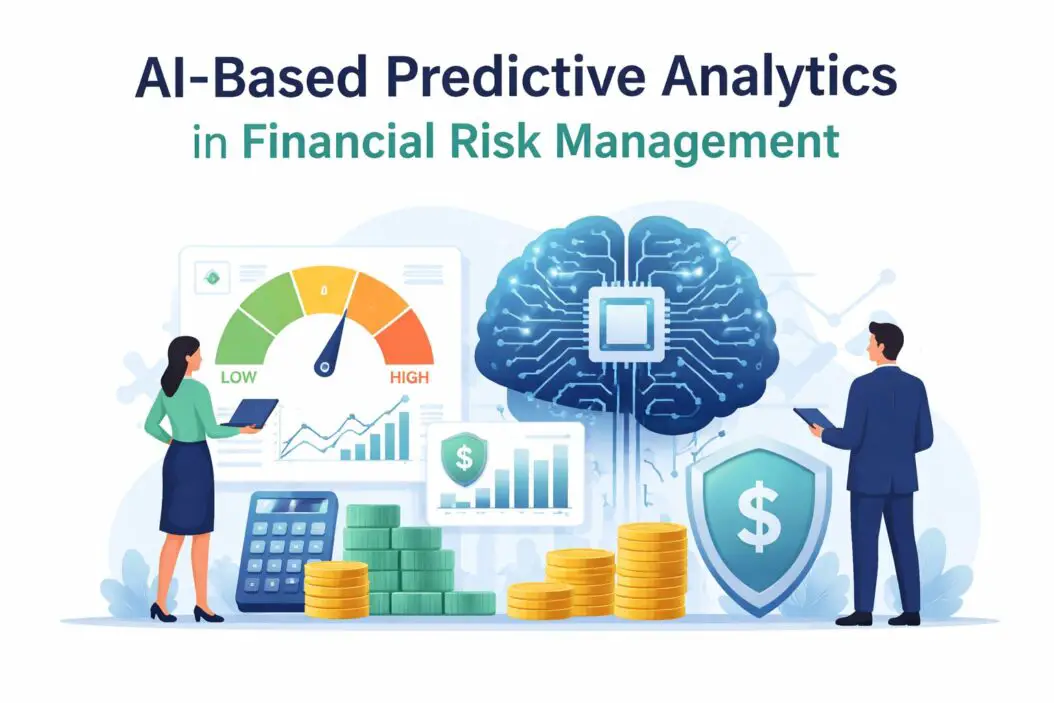
Financial risk is not new. What is new is the ability to see it coming before it hits. AI-based predictive analytics in financial risk management has changed how banks, insurers, hedge funds, and fintech companies detect, measure, and respond to risk. Instead of reacting after a loss, institutions now have tools that flag problems days, weeks, or even months earlier.
This article explains exactly how that works, what tools are involved, where it is being used right now, and what challenges you still need to plan for.
What Is AI-Based Predictive Analytics in Financial Risk Management?
Predictive analytics uses historical data, statistical models, and machine learning algorithms to forecast what is likely to happen next. In financial risk management, that means predicting things like loan defaults, market crashes, fraud attempts, liquidity shortfalls, and credit rating changes.
Traditional risk models used fixed rules and backward-looking reports. AI-based systems go further. They learn from new data in real time, identify non-linear patterns humans miss, and update their predictions as conditions change.
The core difference is this: old systems told you what happened. AI systems tell you what is about to happen.
Why It Matters More in 2026
The financial landscape in 2026 is more complex than ever. Geopolitical volatility, rising interest rates, crypto market fluctuations, and interconnected global supply chains create risk signals that are too fast and too layered for human analysts to process manually.
Regulators like the Basel Committee and the Financial Stability Board are also pushing institutions to adopt forward-looking risk frameworks. AI-based predictive analytics fits directly into that requirement.
Institutions that still rely on spreadsheets and quarterly reports are operating blind by comparison.
Core Types of Financial Risk Where AI Predictive Analytics Applies
Credit Risk
Credit risk is the risk that a borrower will not repay. AI models analyze thousands of variables to predict default probability. These include traditional factors like income and payment history, but also alternative data such as utility bill payments, device usage behavior, and even social footprint in some markets.
Machine learning models like gradient boosting and deep neural networks can spot default signals months before a credit score would drop.
Market Risk
Market risk covers losses from price movements in stocks, bonds, currencies, and commodities. AI predictive models use time-series analysis, sentiment analysis of news and social media, and reinforcement learning to forecast price volatility and identify tail risk.
Value at Risk (VaR) models enhanced with AI now produce more accurate estimates than traditional parametric methods, especially during market stress.
Liquidity Risk
Liquidity risk is the danger of not having enough cash or liquid assets to meet obligations. AI models track transaction flows, monitor customer behavior patterns, and predict cash demand spikes. Banks use these systems to stress test liquidity positions under different economic scenarios.
Operational Risk
Operational risk includes internal failures, fraud, cyberattacks, and system errors. Anomaly detection algorithms powered by AI can flag unusual transaction patterns, access behaviors, and process deviations before they turn into losses.
Systemic Risk
Systemic risk is the risk that one institution’s failure can cascade through the financial system. AI-based network analysis tools map interdependencies between institutions and identify contagion pathways. Regulators and central banks use these models to identify systemically important financial institutions (SIFIs).
How AI Predictive Models Actually Work in Practice
Data Ingestion and Feature Engineering
The first step is data. AI models need large volumes of clean, structured, and unstructured data. This includes transaction records, market feeds, economic indicators, customer behavior data, and increasingly alternative data like satellite imagery of commercial activity or shipping container movements.
Feature engineering is the process of turning raw data into variables the model can use. This step is critical. Garbage in, garbage out still applies.
Model Training and Validation
Models are trained on historical data. The system learns which combinations of features predicted past risk events. Cross-validation techniques ensure the model generalizes to new data rather than just memorizing the training set.
Common algorithms used include:
- Random Forest for credit scoring and classification tasks
- Long Short-Term Memory (LSTM) networks for time-series forecasting
- Gradient Boosting (XGBoost, LightGBM) for high-accuracy tabular data prediction
- Autoencoders for anomaly detection and fraud
- Transformer models for processing news and document data
Real-Time Scoring and Monitoring
Once deployed, the model scores new transactions, accounts, or market conditions continuously. Risk scores are updated in real time as new data arrives. Alerts are triggered when scores cross predefined thresholds.
This continuous loop is what makes AI superior to static quarterly risk reviews.
Explainability and Model Governance
Regulators require financial institutions to explain their decisions. Black-box models that cannot be interpreted are a compliance problem. Tools like SHAP (SHapley Additive exPlanations) and LIME (Local Interpretable Model-agnostic Explanations) help translate model outputs into human-readable explanations.
A credit denial must be explainable. An alert about a risky trade must reference specific signals. Explainability is not optional in 2026.
Key AI Technologies Powering Predictive Risk Analytics
| Technology | Primary Use Case | Advantage |
|---|---|---|
| Machine Learning | Credit scoring, fraud detection | Handles complex patterns in structured data |
| Natural Language Processing | Sentiment analysis, document review | Processes unstructured text data |
| Deep Learning | Market forecasting, image data | Learns abstract representations |
| Graph Neural Networks | Systemic risk, fraud networks | Maps entity relationships |
| Reinforcement Learning | Portfolio risk optimization | Learns from outcomes in dynamic environments |
| Federated Learning | Cross-institutional risk sharing | Preserves data privacy |
Real-World Use Cases
JPMorgan Chase: COiN and Contract Intelligence
JPMorgan uses machine learning to analyze legal documents and contracts for risk exposure. Their COiN platform processes hundreds of thousands of documents in seconds, identifying risk clauses that manual review would miss or take months to complete.
Ant Group: Real-Time Credit Scoring
Ant Group’s Zhima Credit system scores over a billion users using AI models that process hundreds of variables in milliseconds. The system approves or declines micro-loans in under three seconds with default rates below industry averages.
Central Banks: Systemic Risk Monitoring
The European Central Bank and the Bank of England both use AI-based network models to monitor interconnected exposures between financial institutions. These models identify systemic vulnerabilities before they become crises.
Insurance: Predictive Underwriting
Major insurers like AXA and Zurich use AI models to predict claim likelihood at the individual policy level. Instead of grouping customers into broad risk categories, they price risk individually based on real behavioral and contextual data.
Step-by-Step: How a Bank Implements AI Predictive Risk Analytics
Step 1: Define the risk problem clearly. Are you trying to reduce loan defaults? Detect fraud faster? Improve liquidity forecasting? The model architecture depends on the specific problem.
Step 2: Audit your data. Identify what data you have, how clean it is, and what gaps exist. Data quality is the single biggest predictor of model quality.
Step 3: Build a baseline model. Start simple. A logistic regression or decision tree often provides a strong baseline. This gives you something to compare against.
Step 4: Develop and test more advanced models. Try gradient boosting, neural networks, or ensemble methods. Validate on out-of-sample data. Use AUC-ROC, precision-recall curves, and Gini coefficients to evaluate performance.
Step 5: Stress test the model. Run the model against historical crisis periods (2008 financial crisis, COVID-19 shock, 2022 rate hikes). Does it perform reasonably under extreme conditions?
Step 6: Build explainability into the workflow. Use SHAP values or similar tools to generate decision explanations. Ensure compliance teams and regulators can review outputs.
Step 7: Deploy with monitoring. Production models drift as market conditions change. Set up automated monitoring for model performance, data quality, and output distributions. Retrain on a regular schedule.
Step 8: Integrate with risk governance. The model’s outputs should feed into risk committees, limits frameworks, and escalation procedures. AI is a tool, not a replacement for human judgment on consequential decisions.
Challenges You Cannot Ignore
Data Quality and Bias
AI models inherit the biases in their training data. If historical lending data reflects discriminatory practices, the model will reproduce those outcomes. Bias audits and fairness testing are mandatory steps.
Model Risk
Models can be wrong. Overconfidence in AI outputs without human oversight has caused real losses. The 2010 Flash Crash was partly attributed to algorithmic systems responding to each other without human intervention.
Regulatory Compliance
Different jurisdictions have different rules. GDPR in Europe restricts certain uses of personal data. The US Consumer Financial Protection Bureau requires explainability in credit decisions. The EU AI Act classifies some financial AI systems as high-risk. Staying compliant across markets is genuinely complex.
Cybersecurity
AI systems that control risk decisions are high-value attack targets. Adversarial inputs can deliberately fool models. A competitor or bad actor could craft a loan application specifically designed to evade a fraud detection model. Adversarial robustness testing is an emerging but necessary discipline.
Talent Gap
Building and maintaining these systems requires data scientists, ML engineers, risk quants, and domain experts working together. That combination is rare and expensive.
What Good AI Risk Management Looks Like in 2026
The best institutions in 2026 are not just running models. They are operating complete risk intelligence ecosystems. These include:
- Real-time data pipelines feeding models continuously
- Multiple model types working in ensemble rather than one model doing everything
- Automated alert routing with human review at key decision points
- Model risk management frameworks that treat AI models like any other business risk
- Regular third-party audits of model performance and fairness
- Clear accountability lines for when a model recommendation is overridden
For further reading on model risk management frameworks, the Basel Committee on Banking Supervision provides detailed guidance at https://www.bis.org/bcbs/publ/d562.htm.
The Role of Alternative Data
One of the biggest shifts in predictive analytics since 2020 is the explosion of alternative data. Traditional financial models used balance sheets, payment histories, and market prices. Today’s models also use:
- Geolocation data (is the business actually operating where it claims?)
- Web traffic and app usage data
- News sentiment and social media signals
- Weather and climate data for agricultural lending and insurance
- ESG scores and supply chain data for corporate credit risk
Alternative data gives models more signal, especially for thin-file borrowers who have little traditional credit history. It also creates new risks around privacy, consent, and regulatory compliance.
AI Predictive Analytics vs Traditional Risk Models
| Dimension | Traditional Models | AI-Based Predictive Analytics |
|---|---|---|
| Data Volume | Limited, structured | High volume, structured and unstructured |
| Update Frequency | Monthly or quarterly | Real-time or near real-time |
| Pattern Recognition | Linear, rule-based | Non-linear, complex interactions |
| Adaptability | Manual recalibration needed | Self-updating with new data |
| Explainability | High (simple formulas) | Variable (requires explainability tools) |
| Regulatory Acceptance | Well established | Increasing but still evolving |
| Implementation Cost | Lower | Higher upfront, lower ongoing |
| Accuracy in Crisis Periods | Often fails | Better but not immune to failure |
Regulatory Landscape in 2026
Regulation is catching up with AI in finance. Key frameworks to know:
The EU AI Act classifies AI systems used in credit scoring, insurance pricing, and essential financial services as high-risk. High-risk systems face mandatory conformity assessments, documentation requirements, and human oversight obligations.
The US Federal Reserve’s SR 11-7 guidance on model risk management is being updated to address machine learning specifically. The key principle remains: every model is a risk, and every model needs governance.
The Financial Stability Board released principles for AI in financial services in 2024 that are now forming the basis of national regulatory guidance in G20 countries. The FSB guidance is available at https://www.fsb.org/work-of-the-fsb/financial-innovation-and-structural-change/artificial-intelligence-and-machine-learning/.
Conclusion
AI-based predictive analytics in financial risk management is not a future technology. It is the current standard for any institution serious about managing risk in 2026. It gives you earlier warnings, better accuracy, and the ability to process far more data than any team of analysts could handle manually.
But it is not a silver bullet. Models fail. Data has bias. Regulations evolve. The institutions that benefit most are those that treat AI as a powerful tool within a disciplined risk governance framework, not a replacement for human judgment and accountability.
The question is not whether to adopt predictive analytics. The question is how fast you can build the data infrastructure, talent, and governance frameworks to make it work safely and effectively.
Frequently Asked Questions
What is AI-based predictive analytics in financial risk management?
It is the use of machine learning and statistical models to forecast financial risks such as loan defaults, market volatility, fraud, and liquidity shortfalls before they occur. These models analyze large volumes of historical and real-time data to identify patterns that predict future risk events.
How does AI improve credit risk assessment?
AI models analyze hundreds of variables simultaneously, including alternative data sources like payment behavior, device usage, and transaction patterns. This produces more accurate default probability scores than traditional credit scoring methods, especially for borrowers with limited credit history.
What are the main challenges of using AI in financial risk management?
The main challenges include data quality and bias, model explainability for regulatory compliance, model drift as market conditions change, cybersecurity threats, and the difficulty of hiring people with both machine learning expertise and financial domain knowledge.
Is AI predictive analytics regulated in financial services?
Yes. The EU AI Act classifies many financial AI applications as high-risk with strict requirements. The US Fed’s model risk management guidance applies to AI models. The Financial Stability Board has published AI principles now being adopted by regulators globally. Compliance requirements are growing significantly in 2026.
How do financial institutions ensure AI risk models are fair and unbiased?
Institutions use bias audits, fairness testing across demographic groups, and explainability tools like SHAP values to detect and correct discriminatory patterns. Regulatory frameworks in most markets now require documentation of fairness testing for AI systems used in credit and insurance decisions.

- How to Fix Overscan on Windows 11/10: Stop Your Screen Getting Cut Off (2026) - April 1, 2026
- How to Disable Lock Screen on Windows 11/10 in 2026 - April 1, 2026
- Top 7 NFT Integration Ideas for Brands in 2026 - March 31, 2026