
Neural networks are primarily used in pattern recognition and prediction tasks across AI. They excel at image recognition, natural language processing, speech recognition, autonomous vehicles, and recommendation systems. If you’ve used facial recognition, talked to Siri, or got a Netflix recommendation, you’ve experienced neural networks at work.
Let me break down exactly where these systems shine and why they’ve become essential.
What Neural Networks Actually Do
Neural networks mimic how human brains process information. They learn from examples rather than following strict rules.
Think of it this way: Instead of programming every possible scenario, you show the network thousands of examples. It finds patterns on its own.
Key characteristics:
- Learn from data without explicit programming
- Improve accuracy with more training examples
- Handle complex, non-linear relationships
- Adapt to new information over time
Primary Areas Where Neural Networks Dominate
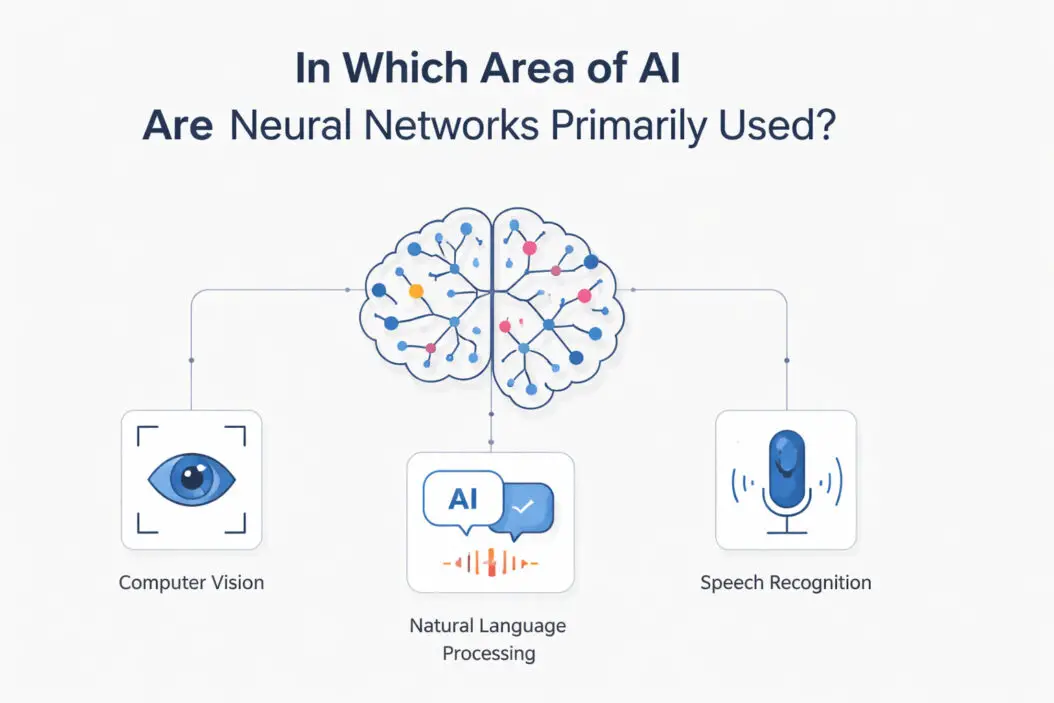
1. Computer Vision and Image Recognition
This is where neural networks have made the biggest splash.
What they do here:
- Identify objects in photos and videos
- Detect faces and recognize individuals
- Read text from images (OCR)
- Analyze medical scans for diseases
- Enable self-driving cars to “see” the road
Real-world example: When you upload a photo to Facebook and it suggests tagging your friends, that’s a convolutional neural network (CNN) at work. These specialized networks process images layer by layer, identifying edges, shapes, then complete objects.
Medical imaging has been transformed. Neural networks now detect cancers in X-rays and MRIs with accuracy matching or exceeding human radiologists. They spot patterns too subtle for human eyes.
2. Natural Language Processing (NLP)
Neural networks have revolutionized how computers understand and generate human language.
Applications include:
- Machine translation (Google Translate)
- Chatbots and virtual assistants
- Text summarization
- Sentiment analysis
- Content generation
- Grammar checking
The transformer architecture, a type of neural network, powers modern language models. It processes entire sentences simultaneously, understanding context better than older methods.
According to research from Stanford’s AI Index, language model performance has improved dramatically since 2018, largely due to neural network advances.
Why this matters: You can now have natural conversations with AI, get accurate translations instantly, and receive writing suggestions that actually make sense.
3. Speech Recognition and Audio Processing
Neural networks have made voice interfaces practical and reliable.
Key uses:
- Voice-to-text transcription
- Virtual assistants (Alexa, Siri, Google Assistant)
- Real-time translation of spoken language
- Music generation and audio enhancement
- Voice authentication
Recurrent neural networks (RNNs) and their improved versions, Long Short-Term Memory networks (LSTMs), excel at sequential data like audio. They remember context from earlier in a conversation.
Practical impact: Speech recognition accuracy has gone from 80% to over 95% in the past decade. You can now dictate messages reliably or control your home with voice commands.
4. Recommendation Systems
Every streaming service and online store uses neural networks to suggest content.
How they work:
- Analyze your viewing/purchasing history
- Compare you to similar users
- Predict what you’ll enjoy next
- Continuously learn from your choices
Companies using this:
- Netflix for show recommendations
- Amazon for product suggestions
- Spotify for music discovery
- YouTube for video suggestions
These systems process billions of data points about user behavior. They find subtle patterns in what people with similar tastes enjoy.
5. Autonomous Vehicles
Self-driving technology relies heavily on multiple neural networks working together.
What they handle:
- Object detection (pedestrians, other cars, signs)
- Path planning and navigation
- Traffic prediction
- Sensor fusion (combining camera, radar, lidar data)
- Decision-making in real-time
Tesla, Waymo, and other companies use deep neural networks to process sensor data and make split-second driving decisions. These networks analyze the environment faster and more consistently than human drivers.
6. Healthcare and Medical Diagnosis
Neural networks are transforming medicine beyond imaging.
Current applications:
- Drug discovery and development
- Predicting patient outcomes
- Personalized treatment recommendations
- Genomic analysis
- Early disease detection
Research published in Nature shows neural networks can predict protein structures, accelerating drug development by years. They also analyze electronic health records to identify patients at risk for specific conditions.
The advantage: Neural networks process far more variables than humans can track mentally, spotting disease markers earlier.
7. Financial Services and Fraud Detection
Banks and financial institutions deploy neural networks extensively.
Primary uses:
- Credit scoring and loan approval
- Stock market prediction
- Algorithmic trading
- Fraud detection in transactions
- Risk assessment
These systems analyze transaction patterns in real-time. They flag suspicious activity faster than rule-based systems because they adapt to new fraud techniques.
Impact: Credit card fraud detection has improved significantly. Networks catch fraudulent transactions within milliseconds while approving legitimate purchases smoothly.
Types of Neural Networks and Their Specializations
Different architectures excel at different tasks:
| Neural Network Type | Best For | Common Applications |
|---|---|---|
| Convolutional Neural Networks (CNNs) | Image and video analysis | Facial recognition, medical imaging, autonomous vehicles |
| Recurrent Neural Networks (RNNs) | Sequential data | Speech recognition, time series prediction, text generation |
| Long Short-Term Memory (LSTM) | Long sequences with context | Language translation, video analysis, music generation |
| Generative Adversarial Networks (GANs) | Creating new content | Image generation, video synthesis, data augmentation |
| Transformer Networks | Language understanding | ChatGPT, translation, document analysis |
Why Neural Networks Work Better Than Traditional AI
Traditional AI used hand-coded rules. Developers had to anticipate every scenario.
Problems with rule-based systems:
- Couldn’t handle unexpected inputs well
- Required constant manual updates
- Struggled with nuance and context
- Limited by human ability to define rules
Neural networks learn patterns from data. They handle edge cases better because they’ve seen similar examples during training.
The trade-off: Neural networks need lots of data and computing power. They’re also less transparent—you can’t always explain why they made a specific decision.
Real-World Impact and Results
The numbers tell the story:
- Image recognition accuracy: From 70% (2010) to 99%+ (2026)
- Machine translation quality: Now indistinguishable from human translators for many language pairs
- Speech recognition: Word error rates dropped from 25% to under 3%
- Medical diagnosis: Matching or exceeding specialist accuracy in specific domains
These improvements have made previously impossible applications practical and affordable.
Limitations and Challenges
Neural networks aren’t perfect for everything.
Where they struggle:
- Small datasets (they need lots of examples)
- Explaining their decisions (black box problem)
- Adversarial attacks (carefully crafted inputs can fool them)
- Bias in training data leads to biased outputs
- High energy consumption for training
Traditional algorithms still outperform neural networks for well-defined problems with clear rules. Sorting a list, calculating taxes, or managing databases don’t need neural networks.
Use neural networks when:
- Patterns are complex and subtle
- Rules are hard to define explicitly
- You have lots of training data
- Exact explanations aren’t critical
Use traditional methods when:
- Rules are clear and stable
- Data is limited
- Transparency is required
- Computing resources are constrained
The Future of Neural Networks
Current trends point toward:
More efficient architectures: New designs require less data and computing power while maintaining accuracy.
Multimodal systems: Combining vision, language, and audio in single networks. These understand images and text together, like humans do.
Edge computing: Running neural networks on phones and devices instead of cloud servers. This improves privacy and response time.
Automated machine learning (AutoML): Systems that design and optimize neural networks automatically, making the technology accessible to non-experts.
How to Get Started with Neural Networks
If you want to work with this technology:
1. Learn the basics
Start with online courses covering:
- Linear algebra fundamentals
- Probability and statistics
- Python programming
- Basic calculus concepts
2. Use existing frameworks
Popular tools include:
- TensorFlow (Google’s framework)
- PyTorch (Facebook’s framework)
- Keras (beginner-friendly wrapper)
3. Practice with real datasets
Free resources:
- Kaggle competitions
- UCI Machine Learning Repository
- ImageNet database
- Google Dataset Search
4. Start small
Build simple projects before complex ones:
- Handwritten digit recognition (MNIST dataset)
- Image classification with pre-trained models
- Basic sentiment analysis
- Simple time series prediction
5. Join communities
Learn from others:
- Reddit’s r/MachineLearning
- GitHub repositories
- Local AI meetups
- Online forums and Discord servers
Conclusion
Neural networks have become the dominant tool in AI because they excel at pattern recognition tasks that stumped traditional programming approaches. They power the image recognition in your phone, the voice assistant in your home, the recommendations you see online, and the medical diagnoses saving lives.
Their primary areas, computer vision, natural language processing, speech recognition, autonomous systems, and predictive analytics—represent where human-like perception and decision-making matter most.
The technology isn’t perfect. Neural networks need substantial data, computing power, and expertise to deploy effectively. They work best for complex pattern recognition, not rule-based logic.
But for translating languages, recognizing faces, driving cars, diagnosing diseases, and countless other tasks, neural networks have proven irreplaceable. As architectures improve and applications expand, their role in AI will only grow larger.
Understanding where neural networks excel helps you recognize their impact on daily life and identify opportunities to apply them to new problems. Whether you’re building AI systems or simply using them, knowing their strengths and limitations makes you a more informed participant in our AI-driven world.
Frequently Asked Questions
What is the main purpose of neural networks in AI?
Neural networks identify patterns in complex data that traditional programming cannot easily handle. They learn from examples rather than following explicit rules, making them ideal for tasks like image recognition, language understanding, and prediction. Their main purpose is to enable machines to perform human-like perception and decision-making tasks at scale.
Can neural networks work without large amounts of data?
Neural networks typically need substantial training data to achieve good performance, but techniques like transfer learning and few-shot learning help them work with limited data. Transfer learning uses a network trained on one task as a starting point for another, requiring less new data. However, traditional machine learning methods often outperform neural networks when data is truly scarce.
Are neural networks the same as deep learning?
Deep learning is a subset of neural networks that uses multiple layers (hence “deep”) to process information. All deep learning uses neural networks, but not all neural networks are deep learning. Simple neural networks might have just one or two layers, while deep learning architectures can have dozens or even hundreds of layers, enabling them to learn more complex patterns.
Why do companies prefer neural networks for image recognition?
Neural networks, specifically convolutional neural networks, naturally handle the spatial relationships in images. They automatically learn to detect edges, shapes, and objects without manual feature engineering. This makes them far more accurate and adaptable than traditional computer vision methods, which required programmers to manually specify what features to look for.
What industries benefit most from neural network technology?
Healthcare benefits through improved diagnostics and drug discovery. Finance uses them for fraud detection and trading. Automotive relies on them for autonomous vehicles. Technology companies apply them to search, recommendations, and virtual assistants. Retail uses them for demand forecasting and personalization. Essentially, any industry dealing with large amounts of complex data can benefit from neural network applications.

- How to Fix Overscan on Windows 11/10: Stop Your Screen Getting Cut Off (2026) - April 1, 2026
- How to Disable Lock Screen on Windows 11/10 in 2026 - April 1, 2026
- Top 7 NFT Integration Ideas for Brands in 2026 - March 31, 2026