
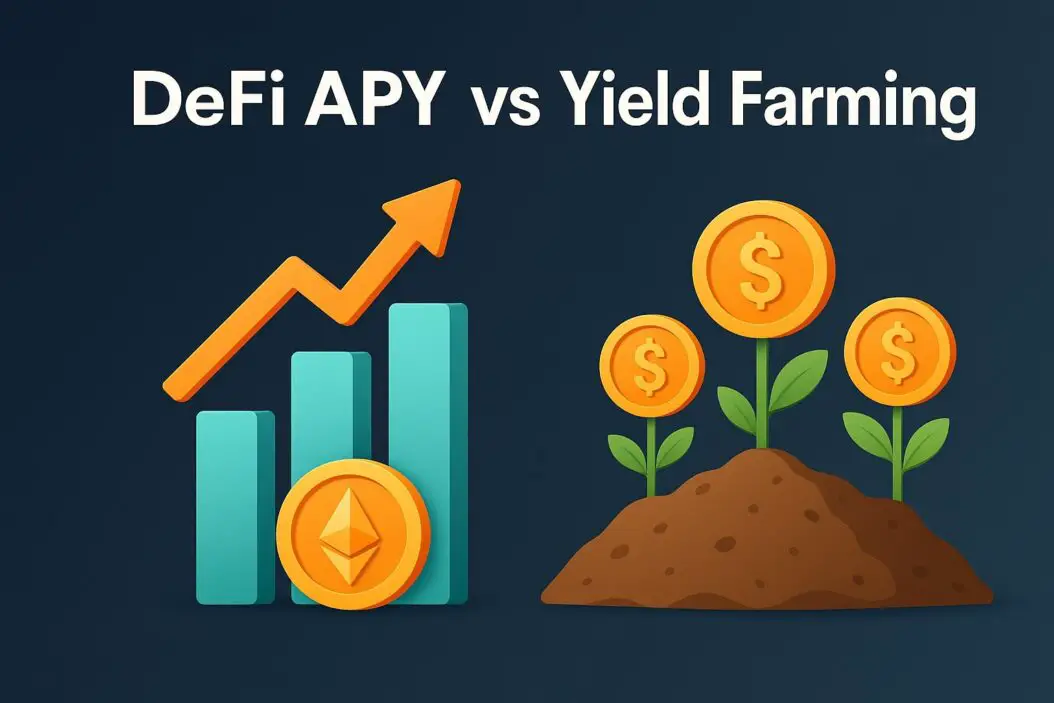
APY and yield farming are not the same thing. APY (Annual Percentage Yield) is the total return you earn in one year, including compound interest. Yield farming is the strategy of depositing crypto into DeFi protocols to earn that return. Think of APY as the speed, and yield farming as the vehicle. You use yield farming to chase APY returns.
Most people get confused because they hear “yield” and think it means one thing. But in DeFi, yield farming means putting your money somewhere. The APY is what you actually get back.
Understanding APY in DeFi
APY stands for Annual Percentage Yield. It’s a standardized way to show how much money you’ll earn in one year.
The key word is “compound.” Your earnings get added to your original amount. Then those earnings make more earnings. This happens continuously in DeFi, not just once per year.
Here’s a simple example. You put in $1,000 at 20% APY:
After 1 month, you have about $1,016.67 (because 20% divided by 12 months). After 6 months, you have about $1,082.43. After 1 year, you have $1,200.
That extra money comes from compounding. Your interest earns interest.
How APY Differs from Simple Interest
Simple interest gives you the same amount every time period. If you earn $20 in month one, you earn $20 in month two.
APY compounds. Month two earnings are higher because your balance grew.
DeFi protocols almost always use APY, not simple interest. This means your money works harder the longer it stays in the protocol.
What Yield Farming Actually Means
Yield farming is the practice of putting your cryptocurrency into a protocol to earn returns. You’re “farming” yield by lending, providing liquidity, or staking your assets.
The most common types are:
Lending protocols like Aave or Compound. You deposit stablecoins or other tokens. Borrowers pay interest. You earn that interest. It’s like being a bank.
Liquidity pools on decentralized exchanges (DEXs). You deposit two tokens in equal value. Traders pay fees to swap between those tokens. You earn a portion of those fees plus any reward tokens the protocol gives out.
Staking in proof-of-stake networks. You lock up tokens to help secure the network. You earn new tokens as a reward. This is different from lending or providing liquidity.
Each method has different risks and different returns.
Why It’s Called Farming
The word “farming” comes from agriculture. Farmers plant seeds, wait, and harvest crops. Yield farmers deposit tokens and wait to harvest returns. The “crops” are new tokens or interest paid to them.
Early DeFi projects gave huge rewards to attract users. Some APYs reached hundreds or thousands of percent. People jumped in like farmers rushing to harvest. The name stuck.
Today, returns are more realistic. But the farming metaphor remains useful. You put in assets. Time passes. You collect your rewards.
Key Differences Explained
| Aspect | APY | Yield Farming |
|---|---|---|
| What it is | A rate of return | A strategy to earn that return |
| Time frame | Always annual (yearly) | Can be short or long term |
| Compounding | Always included in the calculation | Depends on the protocol |
| Risk level | Varies by APY source | Higher due to strategy choices |
| Passive vs Active | Passive (just collect returns) | Can be active (rebalancing, switching pools) |
The biggest difference is this: APY is a measurement. Yield farming is an action.
You cannot do APY. You cannot measure yield farming as a single number.
You DO yield farming IN ORDER TO earn APY.
Where APY Comes From in DeFi
APY doesn’t appear from nowhere. It comes from real economic activity.
Lending Protocol APY
When you deposit stablecoins in Aave, borrowers borrow your money. They pay interest on loans. That interest becomes your APY. The higher the demand to borrow, the higher your APY. If nobody wants to borrow, APY drops to near zero.
DEX Liquidity Pool APY
When you provide liquidity on Uniswap, traders pay a small fee (usually 0.3%) to swap tokens using your liquidity. Your APY comes from those fees split among all liquidity providers. It also comes from reward tokens the protocol distributes.
A $10,000 liquidity pool might generate $20 in daily swap fees. Shared among all providers, that creates APY for each provider.
Staking Rewards APY
Networks like Ethereum validation or protocols like Lido distribute new tokens to people who stake. That distribution is your APY. It’s funded by new tokens entering the system, not from trading fees.
Real Examples of APY vs Yield Farming
Scenario 1: Lending Platform
You want to earn passive income on 10,000 USDC (a stablecoin).
You go to Compound or Aave. Both show lending APY around 5.2% today.
That APY means if you deposit 10,000 USDC, in one year you’ll have 10,520 USDC.
That’s your yield farming strategy: deposit into the lending protocol to earn the 5.2% APY.
The APY is measured. The farming is what you do.
Scenario 2: Liquidity Pool
You have 5,000 USDC and 5,000 USDT. You pair them into a Uniswap pool to earn fees.
The pool shows 8% APY from fees, plus 12% APY from reward tokens. Total 20% APY.
Your yield farming strategy is providing liquidity to earn that 20% APY.
Your expected return is 20% annually. But the APY can change. If the pool gets crowded with other providers, APY drops. If traders suddenly use the pool less, APY drops.
This shows yield farming risk. The APY you see today isn’t guaranteed tomorrow.
Why APY Matters for Your Yield Farming Decisions
APY is how you compare opportunities.
If one lending protocol offers 4% APY and another offers 6% APY, the second one is clearly better for lending your stablecoins. Same activity, different returns.
But higher APY usually means higher risk. A protocol offering 50% APY is either:
- Offering unsustainable rewards (the protocol will collapse).
- Exposing you to more risk (new, untested protocol).
- Using a token with inflation (your rewards decrease in value).
Lower APY on established protocols is often safer. Aave’s 4% APY is more reliable than an unknown protocol’s 40% APY.
Understanding Sustainable APY
Sustainable APY is built on real activity. Aave lending APY comes from real borrowers paying real interest. That’s sustainable.
Unsustainable APY comes from the protocol printing new tokens to pay farmers. Once the protocol stops printing tokens or fewer new users join, APY crashes.
Early liquidity mining campaigns (like Uniswap in 2020) offered massive APY. It was real money for a short time. But it ended. Farmers who understood it was temporary cashed out. Those who thought it would last forever lost money.
The Risks You Need to Know
Smart Contract Risk
DeFi protocols are software. Software has bugs. A bug could lock your funds or drain them.
Established protocols like Aave and Uniswap have been audited many times. Risk is lower but not zero.
New protocols have higher smart contract risk. Higher APY sometimes reflects this risk.
Impermanent Loss (Liquidity Pools Only)
When you provide liquidity, you hold two tokens in equal value. If one token’s price moves dramatically against the other, you lose money.
This loss is called impermanent loss. It can erase weeks of APY earnings.
If you deposit 5,000 USDC and 5,000 of Token X (at $1 each), and Token X drops to $0.50, your position is worth less. Even after earning fees, you’re down compared to just holding the tokens separately.
Liquidation Risk (Lending Protocols)
Some protocols let you borrow against collateral. If your collateral’s value drops too much, your position gets liquidated. You lose collateral.
This mainly affects advanced users. Simple depositing has no liquidation risk.
Token Value Risk
Many yield farming strategies pay you in new tokens, not stablecoins. If that token’s price crashes, your rewards lose value.
Earning 50% APY in a token worth half tomorrow means you actually lost money.
How to Choose Between Different Yield Farming Strategies
Step 1: Know Your Risk Tolerance
Can you afford to lose this money? If not, stick to established protocols like Aave, Compound, or Uniswap with mainstream token pairs.
If you can afford the risk and want higher returns, newer protocols exist. Just know the risks.
Step 2: Compare Real APY, Not Projected
Displayed APY can be misleading. Some protocols show “gross APY” before gas fees. Others show inflated APY that won’t last.
Check historical APY. Did this pool’s APY stay stable for months, or did it crash?
Step 3: Calculate Your Actual Returns
APY assumes you’re there for a full year. You’re probably not.
If you deposit for 6 months at 20% APY, you earn about 9.5% (not 10%, because of compounding math). That’s roughly $950 on $10,000.
Subtract gas fees and any transaction costs. What’s left is your real profit.
Step 4: Watch for Sustainability
Is the APY paid from:
- Real fees from traders or borrowers? (Likely sustainable)
- New tokens printed by the protocol? (Temporary)
- Community incentives that end in 3 months? (Temporary)
Temporary APY can be great for quick profits. Just don’t plan on it forever.
Step 5: Diversify
Put money in multiple protocols and strategies. This reduces the damage if one protocol fails.
Common Yield Farming Strategies Explained
Conservative: Stablecoins on Lending Protocols
You deposit USDC or USDT on Aave. You earn 4% to 6% APY. No volatility risk. Low smart contract risk on established protocols.
Best for: Safety-first investors, short-term capital parking.
Moderate: Mainstream Token Liquidity Pairs
You provide liquidity for ETH/USDC or USDC/USDT pairs on Uniswap. You earn fees plus rewards. Moderate risk.
Best for: Investors willing to tolerate some price volatility.
Aggressive: New Protocol Liquidity Mining
You deposit into a new protocol’s liquidity pool. You earn 50% to 300% APY. High risk, potential for big losses.
Best for: Experienced users with money they can afford to lose.
Ultra Aggressive: Leveraged Yield Farming
You borrow money to amplify your position. Your potential returns multiply. Your potential losses also multiply.
Best for: Only experienced traders with proven risk management.
Gas Fees and Their Impact on Returns
Gas fees can destroy small positions in yield farming.
If you deposit $500 into a DeFi protocol and gas costs $50, that’s 10% of your money gone immediately.
You need to earn enough APY to make back the gas fee. On a 20% APY strategy, that takes about 2 months for a $500 position.
For small amounts, yield farming often doesn’t make sense. The costs outweigh the returns.
Layer 2 solutions like Arbitrum or Optimism have much lower gas fees. This makes small positions viable.
APY Rates: What’s Normal Today
As of early 2026, here are typical APY ranges:
Stablecoins on lending protocols: 3% to 6% APY. Boring, but safe.
Major token staking (Ethereum, Solana): 4% to 8% APY. Depends on the network.
Mainstream DEX liquidity pools: 5% to 15% APY. Includes fee rewards.
New protocol farming: 30% to 500% APY. High risk, temporary rewards.
If someone promises 200% APY on a “safe” investment, they’re lying. That’s a red flag.
How to Monitor Your APY Over Time
Most DeFi apps show your current APY. But APY changes constantly.
To track real returns:
- Record your initial deposit amount and date.
- Check your balance regularly (weekly or monthly).
- Calculate your actual percentage gain.
- Compare to the displayed APY.
If displayed APY is 20% for 3 months but you only earned 3%, something is wrong. Either APY changed, or the calculation was misleading.
Good protocols provide historical data. You can see past APY to judge trends.
Compounding Your APY for Better Returns
The power of yield farming is compounding.
Let’s say you earn 20% APY on $10,000:
Year 1: $10,000 becomes $12,000. Year 2: $12,000 becomes $14,400. Year 3: $14,400 becomes $17,280.
After 3 years, you have $17,280. That’s not $16,000 from simple math (3 times 20% = 60% total). Compounding added $1,280 extra.
To maximize compounding:
- Let money sit as long as possible.
- Deposit additional funds regularly.
- Choose protocols that compound automatically.
Many protocols compound daily or even more frequently. This is better than annual compounding.
When to Exit a Yield Farming Position
Exit when:
- APY drops significantly. If 20% APY drops to 5%, consider moving to a better opportunity.
- New risks emerge. The protocol gets hacked, or the team shows red flags.
- You’ve hit your profit target. You earned the returns you wanted. Take the money.
- You need the capital elsewhere. Farming is not as important as financial emergencies.
- A better opportunity exists. A safer protocol with comparable APY.
Don’t hold positions just because you invested. This is the sunk cost fallacy. What matters is future returns, not past decisions.
Understanding APY Changes
APY is not static. It changes based on supply and demand.
On lending protocols:
Higher demand to borrow = Higher APY for lenders. Lower demand to borrow = Lower APY for lenders.
On DEX pools:
More liquidity providers = Lower APY per provider. Fewer liquidity providers = Higher APY per provider.
More traders using the pool = Higher fees = Higher APY. Fewer traders = Lower fees = Lower APY.
New users are constantly entering DeFi. As more people provide liquidity or lend, APY spreads across more people, so each person earns less. This is natural market dynamics.
The Difference Between Gross APY and Net APY
Gross APY is before costs. Net APY is after costs.
If a pool shows 15% gross APY but costs 2% in gas fees yearly, your net APY is 13%.
Some protocols don’t clearly show this difference. Always calculate it yourself.
Net APY is what actually matters for your pocket.
Is Yield Farming Right for You?
Yield farming works if:
- You have capital you’re willing to risk.
- You understand the risks specific to your strategy.
- You can afford gas fees (or use Layer 2).
- You’re not counting on it as primary income.
- You monitor your positions regularly.
Yield farming doesn’t work if:
- You can’t afford to lose the money.
- You don’t understand the strategy.
- You think high APY is risk-free.
- You expect returns without doing research.
Frequently Asked Questions
Does APY mean I’m guaranteed to earn that amount?
No. APY is based on current conditions. It can change daily. It’s a snapshot rate, not a promise. Past APY doesn’t guarantee future APY.
Can I lose money while yield farming?
Yes. Smart contract hacks, impermanent loss, token crashes, and liquidations can all cause losses. High APY often signals higher risk.
Is it better to farm one token or multiple tokens?
Multiple tokens reduce risk. If one protocol fails, you still have money in others. Diversification is safer than concentration.
How long should I farm?
That depends on your goals. Short term (weeks to months) works if APY is unsustainably high. Long term (years) works better for stable, sustainable APY like lending stablecoins.
Do I need to do anything once I deposit my tokens?
On simple lending protocols, no. Money just earns passively. On liquidity pools, you might need to monitor for impermanent loss. On farming platforms with yield incentives, you might need to harvest and reinvest rewards to compound.
Conclusion
APY and yield farming are linked but distinct concepts. APY is your rate of return. Yield farming is your strategy to earn that return.
Understanding both helps you make smarter DeFi decisions. High APY attracts yield farmers. But sustainability matters more than size. A 6% APY from Aave (a proven protocol) often beats 60% APY from an unknown farm.
Start small, diversify, and prioritize understanding over returns. The most profitable yield farmers are the ones still here years later because they avoided catastrophic losses.
DeFi is still young. Opportunities exist. But so do risks. Treat it accordingly.
