
NFT markets move fast. One tweet from a big account can send a collection’s floor price up 40% in an hour. One piece of bad news can wipe it out overnight. If you are trying to trade, invest in, or analyze NFTs, you need to know what the crowd is feeling before prices move. That is exactly what AI-based sentiment tracking for NFT hype does.
This article explains how it works, which tools exist, how to use the data, and what to watch out for. No fluff. Just what you need.
What Is AI-Based Sentiment Tracking for NFT Hype
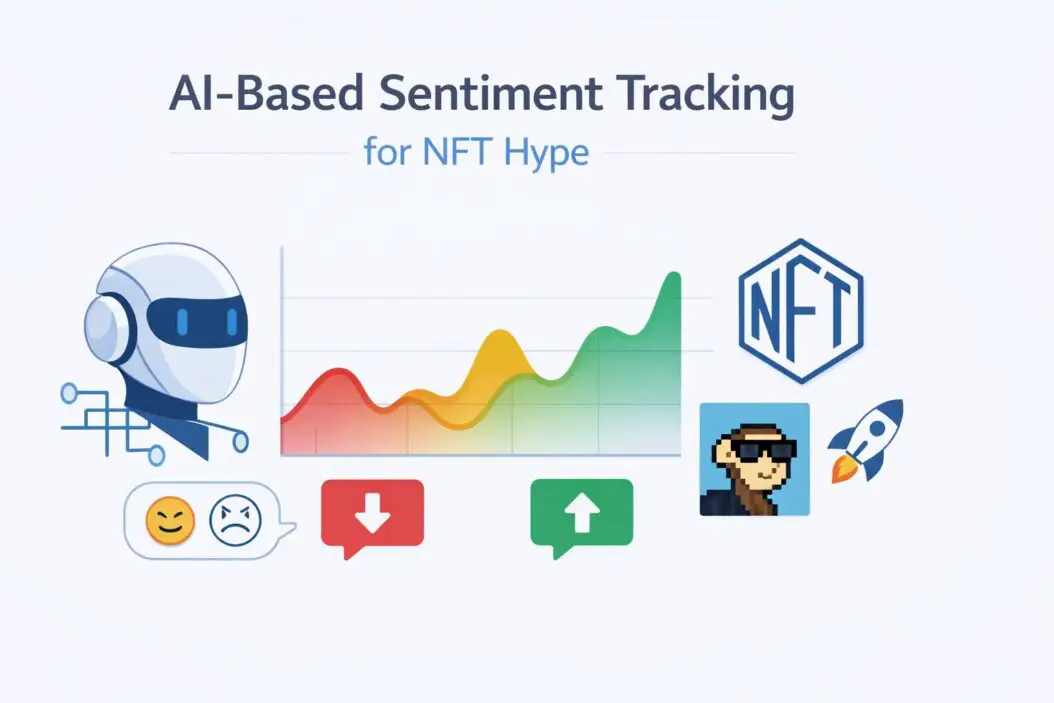
Sentiment tracking means measuring how people feel about something. Positive, negative, or neutral. AI-based sentiment tracking does this at scale, automatically, in real time.
In the NFT world, this means an AI system reads thousands of tweets, Discord messages, Reddit posts, Telegram chats, and even news articles. It figures out whether the overall mood around a project is bullish or bearish. It does this faster than any human team could.
The core technology behind this is called Natural Language Processing, or NLP. It is a branch of AI that helps machines understand human language. Modern NLP models can detect sarcasm, slang, and even emojis. That matters a lot in crypto and NFT communities where language is informal and fast-moving.
Why Sentiment Matters More in NFT Markets Than in Traditional Markets
NFT prices are driven heavily by narrative and community. Unlike a stock, an NFT has no earnings report. Its value is almost entirely based on perceived demand and cultural relevance.
This makes sentiment data extremely powerful. When the community around a project feels excited, prices go up. When confidence breaks, prices collapse. There is very little fundamental analysis to fall back on. Sentiment IS the fundamental.
Here is a quick comparison to show you the difference:
| Factor | Traditional Stock | NFT |
|---|---|---|
| Earnings Reports | Very important | Not applicable |
| Community Sentiment | Moderately important | Extremely important |
| Social Media Buzz | Minor signal | Major signal |
| Influencer Impact | Small | Huge |
| Price Reaction Speed | Days to weeks | Minutes to hours |
This table shows why AI sentiment tools built for crypto and NFTs are not the same as tools built for stock markets. NFT sentiment needs to be tracked in real time, from the right platforms, with models trained on crypto-specific language.
How AI Sentiment Tracking Works Step by Step
Step 1: Data Collection
The AI first collects raw data from relevant sources. For NFTs, those sources include:
- Twitter/X, especially from accounts in the NFT space
- Discord servers of specific projects
- Reddit communities like r/NFT and r/CryptoArt
- Telegram groups
- OpenSea activity and listing changes
- News and blog mentions
The system pulls this data continuously. Some tools update every few minutes.
Step 2: Text Preprocessing
Raw social media text is messy. The AI cleans it up. It removes links, handles emojis, normalizes slang, and deals with abbreviations like “gm,” “wen moon,” “rug pull,” and “fud.”
This step is crucial. An NFT-specific model trained on crypto language will outperform a generic sentiment model trained on news articles. Generic models often misread community language.
Step 3: Sentiment Classification
After cleaning, the NLP model reads each piece of text and classifies it. Most systems use three labels: positive, negative, neutral. More advanced systems use a score on a scale, like 0 to 100, which shows the intensity of sentiment.
Some systems also detect specific topics. Not just “is this positive,” but “is this positive about the art quality” or “is this negative about the team’s communication.” That deeper layer is called aspect-based sentiment analysis.
Step 4: Aggregation and Trend Detection
Individual posts are then aggregated. The system creates a sentiment score for a collection over time. You can see if sentiment is rising, falling, or holding steady.
Sudden spikes in either direction are especially important. A sharp positive spike often means a big influencer just posted about the project. A sharp negative spike might mean a rug pull accusation or a technical exploit was discovered.
Step 5: Visualization and Alerts
The best tools turn this data into charts and dashboards. You can see sentiment history, compare it to price movement, and set alerts when sentiment crosses a threshold.
Real Examples of Sentiment Signals in NFT Markets
Let us look at how this plays out in real situations.
Example 1: Mint Hype Detection
Before a new NFT collection mints, social buzz builds. AI tools can track how fast the conversation volume grows and whether the tone is excited or skeptical. If volume is high and sentiment is positive but price data is not available yet, that is an early entry signal.
Example 2: Spotting a Rug Pull Early
In several high-profile rug pulls, community members started raising concerns days before the team disappeared. Phrases like “team is inactive,” “devs not responding,” and “suspicious wallet movement” showed up in Discord. An AI trained to detect these patterns can flag a project before the collapse.
Example 3: Post-Drop Sentiment Decay
Some collections spike after mint, then fade fast. Tracking sentiment in the week after mint shows whether a community is staying engaged or losing interest. Fast sentiment decay often predicts floor price decline.
Top AI Tools for NFT Sentiment Tracking in 2026
Here are the most commonly used tools. Some are dedicated NFT tools. Some are broader crypto sentiment platforms that include NFT data.
| Tool | Focus | Real-Time | Price |
|---|---|---|---|
| LunarCrush | Crypto and NFT social | Yes | Freemium |
| Santiment | On-chain plus sentiment | Yes | Paid |
| Nansen | Wallet and trend analysis | Yes | Paid |
| Icy.tools | NFT market intelligence | Yes | Freemium |
| The TIE | Institutional crypto sentiment | Yes | Paid |
LunarCrush is popular for tracking social volume and engagement scores across NFT collections. Santiment combines on-chain data with sentiment which gives a more complete picture. For a deeper dive into how LunarCrush tracks crypto social activity, their own documentation explains their scoring methodology clearly.
For traders who want free-tier access, Icy.tools is worth exploring as a starting point before upgrading to paid tools.
How to Actually Use Sentiment Data for NFT Decisions
Knowing the data exists is one thing. Using it well is another.
Combine Sentiment With Volume
Sentiment alone can mislead. A project might have very positive sentiment but from only 50 people. That is a small signal. When sentiment is positive AND volume is high, the signal is much stronger.
Always look at both. Most tools show these two metrics side by side.
Use Sentiment as a Timing Tool, Not a Decision Tool
Sentiment tracking is best for timing entry and exit, not for deciding whether a project is fundamentally worth owning. A project with terrible art but massive hype might be a short-term trade. A project with good fundamentals and low sentiment might be a longer-term hold.
Use sentiment to answer the question: “Is right now a good time to buy or sell?” Not “Is this project good?”
Watch for Sentiment Divergence
Sometimes price goes up but sentiment drops. That is a warning sign. It may mean whales are pushing price while the community is losing interest. This divergence often precedes a correction.
The opposite, price drops while sentiment stays high, can indicate a buying opportunity. The community still believes in the project even though the floor dipped.
Set Specific Alerts
Do not just monitor dashboards passively. Use the alert features in these tools. Set a trigger when sentiment score drops below a certain level or when negative mentions spike above a percentage of total volume. This turns the tool from something you check into something that works for you.
Limitations of AI Sentiment Tracking You Must Know
It Can Be Gamed
NFT teams and their marketing agencies know these tools exist. They run coordinated shill campaigns that create artificial positive sentiment. A large number of low-engagement accounts posting positive things looks good to an AI but means nothing in reality.
Better tools try to weight by account quality and engagement rate. But gaming is still a real problem.
Sentiment Lags Real Events
Even real-time tools have some delay. By the time the AI detects a spike, aggregates it, and you see it on a dashboard, fast movers may have already acted. For very short-term trades, you may still need to be directly in the Discord server yourself.
Language and Context Gaps
NFT communities use very specific language that evolves constantly. “Ded” means the project is dying. “This slaps” means it is good. New terms appear every month. Models need regular retraining to stay current. Older or cheaper tools may miss these signals.
False Positives
Sometimes a project gets mentioned a lot for the wrong reasons, like a controversy or a criticism thread. The AI might read “everyone is talking about this project” as a positive signal when the conversation is actually negative. Always read sample posts manually to sanity-check the data.
Semantic Signals Beyond Basic Sentiment
Modern AI tools go beyond positive and negative. In 2026, the better platforms track deeper signals:
Emotion classification: Not just positive, but excited, fearful, angry, or disappointed. Fear-based posts often precede sell-offs. Excitement posts often precede buy-ins.
Intent signals: Posts that say “I just bought,” “I am selling,” or “I am waiting for a dip” carry different actionable information than general opinion posts.
Influencer weight scoring: A tweet from a wallet-verified account with 300k followers carries more signal than a tweet from a new account with 50 followers. AI systems that apply influence weighting give you better signal quality.
Multimodal analysis: Some systems are starting to analyze images and videos. For NFTs where art matters, the visual reception of a collection on social media is a valid data point.
For a broader understanding of how NLP models are trained for financial and social media text, the research shared on Papers With Code gives you access to the academic foundations behind these tools.
Building a Simple Sentiment Workflow
If you want to start using AI sentiment tracking without spending a lot of money, here is a basic workflow:
- Create a free LunarCrush account and track three to five NFT collections you care about.
- Check the social volume and sentiment score every morning.
- Follow the collections on Twitter yourself to add a human layer to the AI data.
- Before any buy or sell decision, check if sentiment aligns with your intent.
- After two weeks, compare your decision outcomes when you used sentiment data versus when you did not.
That comparison will show you where the tool adds value in your specific trading style.
Conclusion
AI-based sentiment tracking for NFT hype is not a magic tool. It will not make you rich by itself. But it gives you an edge that most retail participants do not have, which is a structured, real-time view of how the crowd is feeling about a project.
The NFT market is emotional by nature. Using AI to measure and track those emotions turns a noisy, chaotic space into something more readable. Used alongside on-chain data, project fundamentals, and your own judgment, sentiment tracking becomes a genuinely useful layer in your decision-making process.
Start simple. Pick one tool. Track a few projects. Learn what the signals mean in practice. That hands-on experience is worth more than any theoretical guide.
Frequently Asked Questions
What data sources give the best NFT sentiment signals?
Twitter and Discord are the two most important sources. Twitter shows public buzz and influencer activity. Discord shows community health and team responsiveness. Reddit adds a slower but more reflective signal. Tools that combine all three tend to outperform tools that rely on just one.
Can AI sentiment tracking predict NFT price movements?
It can improve the probability of good timing decisions, but it cannot predict prices reliably. Sentiment is one signal among many. Projects can have great sentiment and still drop in price because of broader market conditions, whale manipulation, or team failures. Treat it as a useful input, not a price prediction system.
How is AI sentiment for NFTs different from crypto sentiment tools?
NFT sentiment requires different training data and different data sources. NFT communities are smaller, more concentrated, and more community-driven than broad crypto markets. Discord is far more important for NFTs than it is for Bitcoin or Ethereum. NFT-focused tools tend to outperform general crypto sentiment tools for this reason.
Is it possible to build a custom NFT sentiment tracker?
Yes, with some technical background. You would use a Twitter API, a Discord bot, and a pretrained NLP model like a fine-tuned BERT or RoBERTa model. Services like Hugging Face offer pretrained models you can fine-tune on NFT-specific language. Building custom alerts on top of that data gives you a highly tailored tool. The effort is significant but worthwhile if you are managing a large portfolio.
What are the biggest mistakes people make with NFT sentiment data?
The most common mistake is treating a positive sentiment score as a buy signal without checking volume or source quality. Another is ignoring negative signals because you are emotionally attached to a project. A third is relying on sentiment data alone without looking at on-chain metrics like wallet concentration and transaction patterns. Sentiment tells you what people feel. On-chain data tells you what they are actually doing. Both together give you a much clearer picture.
