
You want to write stories but struggle with writer’s block, lack time, or need creative ideas fast. AI story generators solve this by creating original narratives in seconds. This guide shows you exactly how these tools work, which ones deliver real results, and how to use them effectively.
What Is an AI Story Generator?
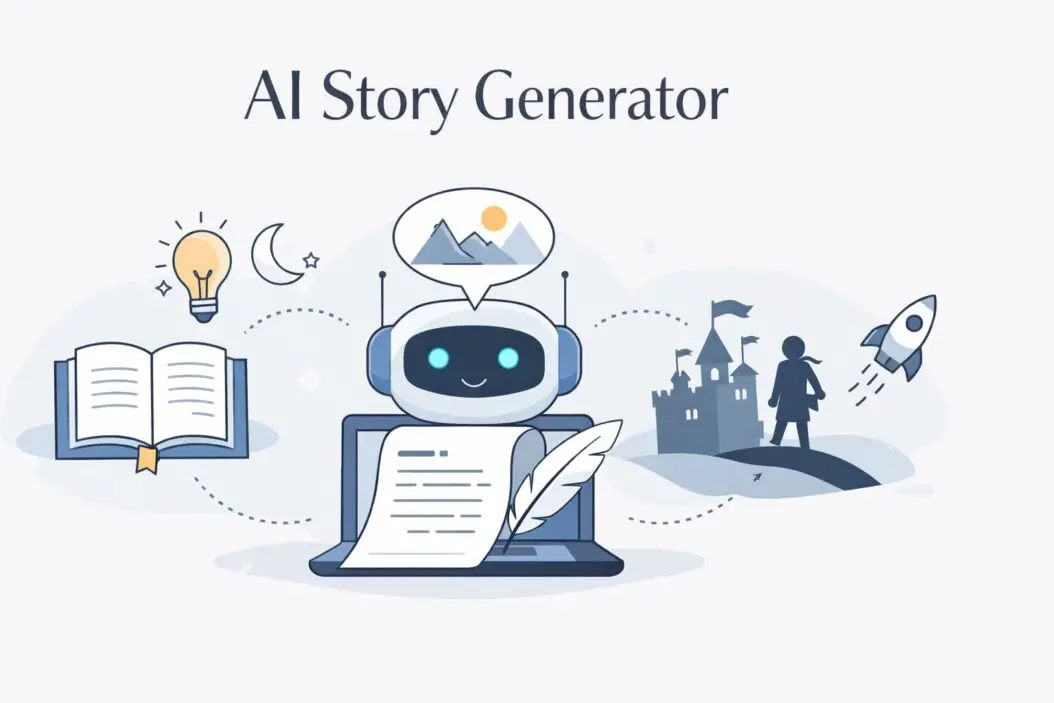
An AI story generator is software that uses artificial intelligence to create written narratives. You provide inputs like genre, characters, or plot points, and the AI produces complete stories, story outlines, or scene suggestions.
These tools use large language models trained on millions of texts. They understand story structure, character development, and writing styles. The technology has improved dramatically since 2024, with current generators producing coherent multi-chapter narratives that feel genuinely creative.
Why people use AI story generators:
- Speed: Generate a complete short story in under 60 seconds
- Idea generation: Break through creative blocks with fresh plot concepts
- Learning: Study story structure by analyzing AI-generated examples
- Content production: Create multiple story variations quickly
- Experimentation: Test different genres without time investment
Best AI Story Generators in 2026
Here are the tools that actually deliver quality results right now:
1. Claude (Anthropic)
Claude Sonnet 4.5 excels at creative writing with natural dialogue and consistent character voices. It handles complex narratives and maintains plot coherence across long stories. The context window allows for entire novel chapters in one generation.
Best for: Literary fiction, character-driven stories, dialogue-heavy narratives
2. ChatGPT (OpenAI)
GPT-4 and GPT-4o create engaging stories across all genres. The tool adapts well to specific style requests and can mimic different author voices. Custom instructions let you set permanent preferences for tone and structure.
Best for: Genre fiction, commercial storytelling, quick drafts
3. Sudowrite
Built specifically for fiction writers. Offers targeted tools like “Story Engine” for plot development and “Describe” for sensory details. The interface guides you through story creation step by step.
Best for: Novelists, serious fiction writers, collaborative writing
4. NovelAI
Specializes in interactive storytelling with memory features that track characters and plot points. Supports long-form fiction with consistent world-building across chapters.
Best for: Fantasy, science fiction, serialized stories
5. Jasper
Strong commercial writing focus with templates for different story types. Fast generation speeds and team collaboration features make it practical for content creators.
Best for: Marketing stories, brand narratives, content teams
How AI Story Generators Actually Work
The process breaks down into clear steps:
Input Processing
You provide prompts containing story elements. The AI analyzes your request to identify genre, tone, characters, and plot requirements. More specific prompts produce better results.
Pattern Recognition
The AI references patterns from its training data. It recognizes that mysteries need clues and red herrings, romances need tension and resolution, thrillers need escalating stakes. It applies these patterns to your specific request.
Text Generation
The model predicts word sequences that fit your requirements. It builds sentences that follow grammatical rules, maintain narrative flow, and advance the plot logically.
Coherence Checking
Modern AI generators monitor their output for consistency. They track character names, plot details, and timeline logic to avoid contradictions within the story.
How to Use an AI Story Generator (Step by Step)
Follow this process to get usable results:
Step 1: Define Your Story Elements
Write down these components before prompting:
- Genre (mystery, romance, sci-fi, horror)
- Setting (time period, location, world details)
- Main characters (names, traits, motivations)
- Central conflict or problem
- Desired tone (dark, humorous, serious)
- Target length (flash fiction, short story, novel chapter)
Step 2: Write a Detailed Prompt
Bad prompt: “Write a story about a detective.”
Good prompt: “Write a 1500-word noir detective story set in 1940s Los Angeles. The protagonist is Marcus Cole, a cynical private investigator who discovers his latest missing person case connects to his own forgotten past. Include atmospheric descriptions and hard-boiled dialogue. End with a twist that reveals the missing woman is his daughter.”
Step 3: Generate and Review
Run your prompt. Read the output completely. Check for:
- Plot logic and consistency
- Character voice authenticity
- Pacing issues
- Clichéd phrases or predictable elements
- Factual errors or anachronisms
Step 4: Refine With Follow-Up Prompts
Don’t accept the first draft. Improve it with specific requests:
- “Rewrite the opening paragraph with more sensory details”
- “Make the dialogue between Marcus and the client more tense”
- “Add a scene showing Marcus investigating the warehouse”
- “Change the ending to be more ambiguous”
Step 5: Edit Manually
AI generates raw material. You transform it into polished writing. Focus on:
- Removing repetitive phrases
- Strengthening word choices
- Adding unique details only you would know
- Ensuring authentic human emotion
- Fixing awkward transitions
Prompting Techniques That Get Better Stories
These methods improve output quality significantly:
Genre-specific elements: “Include three false clues typical of locked-room mysteries” works better than “make it mysterious.”
Character constraints: “The protagonist never uses contractions and speaks in formal Victorian English” creates distinct voice.
Structural frameworks: “Use the hero’s journey structure with clear stages: ordinary world, call to adventure, refusal, mentor, crossing threshold” provides narrative scaffolding.
Sensory anchors: “Every scene should include specific smells and textures” grounds abstract stories in concrete details.
Emotional beats: “The story should move from hope to despair to cautious optimism” gives emotional architecture.
Style references: “Write in the sparse, punchy style of Elmore Leonard” or “Use the lyrical, metaphor-rich prose of Ocean Vuong” establishes clear aesthetic targets.
Common Problems and Real Solutions
Problem: Generic, Predictable Stories
The AI relies too heavily on common tropes. Stories feel like combinations of elements you’ve read before.
Solution: Add specific constraints that force originality. Instead of “write a vampire story,” try “write a story where vampires are real but boring office workers who drink synthetic blood and complain about paperwork.” Unusual combinations break predictable patterns.
Problem: Inconsistent Character Behavior
Characters act differently in different scenes without motivation. Their personality traits change randomly.
Solution: Create a character sheet first. Ask the AI to generate detailed character profiles before writing the story. Reference these profiles in your story prompt: “Use the character sheet above and ensure Marcus behaves consistently with his established fear of abandonment.”
Problem: Weak Dialogue
Conversations feel stilted or on-the-nose. Characters explain things they both already know.
Solution: Specify subtext. “Write dialogue where both characters want different things but neither states their goal directly. Include interruptions, topic changes, and things left unsaid.” This creates realistic tension.
Problem: Plot Holes and Logic Errors
Events happen without proper setup. Solutions appear without foreshadowing. Timelines don’t match.
Solution: Generate an outline first. Ask for a beat-by-beat plot summary. Review the outline for logic issues before requesting full prose. Fix structural problems early.
Problem: Purple Prose or Flat Writing
The AI either overloads description with flowery language or produces dry, reportorial text.
Solution: Provide sentence-level examples of your preferred style. “Match this rhythm and detail level: [paste 2-3 sentences from your favorite author].” The AI will calibrate to concrete examples better than abstract style instructions.
What AI Story Generators Cannot Do
Understanding limitations helps you use these tools effectively:
Original lived experience: AI cannot write authentically about experiences it has never had. Personal stories need human input.
Emotional authenticity: Generated emotion describes feelings but doesn’t evoke them. The resonance that makes readers cry or laugh comes from human revision.
Cultural nuance: AI often misses subtle cultural details, uses stereotypes, or makes assumptions that reveal its training data biases.
Unique voice: Every writer has a distinctive style shaped by their reading, thinking, and personality. AI produces competent prose but not YOUR voice without heavy editing.
Creative risk: AI optimizes for coherence and acceptability. It rarely makes bold, strange, boundary-pushing choices that define memorable literature.
Long-term vision: AI struggles with complex novels requiring dozens of interconnected plot threads, subtle foreshadowing across chapters, and thematic unity across 80,000+ words.
Legal and Ethical Considerations
These issues matter if you plan to publish or monetize AI-generated stories:
Copyright status: As of 2026, purely AI-generated text receives no copyright protection in most jurisdictions. You must add substantial human authorship to claim copyright. Courts evaluate this case by case.
Disclosure requirements: Some publishers and platforms require disclosure if AI contributed significantly to the work. Read submission guidelines carefully.
Training data concerns: AI models train on copyrighted works. Some authors and estates object to their writing being used this way. Legal battles continue in 2026.
Commercial use rights: Check the terms of service for your AI tool. Some restrict commercial use or require attribution. Violations can result in legal action.
Plagiarism detection: Advanced AI detectors can identify machine-generated text. Academic institutions and some publishers reject AI-written work. Substantial human revision helps avoid detection.
Attribution and transparency: Ethical practice suggests crediting AI assistance even when not legally required. Readers deserve to know how content was created.
Using AI Stories for Learning and Development
Story generators serve as powerful educational tools:
Structure analysis: Generate stories in different structures (three-act, hero’s journey, kishotenketsu). Study how each framework shapes narrative flow.
Style comparison: Request the same plot in different author styles. Notice how word choice, sentence rhythm, and description change the reading experience.
Dialogue practice: Generate conversation-heavy scenes, then rewrite the dialogue yourself. Compare your version to the AI’s. Identify strengths and weaknesses in both.
Rapid prototyping: Test 10 different plot variations in an hour. Find which premise has the most potential before investing writing time.
Genre convention study: Generate pure examples of genre tropes. Learn what makes a romance feel like romance or a thriller create tension. Apply these patterns consciously in your writing.
Overcoming fear: New writers often freeze facing the blank page. Generating an imperfect draft removes that pressure. You can edit bad writing. You cannot edit nothing.
Advanced Techniques for Serious Writers
These methods help professional-level story development:
Chain Prompting for Novels
Break novel creation into stages. Generate a premise, then expand it to an outline, then write chapter summaries, then draft individual chapters. This maintains coherence better than requesting entire novels at once.
Character Interview Method
Ask the AI to roleplay as your character. Interview them about their background, motivations, fears, and secrets. Use these responses to inform how the character behaves in your story.
Constraint-based Generation
Give the AI difficult constraints: “Write a complete story in exactly 100 words where every sentence starts with the next letter of the alphabet.” Constraints force creativity and produce unexpected results.
Hybrid Collaboration
Write key scenes yourself. Use AI to generate connecting material, description, or alternate versions of scenes you’re struggling with. Keep the important moments human-written.
Prompt Libraries
Build a collection of effective prompts for different story needs. When you get great results, save that prompt template. Refine it over time. According to Stanford research on creative AI use, systematic prompt development significantly improves output quality.
Comparing AI Story Output Quality
This table shows realistic expectations for different generators based on 2026 testing:
| Tool | Plot Coherence | Dialogue Quality | Style Flexibility | Length Capability | Creativity Score |
|---|---|---|---|---|---|
| Claude Sonnet 4.5 | Excellent | Excellent | High | 100K+ words | 8.5/10 |
| ChatGPT-4o | Excellent | Very Good | High | 50K words | 8/10 |
| Sudowrite | Very Good | Good | Medium | Unlimited | 7.5/10 |
| NovelAI | Good | Good | Medium | Unlimited | 7/10 |
| Jasper | Good | Fair | Low | 20K words | 6/10 |
Future Developments to Watch
The technology continues advancing rapidly:
Personalization models: Tools that learn your specific writing style from samples you provide. Expected late 2026 releases will generate prose that genuinely sounds like you wrote it.
Multi-modal storytelling: Integration of image, audio, and video generation with text. Complete multimedia story packages from single prompts.
Collaborative AI: Systems that ask clarifying questions, suggest alternatives, and participate in back-and-forth creative discussion rather than single-prompt generation.
Genre-specific training: Models trained exclusively on mystery novels or romance or literary fiction, with deep understanding of genre-specific conventions and reader expectations.
Ethical sourcing: New models trained only on licensed, compensated, or public domain texts in response to copyright concerns and creator advocacy.
Real-time editing: AI that watches you write and offers suggestions, alternatives, or continuations as you type. Seamless integration with writing software like Scrivener and Google Docs.
Summary
AI story generators are practical tools for creating narrative content quickly. They work best when you provide detailed prompts, review output critically, and edit substantially. Current leaders include Claude Sonnet 4.5 for literary quality, ChatGPT for versatility, and Sudowrite for serious novelists.
Use these tools to overcome writer’s block, explore story possibilities, and learn narrative structure. Understand their limitations around originality, emotional depth, and cultural nuance. Always add significant human creativity through revision and personal insight.
The technology serves writers best as a collaborative partner, not a replacement. Your unique perspective, lived experience, and creative vision transform generic AI output into genuine literature. The generator provides raw material. You provide the artistry.
Research from MIT’s comparative study on AI-assisted creativity shows that writers who treat AI as a drafting assistant while maintaining creative control produce higher-quality work than those who rely on AI completely or reject it entirely. The balance matters.
Frequently Asked Questions
Can I publish stories written by AI?
Yes, but with important qualifications. You can publish AI-assisted work if you add substantial human authorship through editing, revision, and creative input. Pure AI output without human modification has questionable copyright status and many publishers reject it. Always check specific publisher guidelines and disclose AI use when required. The key is making the work genuinely yours through significant human contribution.
How do I avoid AI-generated stories sounding generic?
Provide extremely specific prompts with unusual combinations of elements. Add constraints that force originality. Edit heavily to remove clichéd phrases and predictable plot points. Insert personal observations, unique details from your life, and unexpected metaphors. The more you customize prompts and revise output, the less generic the final story becomes. Generic input produces generic output, while specific, weird prompts create distinctive stories.
What’s the best free AI story generator?
ChatGPT offers the best free tier in 2026 with access to GPT-4o mini. Claude provides generous free usage of Sonnet 4.5 through the web interface. Both handle complex story requests well. For pure story generation without conversation limits, NovelAI has a limited free trial. Completely free unlimited access doesn’t exist for quality generators, but the free tiers of major AI assistants work well for most casual storytelling needs.
Do AI story generators steal from published authors?
AI models train on large text datasets that include copyrighted works, raising legitimate ethical concerns. The models learn patterns and structures rather than memorizing specific texts, but the line between learning from and copying remains legally contested in 2026. Some authors object to their work being used for training without compensation. Using AI generators doesn’t directly steal, but the training process raises unresolved questions about creative labor and intellectual property rights.
How long does it take to generate a complete story?
Simple short stories (500-1500 words) generate in 30-90 seconds with current AI tools. Complex multi-chapter stories require multiple prompts and take 15-30 minutes to develop fully. Novel-length works need hours of iterative prompting, generation, and revision across multiple sessions. The generation itself is fast but developing a polished, coherent long-form story requires significant time investment in prompt refinement and editing regardless of AI speed.

- How to Uninstall Apps from the Start Menu in Windows 11/10 (2026 Guide) - April 2, 2026
- How to Fix Overscan on Windows 11/10: Stop Your Screen Getting Cut Off (2026) - April 1, 2026
- How to Disable Lock Screen on Windows 11/10 in 2026 - April 1, 2026