
Blockchain is a digital record-keeping system that stores information in connected blocks. Each block contains data, a timestamp, and a link to the previous block. This chain structure makes it extremely difficult to change old information without being detected.
Think of it like a shared notebook that many people maintain together. Everyone has an identical copy. When someone wants to add a new page, everyone must agree it’s valid before it gets added. Once added, that page is locked in place and connected to all previous pages.
If someone tries to change page number 5, the connection to page 6 breaks immediately. Everyone notices. This transparency and security are why blockchain matters for so many industries today.
What is Blockchain? The Core Concept
A blockchain is a type of distributed database. “Distributed” means many computers hold copies instead of one central server. The database stores information permanently and in a way that’s nearly impossible to alter retroactively.
The word itself tells you how it works. Information gets stored in “blocks.” These blocks are “chained” together using cryptographic math. When a new block is created, it contains a unique fingerprint (called a hash) of the previous block. This creates an unbreakable chain going back to the very first block.
Here’s what happens when you add something to a blockchain:
- A person requests a transaction or data entry
- The network of computers validates this request
- The data gets bundled into a new block
- Cryptographic math links this block to the previous one
- The new block gets added to every copy of the chain
- Everyone’s records now match and stay synchronized
This process ensures accuracy and honesty without needing a bank, government, or company to supervise everything.
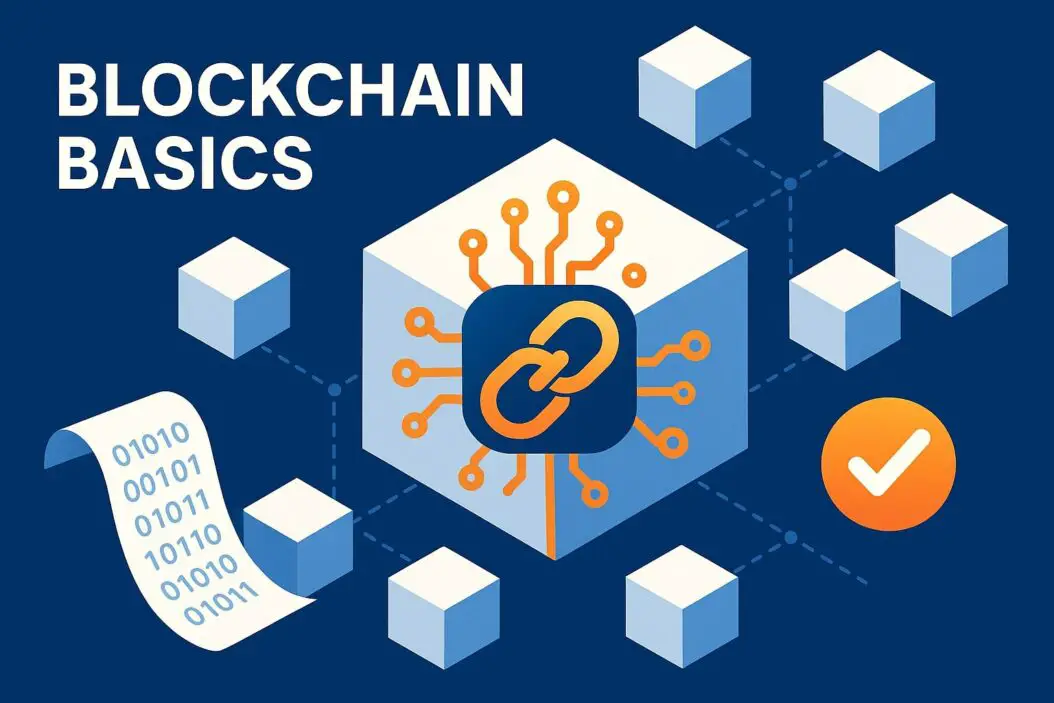
How Blockchain Actually Works: The Technical Process
The Block Structure
Each block contains three essential parts:
Data: This is the information being stored. It could be cryptocurrency transactions, medical records, property ownership, or any other information that needs permanent recording.
Timestamp: The exact date and time the block was created. This proves when the information was recorded.
Hash: A unique string of characters generated by running the block’s data through a mathematical algorithm. Even changing one letter in the data would create a completely different hash. Think of it as the block’s unique fingerprint.
How Blocks Connect
Here’s the critical part that makes blockchain secure. Each new block includes the hash of the previous block. This creates a chain where every block points backward to the one before it.
If someone tries to change data in block 5, its hash changes. Now block 6’s pointer no longer matches. Block 6 then becomes invalid. And block 7 becomes invalid too. And block 8. And so on. The tampering becomes immediately obvious to everyone.
To successfully cheat the system, someone would need to recalculate every single block after the one they changed, do this faster than the rest of the network is adding new blocks, and do this on more than half the computers in the network simultaneously. This is mathematically impractical.
Network Validation
When someone wants to add a new block, the network must verify it’s legitimate. This is where different blockchain systems differ, but the concept stays the same.
In some blockchains, computers compete to solve a difficult math puzzle. The first to solve it gets to add the next block. This method is called “proof of work.”
In others, computers take turns or are randomly selected based on how much cryptocurrency they hold. These are called “proof of stake” systems.
Either way, multiple computers must agree the transaction is valid before it becomes permanent. No single person or company decides what gets recorded.
Key Characteristics That Make Blockchain Special
Decentralization
Traditional databases have one owner or company controlling them. A hospital manages patient records. A bank manages your account. A government manages property titles.
Blockchain works differently. No single entity controls the system. Instead, the network itself enforces the rules through mathematics and consensus.
This matters because it removes the need to trust one organization. You don’t trust the blockchain itself. You trust the system because it’s mathematically impossible to cheat without being noticed.
Immutability
Once information is recorded on a blockchain, changing it is virtually impossible without massive computational effort and network consensus.
This makes blockchain useful for situations where a permanent record matters. Proving you paid for something. Proving you earned a credential. Proving you own property. All of these benefits from immutable records that nobody can secretly modify.
Transparency
Every transaction on a blockchain is visible to everyone on the network. Anyone can download and verify the entire history.
This doesn’t mean identities are always visible. In Bitcoin, you see wallet addresses rather than names. But you can see exactly how much cryptocurrency moved between any two addresses and when.
For businesses or governments, this creates accountability. Someone can’t claim a transaction happened differently than it actually did. The record speaks for itself.
Security Through Cryptography
Blockchain uses advanced mathematical encryption to secure information. Each user has a public key (like an email address that anyone can see) and a private key (like a password only you know).
When you send something on a blockchain, you “sign” it with your private key. This creates proof that it came from you and hasn’t been modified in transit. Others verify your signature using your public key, but they can’t forge your signature without knowing your private key.
This cryptographic security means blockchain doesn’t need a bank verifying every transaction. The math does the verification automatically.
Real World Examples of Blockchain in Use
Cryptocurrency
Bitcoin was the first practical application of blockchain. It lets people send money directly to each other without banks in the middle. The blockchain records every transaction permanently.
When you send Bitcoin, the transaction gets broadcast to thousands of computers. They verify you actually have the Bitcoin you’re sending. Then they add your transaction to the blockchain. You can’t spend the same Bitcoin twice because the permanent record prevents it.
Healthcare Records
Some hospitals are testing blockchain for medical records. Instead of each hospital keeping separate records, a blockchain could create one shared record that follows the patient.
A patient grants doctors permission to access their records through cryptographic keys. The permanent history shows exactly who accessed what information and when. If a doctor claims they reviewed your test results, that claim can be verified against the blockchain.
Supply Chain Tracking
Companies use blockchain to track products from factory to store. Each step in the journey gets recorded. Retailers can prove food actually came from the farm they claim. Manufacturers can prove a diamond wasn’t conflict sourced.
Consumers can scan a product’s QR code and see the entire history on the blockchain.
Property and Deed Recording
Some countries are testing blockchain for property records. Instead of wondering if your deed is safe in a government office, property ownership could be recorded on a blockchain.
This is especially valuable in countries with weak property systems or high corruption. The blockchain creates a permanent, transparent record of who owns what.
Types of Blockchain
Public Blockchains
Anyone can join, read the entire history, and submit transactions. Bitcoin and Ethereum are public blockchains.
The advantage is complete openness. Nobody can secretly change the rules. The disadvantage is slower transaction speeds because thousands of computers must reach agreement.
Private Blockchains
Only approved members can participate. A company or organization controls who joins and who sees what information.
This is faster and more efficient for businesses. But it reintroduces the trust problem. You’re trusting the company running the blockchain instead of trusting mathematics.
Many companies use private blockchains internally while others use public ones.
Hybrid Blockchains
These combine public and private elements. Some data is visible to everyone. Other data is restricted to approved members.
A healthcare blockchain might be private for patient privacy but public for verifying the integrity of records.
Blockchain vs Traditional Databases
| Feature | Blockchain | Traditional Database |
|---|---|---|
| Ownership | Distributed among network | Controlled by one entity |
| Data Change | Extremely difficult | Easy if you have access |
| Verification | Mathematical consensus | Trusted administrator |
| Speed | Slower (multiple validations) | Faster |
| Cost | Decentralized (no middleman) | Centralized (one manager) |
| Transparency | Complete (everyone sees) | Limited (only owner decides) |
| Downtime Risk | Very low (thousands of copies) | Higher (single point failure) |
Common Misconceptions About Blockchain
Misconception 1: Blockchain Equals Bitcoin
Bitcoin uses blockchain technology, but blockchain is much broader. It’s like saying the internet equals email. Email uses the internet, but the internet powers many applications.
Blockchain can track property, medical records, supply chains, and countless other things. Bitcoin is just one application.
Misconception 2: Blockchain is Completely Anonymous
The technology can be anonymous or transparent depending on implementation. Bitcoin shows all transactions publicly but uses wallet addresses instead of names. Healthcare blockchains might restrict who sees what.
Blockchain doesn’t automatically create privacy. It creates transparency and immutability. How that information is used depends on the system design.
Misconception 3: Blockchain is Unhackable
Blockchain is very secure, but it’s not impossible to attack. If someone gained control of more than half the computers in a network, they could potentially alter records. For large public blockchains like Bitcoin, this would cost billions of dollars and be immediately noticed. But it’s theoretically possible.
Blockchain security comes from making attacks impractical and obvious, not from being absolutely impossible.
Misconception 4: Blockchain Will Replace Everything
Blockchain solves specific problems: situations needing transparency, permanent records, and decentralized agreement. It doesn’t make sense for everything.
If you need a fast database that one company controls, a traditional database works perfectly fine. Not every application needs decentralization.
Why Blockchain Matters Now
The fundamental problem blockchain solves is trust between parties who don’t know each other.
Historically, we’ve used middlemen to solve this. Banks verify you have money before transferring it. Title companies verify property ownership before recording deeds. Governments verify credentials before issuing licenses.
These middlemen charge fees, can make mistakes, can be corrupted, and create single points of failure. If the bank’s records get hacked, you lose proof of your money.
Blockchain lets people verify things directly without middlemen. The network itself becomes the trusted authority through mathematics and consensus.
This matters most in situations with weak institutions, high corruption, expensive middlemen, or where multiple parties need shared records they can’t secretly change.
For rich countries with strong institutions and cheap banking systems, blockchain offers less immediate benefit. For developing nations, healthcare systems, supply chains, and property recording in weak regions, blockchain offers significant advantages.
Getting Started Understanding Blockchain Better
If you want to go deeper on blockchain, focus on these specific areas:
Cryptography basics help you understand how blockchain creates security without central authority. Understanding public key encryption makes the whole system click. Resources like Khan Academy’s introduction to cryptography provide solid foundations.
Specific use cases matter more than abstract theory. Pick an industry (healthcare, supply chain, real estate) and learn how blockchain specifically helps there. This makes the technology concrete rather than theoretical.
Hands-on experimentation beats passive reading. Create a wallet, send small amounts of cryptocurrency, or explore blockchain explorers that let you view actual transactions. Seeing real data changes your understanding dramatically.
Summary
Blockchain is a distributed database that stores information in connected blocks protected by cryptographic math. It lets people maintain shared, unchangeable records without needing a central authority.
The core innovation is solving the trust problem through mathematics and consensus. Instead of trusting a bank or government to keep accurate records, you trust that changing records would be immediately noticed and would require impossible computational work and network consensus.
Blockchain excels at creating permanent records, proving ownership, enabling transparency, and letting untrusted parties work together. It’s slower and more complicated than traditional databases, so it makes sense only where these benefits matter more than speed and simplicity.
Bitcoin and Ethereum proved blockchain works in practice. Today it’s expanding into healthcare, property records, supply chains, and many other fields.
The technology won’t replace everything. It’s not a solution searching for problems. But for specific situations requiring transparency, permanent records, and decentralized agreement, blockchain offers advantages that traditional systems can’t match.
Understanding blockchain means understanding a fundamental shift in how we can create trust and verify information without centralized authorities.
Frequently Asked Questions
Is blockchain the same as cryptocurrency?
No. Blockchain is the technology. Cryptocurrency is one application of blockchain. You can use blockchain for thousands of things that have nothing to do with money.
Can blockchain records be deleted?
No, not practically. Records stay on the blockchain permanently. This is a feature when you want permanent proof but a limitation if someone wants their data erased.
How much does it cost to use blockchain?
It varies dramatically. Some public blockchains charge small fees per transaction. Private blockchains might require significant infrastructure investment. The cost depends on which system you use and how much data you record.
Can regular people use blockchain?
Yes. You can use public blockchains without special permission. You might need to learn some new concepts and tools, but anyone with a computer and internet can participate.
What’s the difference between blockchain and cloud storage?
Cloud storage keeps your files on servers you don’t control. The provider could change data, get hacked, or go out of business. Blockchain distributes identical copies across thousands of computers. No single provider controls it. The tradeoff is that blockchain is slower and more complicated.

- How to Check Samsung Warranty in 2026: Complete Step-by-Step Guide - April 3, 2026
- How to Access Computer Configuration Settings in Windows 11/10 - April 3, 2026
- How to Check ASUS Warranty Status in 2026 (Step-by-Step) - April 3, 2026