
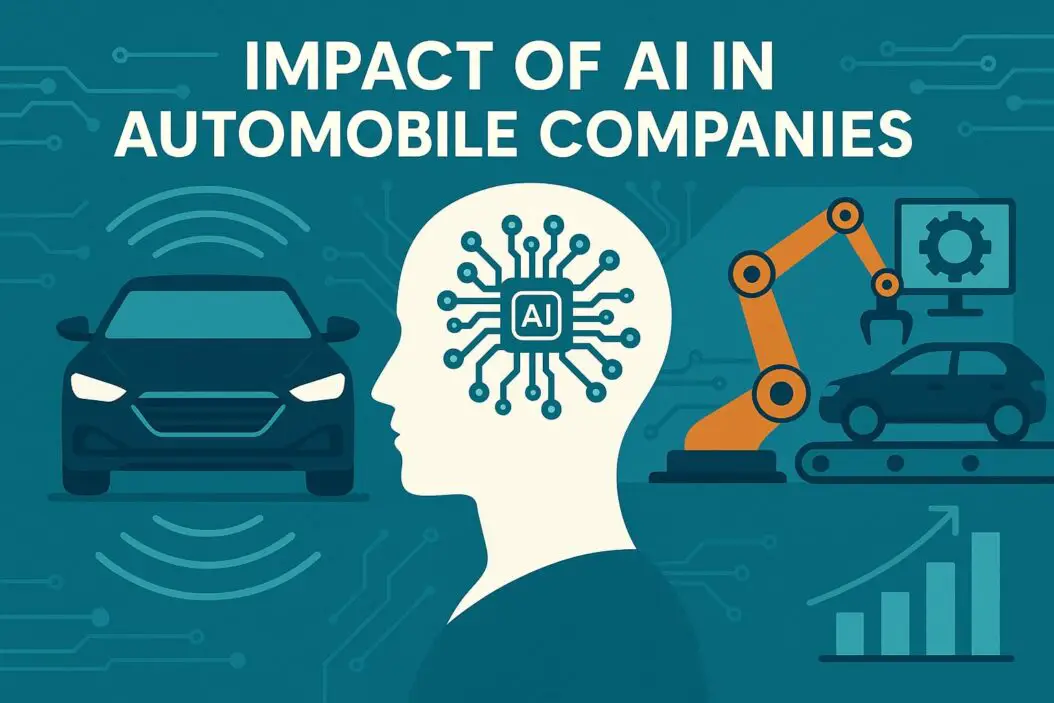
AI is fundamentally reshaping how automobile companies operate. It’s improving manufacturing efficiency, accelerating vehicle design, enhancing safety systems, and creating competitive advantages that directly impact profit margins. Most major automakers now use AI across production, quality control, and autonomous driving development. The real impact? Faster time to market, fewer defects, reduced costs, and vehicles that are measurably safer.
What AI Actually Does in Automobile Manufacturing
AI isn’t replacing your factory. It’s making existing factories smarter and more efficient. Here’s how:
AI systems analyze production data in real time. When something goes wrong, AI catches it before it becomes a major problem. This reduces waste and keeps assembly lines running smoothly.
Predictive maintenance is one of the biggest wins. AI monitors equipment and predicts failures before they happen. This prevents unexpected downtime that can cost manufacturers millions of dollars per day.
Quality control has improved dramatically. Computer vision systems powered by AI can inspect thousands of vehicle components per hour. They catch defects that human inspectors might miss. Toyota and BMW now use AI vision systems in their production lines.
Design and engineering cycles are faster. AI helps simulate crash tests, aerodynamics, and durability testing virtually before building physical prototypes. This saves time and money.
How AI Improves Vehicle Safety and Performance
Modern vehicles are becoming sensor-rich machines. AI interprets data from cameras, radar, and lidar sensors to make driving decisions.
Advanced Driver Assistance Systems (ADAS) use AI to prevent accidents. These include automatic emergency braking, lane-keeping assistance, and collision avoidance. These systems have proven to reduce accident rates significantly.
Autonomous driving development relies entirely on AI. Companies like Tesla, Waymo, and traditional manufacturers invest heavily in machine learning models that can understand complex driving scenarios.
Predictive analytics help manufacturers understand failure patterns. If a specific part fails more often than expected, AI flags it. Engineers can then redesign before the problem becomes widespread in the field.
Supply Chain Optimization Through AI
Supply chain disruptions cost automakers billions annually. AI provides visibility and control.
AI forecasting models predict demand more accurately. This helps manufacturers order the right number of components at the right time. When Tesla faced semiconductor shortages, companies using AI-driven forecasting adapted faster than competitors.
Logistics optimization reduces transportation costs. AI determines the most efficient routes and storage strategies. Some manufacturers report 10 to 15 percent reductions in logistics expenses.
Supplier management improves when AI monitors supplier performance. If a supplier starts shipping lower-quality parts or missing deadlines, AI alerts procurement teams immediately.
Real Examples: How Major Automakers Use AI
| Company | AI Application | Business Impact |
|---|---|---|
| BMW | AI-powered paint line inspection | 40% reduction in paint defects |
| Tesla | Machine learning for quality control | Real-time production monitoring |
| Ford | Predictive maintenance on robotics | $40+ million annual savings |
| Volkswagen | AI supply chain forecasting | Reduced shortage incidents by 35% |
| General Motors | Vision systems for assembly | 99.5% defect detection accuracy |
Ford’s predictive maintenance investment shows the ROI potential. By monitoring 28,000 robots across factories, they predict failures before they happen. The result: fewer unplanned production stops and significant cost savings.
BMW implemented AI-driven paint line inspection on their assembly lines. The system inspects every vehicle for paint defects in real time. Defect rates dropped 40 percent compared to traditional human inspection.
Tesla continuously improves quality through machine learning. Every vehicle’s test data feeds into their system. The algorithm learns patterns and helps identify systematic issues before they affect many vehicles.
Cost Implications and Financial Impact
Here’s what companies care about: cost and profit.
Manufacturing costs decrease when AI reduces defects, equipment downtime, and material waste. A single prevented production line failure can save a manufacturer $100,000 to $500,000 in a single day.
Development timelines compress. Shorter design cycles mean faster product launches. Getting a new model to market faster generates revenue earlier.
Labor costs don’t disappear, but they shift. Workers move from repetitive inspection tasks to more skilled positions like AI system monitoring and maintenance.
Warranty costs drop. Fewer defects mean fewer warranty claims. This directly improves profitability.
Fuel efficiency improvements from AI-optimized designs reduce environmental impact and help manufacturers meet emissions standards worldwide.
Challenges Automobile Companies Face With AI
Implementation isn’t simple. Here are real obstacles:
Data Quality Issues: AI needs massive amounts of clean, labeled data. Collecting this data from manufacturing takes time and investment.
Integration With Legacy Systems: Many factories run on older equipment and software. Connecting this to AI systems requires significant infrastructure investment.
Talent Shortage: Finding engineers who understand both automotive manufacturing and AI is difficult. Competition for this talent is intense.
Cybersecurity Risks: Connected systems create new vulnerabilities. A cyberattack on a production line could be catastrophic.
Regulatory Uncertainty: Different countries have different rules about autonomous driving and AI usage. This complicates global deployment.
High Initial Investment: Setting up AI infrastructure costs millions. Smaller suppliers and manufacturers struggle with this barrier to entry.
The Future: What’s Coming Next
Autonomous vehicles represent the next frontier. Most major manufacturers have autonomous driving divisions. The timeline remains uncertain, but the investment is massive.
AI will increasingly manage entire supply chains autonomously. Instead of humans making decisions, algorithms will optimize procurement, production, and logistics continuously.
Personalization through AI will accelerate. Future vehicles might adjust performance characteristics, interfaces, and features based on individual driver preferences learned over time.
Integration with smart city infrastructure will expand. Vehicles will communicate with traffic systems, parking infrastructure, and other vehicles to optimize traffic flow and safety.
Key Takeaways
AI is transforming automobile companies from manufacturing-focused businesses to technology-driven enterprises. The companies that master AI adoption will have significant competitive advantages. They’ll produce higher-quality vehicles faster and more cheaply than competitors.
The change is already happening. It’s not a future possibility. It’s a present reality affecting how vehicles are built, sold, and serviced today.
For workers and industry professionals, this means understanding AI applications is becoming necessary. For consumers, better quality and safety features are tangible benefits arriving now.
Frequently Asked Questions
Will AI eliminate factory jobs in automobile manufacturing?
Some repetitive positions will change, but manufacturing employment is shifting toward technical roles rather than disappearing entirely. Historically, factory automation has changed job types more than reducing overall employment in the automotive sector.
How does AI improve vehicle safety?
AI processes sensor data from cameras and radar to detect hazards, apply brakes, and avoid collisions in real time. These systems have measurably reduced accident rates in vehicles equipped with advanced driver assistance systems.
Is AI production-ready in automobiles now?
Yes. AI systems are actively used in manufacturing, quality control, and vehicle safety features in current models from major manufacturers. This isn’t experimental technology.
What’s the biggest challenge for AI adoption in automaking?
Integration with existing factory infrastructure and the shortage of engineers with expertise in both automotive manufacturing and AI are the primary obstacles facing most manufacturers.
How long until fully autonomous vehicles are common?
Timeline remains uncertain despite significant investment. Technical challenges remain, and regulatory frameworks are still developing. Most experts project wider availability within 5-10 years, but this depends on solving safety, legal, and ethical issues.
Summary
The impact of AI in automobile companies is substantial and measurable. Manufacturing is more efficient. Quality improves. Products get to market faster. Vehicles are safer. These aren’t theoretical benefits. They’re happening now at Ford, BMW, Tesla, Volkswagen, and other major manufacturers.
Companies investing in AI are gaining competitive advantages that will compound over time. The technology addresses real business problems: reducing costs, preventing defects, optimizing supply chains, and accelerating development. For the automotive industry, AI represents the most significant technological shift since computers entered manufacturing decades ago.
The question isn’t whether AI will impact automobile companies. It’s whether individual companies can implement it effectively enough to compete in an industry where AI capability increasingly determines market position.

- How to Fix Overscan on Windows 11/10: Stop Your Screen Getting Cut Off (2026) - April 1, 2026
- How to Disable Lock Screen on Windows 11/10 in 2026 - April 1, 2026
- Top 7 NFT Integration Ideas for Brands in 2026 - March 31, 2026