
Choosing the right digital camera lens is one of the most important decisions in photography. Most people buy a camera body and then struggle with lens selection for months. This guide cuts through the confusion and helps you understand exactly what different lenses do and which one fits your needs.
The short answer: Start with one versatile zoom lens. Then add specialized lenses only when you’ve identified what you actually want to photograph.
This article covers the real differences between lens types, what each one does well, and how to make smart choices without overspending.
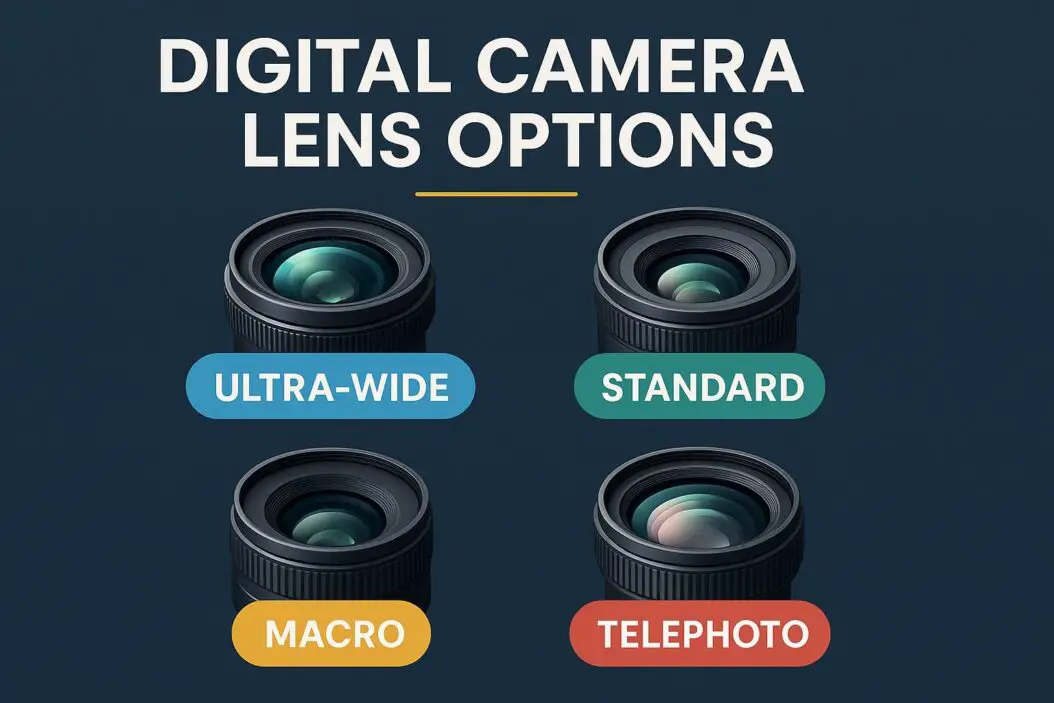
What Digital Camera Lenses Actually Do
A lens takes light from your subject and focuses it onto your camera’s sensor. Different lenses bend light in different ways. This creates different effects in your photos.
Three main things matter:
Focal length controls how much of a scene you see. Short focal lengths show more. Long focal lengths show less but magnify it.
Aperture is the lens opening. Wider openings let in more light. This helps in dim conditions. It also creates blurry backgrounds.
Zoom means the focal length can change. Fixed focal length lenses do one thing extremely well. Zoom lenses are flexible but not quite as specialized.
Understanding these basics helps you stop guessing and start choosing lenses that match what you photograph.
Focal Length Explained: What Different Numbers Mean
Focal length is measured in millimeters (mm). Common ranges go from 10mm to 600mm and beyond.
Wide Angle Lenses (10mm to 35mm)
Wide angle lenses see much more of the scene. They’re perfect for landscapes, architecture, and tight indoor spaces.
These lenses create a distinctive look. Objects close to the camera appear large. Objects far away appear small. This creates drama and depth in your images.
Wide angle lenses work brilliantly for:
- Landscape photography where you want to capture expansive views
- Real estate photos of rooms and buildings
- Travel photography in confined spaces like alleyways
- Group photos when you need everyone in the frame
A 24mm lens is incredibly versatile. The 16mm to 35mm range handles most wide situations well.
Standard/Normal Lenses (35mm to 70mm)
These focal lengths match roughly what your eye sees naturally. The image looks normal, not stretched or compressed. This range includes 50mm lenses, which photographers consider the most versatile focal length ever made.
Standard lenses excel at:
- Everyday photography without distortion
- Street photography and candid moments
- Portrait backgrounds that look natural
- General purpose shooting when you’re unsure what you’ll encounter
A 50mm lens with a wide aperture (like f/1.8) costs under $300. It’s the cheapest way to get excellent image quality and learn photography fundamentals. Many professionals own multiple 50mm lenses because they’re so reliable.
Telephoto Lenses (70mm to 600mm+)
Telephoto lenses magnify distant subjects. They compress the scene, making faraway objects appear closer together.
Wildlife photographers use 400mm to 600mm lenses. Sports photographers use 70mm to 200mm. Portrait photographers often prefer 85mm to 135mm because they’re far enough back to get flattering facial proportions.
Telephoto lenses work well for:
- Wildlife and bird photography
- Sports and action photography
- Portrait photography with compressed backgrounds
- Distant subjects you cannot approach closely
The 70mm to 200mm range is the most useful telephoto for beginners.
Aperture: f-stops and Light
Aperture controls how wide the lens opens. It’s written as f/2.8 or f/5.6. Smaller numbers mean wider openings and more light.
f/1.4 to f/2.8 are considered wide apertures. These lenses cost more but excel in low light. They also create very blurry, beautiful backgrounds.
f/4 to f/5.6 are moderate apertures. These balance cost and performance. Many zoom lenses use this range.
f/8 and smaller apertures let in less light. They keep more of your image sharp from foreground to background. These work best outdoors in good light.
Why Aperture Matters
A lens with f/2.8 aperture gathers roughly four times more light than f/5.6. In a dark room, f/2.8 works without a flash. f/5.6 requires very high ISO, creating grainy photos.
Wide apertures also create shallow depth of field. This is the blurry background you see in professional portraits. Narrow apertures keep everything sharp.
Prime Lenses vs Zoom Lenses
Prime lenses have fixed focal lengths. 50mm always stays 50mm. You move closer or farther to frame your shot.
Advantages of primes:
- Typically cheaper than zooms at the same aperture
- Often faster (wider aperture) than equivalent zooms
- Simpler optical design means sharper images
- More compact and lightweight
- Forces you to think about composition
Disadvantages:
- You must change position to frame differently
- Switching lenses takes time and risks dust on your sensor
- Heavier camera bag with multiple primes
Zoom lenses change focal length. A 24mm to 70mm lens covers that entire range without switching.
Advantages of zooms:
- One lens covers many situations
- Fast to reframe without moving
- Lighter bag with one lens instead of five
- Great for travel and hybrid shooting
Disadvantages:
- More expensive than similar quality prime
- Usually slower aperture
- Slightly heavier and larger per focal length
- More complex optics can introduce distortion
Real talk: Beginners should start with a zoom lens. You’ll learn what focal lengths you actually use. Then you can add specialized primes later.
Common Lens Types and Their Specific Uses
All-Purpose Zoom Lenses (24mm to 200mm)
These cover wide to mild telephoto in one lens. They’re the most practical choice for someone learning photography. You can photograph landscape, people, and distant subjects without changing lenses.
Quality all-purpose zooms cost $200 to $400. They’re not the absolute best at any one thing, but they’re genuinely good at everything.
Ultra-Wide Zoom Lenses (10mm to 24mm)
These extreme wide angles create dramatic images. They’re essential for real estate and landscape work. But casual photographers rarely need them.
Telephoto Zoom Lenses (70mm to 300mm)
These magnify distant subjects without being huge or expensive. They’re perfect for sports, wildlife, and action. A 70mm to 200mm or 70mm to 300mm zoom covers most situations where you need magnification.
Macro Lenses
Macro lenses focus extremely close, photographing tiny subjects at large magnification. They’re specialized tools. Only get one if you actually photograph small things regularly.
Specialty Lenses
Tilt-shift lenses correct converging lines in architecture photos. Fisheye lenses create extreme distortion for artistic effect. These are expert tools. Don’t buy specialty lenses until you understand exactly what they do.
Sensor Size and Lens Compatibility
Your camera sensor size determines actual focal length in your photos.
Full-frame sensors are 36mm by 24mm. These are the standard in professional cameras.
Crop sensors (also called APS-C) are smaller, about 23mm by 15mm. They’re common in mid-range cameras.
A 50mm lens on a crop sensor acts like roughly 75mm on full-frame. This is because the crop sensor crops the image. Crop sensors multiply focal length by about 1.5x or 1.6x depending on the brand.
This isn’t better or worse, just different. Crop sensors make telephoto lenses reach farther. They make wide angles less wide.
When choosing lenses, check if they’re designed for your camera mount. A Canon EF lens doesn’t fit Nikon bodies.
How to Choose Your First Lens
Start here if you’re completely new to lens selection.
Step 1: Identify what you’ll photograph most. Landscapes? People? Sports? Travel? Your answer determines which focal length serves you best.
Step 2: Get one quality zoom lens covering your main range. A 24mm to 70mm lens handles landscape and people. A 70mm to 200mm handles action and distant subjects.
Step 3: Use that lens exclusively for two months. Learn what focal lengths you actually use. Track which distances you shoot from.
Step 4: Add a second lens only when you identify a real gap. Maybe you want wider angles, or more magnification, or better low-light performance.
This approach prevents buying lenses you never use.
Lens Quality: When It Actually Matters
Expensive lenses aren’t always better for beginners. But certain differences are real.
Build quality: Professional lenses use better seals against dust and weather. They feel more solid. This matters if you photograph outdoors frequently or travel.
Sharpness: Quality lenses are sharper, especially at the edges. For social media or small prints, this barely matters. For large prints or professional work, sharpness counts significantly.
Autofocus speed: Fast autofocus matters for sports and wildlife. It barely matters for landscapes or portraits where you have time.
Bokeh: This is the quality of the blurry background. Better lenses create smoother, more pleasing blur. This is noticeable in portraits with f/1.4 or f/1.8 apertures.
Practical advice: Buy a mid-range lens from a reputable brand. You’ll be genuinely happy. Don’t buy the cheapest option, but don’t overspend either.
Lens Costs and Smart Spending
Zoom lenses covering standard ranges (24mm to 70mm) cost $200 to $600 as kits or separately.
Fast primes (50mm f/1.8 or 35mm f/2.0) cost $100 to $300.
Telephoto zooms (70mm to 200mm) cost $300 to $800.
Professional quality zooms cost $1200 to $2500+.
The gear isn’t what makes the difference. A photographer with a $300 zoom lens and good fundamentals takes better photos than someone with $5000 in equipment and no skills.
Spend on glass that solves real problems. Don’t buy “just in case” lenses.
Comparing Lens Types: At a Glance
| Lens Type | Best For | Cost | Weight | Complexity |
|---|---|---|---|---|
| Standard zoom (24-70mm) | General purpose | $200-600 | Medium | Low |
| Ultra-wide (10-24mm) | Landscape, real estate | $400-1000 | Medium | Medium |
| Telephoto zoom (70-200mm) | Wildlife, sports | $300-800 | Heavy | Medium |
| Prime 50mm | Portraits, low light, learning | $100-300 | Light | Low |
| Prime 35mm | Street, travel, everyday | $150-400 | Light | Low |
| Macro | Close-up subjects | $400-900 | Light | High |
Common Mistakes to Avoid
Buying too many lenses too fast: This drains money and overwhelms you. One good lens teaches you more than five mediocre ones.
Chasing megapixels instead of aperture: A 24 megapixel camera with f/2.8 lens beats a 42 megapixel camera with f/5.6 lens for most shooting. Collect light, not pixels.
Assuming professional gear makes better photos: Technical skill matters infinitely more than equipment. Spend your money on practice and learning, not constantly upgrading.
Ignoring weight: A $3000 telephoto that stays home in the closet is worthless. A $400 zoom you actually carry matters more.
Buying specialty lenses before fundamentals: Learn with versatile lenses first. Specialized tools come later.
Lens Maintenance and Care
Clean lenses carefully. Use rocket blowers to remove dust before touching the glass. Never touch the rear or front glass with bare fingers.
Store lenses in a dry place. Use lens caps and rear caps always. Humidity and temperature extremes damage optical elements over time.
Check lens seals if you photograph outdoors frequently. Professional lenses handle weather better than kit lenses. The difference compounds over years of use.
Professional lens cleaning is worth the cost once yearly if you photograph regularly outdoors.
Summary
Digital camera lens selection doesn’t require spending thousands of dollars. It requires understanding what different lenses do and matching that to what you photograph.
Start with one versatile zoom covering the range you’ll use most. Use it exclusively for two months. Add a second lens only when you identify a specific limitation.
Quality matters, but practice matters infinitely more. A photographer with a $300 zoom and refined skills beats a photographer with $5000 in equipment and no fundamentals.
The best lens is the one you’ll actually use. This means considering size, weight, cost, and genuinely matching the lens to your real shooting needs.
Revisit your lens collection yearly. Remove lenses that stay unused. Invest in lenses that solve real problems you encounter repeatedly.
This thoughtful approach builds a practical collection that serves you well for years.
Frequently Asked Questions
Should I buy a kit lens or invest in better glass immediately?
Start with a kit lens or mid-range zoom. It’s enough to learn fundamentals without risking thousands of dollars if you discover photography isn’t for you. Better gear comes after you’ve used one lens extensively.
Is full-frame better than crop sensor for choosing lenses?
Both systems have excellent lenses. Full-frame provides better low-light performance and wider wide-angle options. Crop sensors are more affordable and make telephoto reach farther. Choose based on your primary shooting subject, not sensor size alone.
Can I use old manual lenses on new digital cameras?
Many older lenses physically fit modern cameras through adapters. However, autofocus won’t work, and the camera cannot control aperture. This works for manual focus specialties but not for general purpose photography.
What’s the difference between image stabilization in the lens versus the camera body?
Both reduce blur from camera shake. Lens stabilization only works with that lens. Body stabilization works with any lens. They work well together, making handheld shooting possible in very low light.
Should I wait for newer lens models before buying?
The best lenses remain excellent for 10+ years. Waiting endlessly means never shooting. Buy a quality lens now if it solves your current needs. Future models will always exist, but your creative moment is now.
