
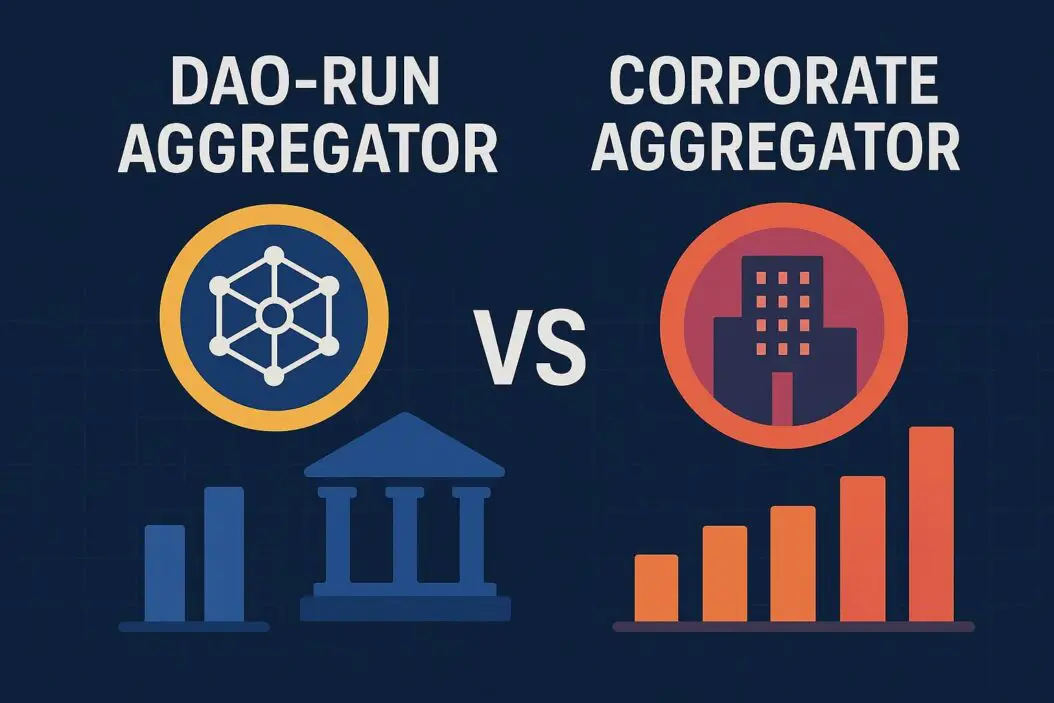
Here’s the straight answer: a DAO-run aggregator is controlled by a decentralized community through voting and shared ownership. A corporate aggregator is controlled by a company with centralized decision-making. That difference changes everything about how they operate, who profits, and what risks you take.
Both aggregate data from multiple sources into one place. But who owns the aggregator and who decides what happens next determines your actual experience using it.
Why This Matters Right Now
Blockchain and crypto tools are exploding. More platforms are collecting and selling data. Aggregators have become essential. But you need to know who controls the one you’re using because that affects your costs, your privacy, and whether you’re actually in control.
This guide breaks down both models so you can understand which one fits your situation.
DAO-Run Aggregators: How They Work
Community Ownership and Voting
In a DAO (Decentralized Autonomous Organization) aggregator, token holders make decisions. You buy or earn tokens. Your tokens give you voting power.
When the platform faces a big choice, token holders vote. Decisions could involve fee changes, new features, or protocol upgrades. The majority vote wins.
This creates transparency. Everyone can see how votes happened. The code often runs on blockchain, so the execution is immutable.
Revenue and Profit Distribution
DAO aggregators distribute profits back to token holders. Instead of money going to shareholders and executives, it flows to the community.
You might receive these rewards monthly or quarterly. The amount depends on how many tokens you hold and how much profit the aggregator generated.
Some DAOs also reward members for participating in governance or contributing to the platform. This encourages active involvement.
How Decisions Get Made
Everything runs through smart contracts. A smart contract is code that executes automatically when conditions are met. There’s no CEO deciding unilaterally.
The process usually works like this: someone proposes a change. The community discusses it. Token holders vote. If the vote passes, the smart contract executes the change.
This takes longer than corporate decision-making. But it ensures no single person or group can dominate.
Corporate Aggregators: The Traditional Approach
Single Owner and Control
A company owns and operates the aggregator. The CEO and board make decisions.
They decide what features to add, which data sources to include, how much to charge. One entity holds all control.
This is faster than DAO governance. The company can pivot quickly when market conditions change.
But it also means users have limited say. If you disagree with a policy, your only option is to leave.
Profit Goes to Shareholders and Executives
All revenue becomes company profit. Shareholders and employees share this money through dividends and salaries.
Users don’t see any direct profit. You pay for access, but the upside goes elsewhere.
The company structure incentivizes growth and market dominance. This sometimes benefits users (more resources for development). But it can also lead to cost increases without corresponding value improvement.
Hierarchical Decision Making
The CEO or executive team makes major decisions. They might consult stakeholders or customers, but final authority rests with leadership.
This creates accountability. Someone is responsible for the platform’s success or failure.
It also creates risk. If leadership makes poor choices, there’s no community vote to override them.
Key Differences in Practice
Cost and Fees
DAO aggregators: Fees are determined by community vote. Members often push for lower fees since they benefit from lower costs. Fees might be variable based on the platform’s financial needs.
Corporate aggregators: Fees are set by company pricing strategy. The goal is profit maximization. Prices can increase without notice. Competition determines the ceiling.
Corporate aggregators often charge more because they have higher overhead. They employ staff and pay for marketing. DAOs rely more on community contributions.
Security and Trust
DAO aggregators: Code is usually open source and auditable. Anyone can review the smart contracts. Bugs get caught faster through community scrutiny.
But DAOs have governance risks. A major token holder could influence votes. If the community makes bad decisions, the platform suffers.
Corporate aggregators: Security depends on the company’s track record and resources. Large corporations hire specialized security teams.
You’re trusting a company to protect your data. If they get hacked or make mistakes, you have legal recourse. But companies can also misuse data for profit.
Speed of Changes
DAO aggregators: Changes move slowly. Proposals need discussion, voting, and implementation. Urgent bugs might get fixed faster through emergency protocols, but routine updates take weeks.
Corporate aggregators: Changes happen quickly. The company can deploy updates overnight if needed. Responsive to market demands.
For critical issues, speed matters. For routine improvements, the difference is minor.
Customization and Features
DAO aggregators: Features reflect what the community votes for. This means features align with user needs. But niche features might never happen if the majority doesn’t want them.
Corporate aggregators: Features follow the company’s vision. Sometimes this creates innovative tools. Sometimes it means features nobody asked for.
A corporate team can also hire expert developers and invest in research. DAOs rely on volunteer or part-time contributors.
Comparison Table
| Factor | DAO-Run Aggregator | Corporate Aggregator |
|---|---|---|
| Control | Community via voting | Company leadership |
| Fees | Community-determined | Market-driven |
| Profit | Distributed to token holders | Retained by company |
| Decision Speed | Slower (voting required) | Fast (executive decision) |
| Code Transparency | Usually open source | Often proprietary |
| Customization | Community-driven features | Company-driven features |
| Accountability | Distributed to voters | Clear legal entity |
| Growth Capital | Limited to revenue | Access to investment |
| Governance Risk | Community votes poorly | Leadership makes bad calls |
| Support | Community-based | Professional support team |
Real World Scenarios
Scenario 1: You Need Fast Feature Development
A corporate aggregator wins here. A company can hire developers, set priorities, and ship features in weeks.
A DAO might discuss a feature request for months before voting. Implementation takes additional time.
If speed matters for your use case, corporate is better.
Scenario 2: You Want Lower Costs Long-Term
A DAO aggregator typically costs less. Token holders actively vote to keep fees low because they benefit.
A corporate aggregator increases prices as they optimize for revenue. Cost creep happens over years.
If you’re price sensitive and patient, DAO is better.
Scenario 3: You’re Concerned About Censorship
A DAO aggregator is harder to censor. No single entity can shut it down or remove your data. The blockchain makes changes immutable.
A corporate aggregator can ban you, delete your data, or change terms overnight.
If censorship resistance matters, DAO is better.
Scenario 4: You Want Professional Support
A corporate aggregator employs support teams. You can call someone or get help via official channels.
A DAO relies on community forums and volunteer support. You might wait longer or get inconsistent help.
If you need reliable support, corporate is better.
Common Misconceptions
“DAOs Are Always Better Because They’re Decentralized”
Not true. Decentralization creates different tradeoffs, not universal improvements. DAOs can make poor decisions through voting. They can also move slower and lack professional support.
“Corporate Aggregators Always Have Better Security”
Not necessarily. Open source smart contracts get thousands of eyes reviewing them. Corporate code often stays private, which can hide vulnerabilities.
A company can have poor security practices. A DAO can have excellent ones.
“DAO Tokens Always Make You Money”
Wrong. Token value depends on the aggregator’s success and adoption. Poor governance or slow development can crater token value.
You’re speculating on the platform’s future. This isn’t guaranteed income.
“Corporate Aggregators Are Evil Profit-Maximizers”
Oversimplified. Corporate structures create misaligned incentives, but many companies genuinely try to serve users well. A well-run company can be more efficient than a DAO stuck in governance debates.
How to Choose Between Them
Choose a DAO Aggregator If
You value community control and long-term cost savings. You’re patient with slower decision-making. You want to participate in governance. You believe in the DAO’s vision. You can tolerate the community support model.
Choose a Corporate Aggregator If
You need features fast. You want professional support and service level agreements. You prefer clear accountability. You’re not interested in governance participation. You need guaranteed uptime and security assurances.
Questions to Ask Any Aggregator
Regardless of type, verify these facts:
Is the code audited by security professionals? Who actually validates data sources? What happens to your personal information? Can you export your data easily? What’s the actual track record of uptime? Who pays if they lose your data or get hacked?
The Future: Hybrid Models
Some platforms are experimenting with hybrid approaches. They start corporate for speed and reliability. They gradually introduce DAO-like governance features.
This lets companies move fast early, then give the community more control as the platform matures.
This model might become more common as blockchain adoption increases.
Deep Dive: Governance Risks in DAOs
DAOs face unique challenges that corporate structures avoid. Understanding these helps you assess risk.
Voter Apathy: Most token holders don’t vote. This means a minority of active voters controls decisions. Large holders have outsized influence.
Plutocracy: One token holder with 20% of tokens can significantly impact votes. Wealthy early investors might dominate governance.
Poor Decisions: Communities sometimes vote for features or policies that harm the platform. Corporate teams have experts who might avoid these mistakes.
Coordination Challenges: Reaching consensus on complex technical issues is hard when thousands of people can vote.
These aren’t reasons to avoid DAOs. But understand that DAO governance isn’t automatically better. It’s just different.
Deep Dive: Hidden Costs in Corporate Aggregators
Corporate aggregators seem straightforward, but hidden costs exist.
Feature Bloat: Companies add features to justify price increases. You pay for things you don’t use.
Data Monetization: Many corporations resell your data to third parties. This creates invisible revenue streams at your expense.
Lock-In Effects: Switching costs get baked in. You invest time learning the platform, so switching becomes painful even if competitors are better.
Margin Expansion: As a company matures, they prioritize profit margins over feature improvement. Support gets worse, costs go up.
These dynamics don’t apply to all corporate aggregators. But watch for them.
Evaluating Token Economics in DAOs
If you’re considering a DAO aggregator as an investment, evaluate token economics.
Token Supply: How many tokens exist? Is there infinite inflation? Do tokens get burned to reduce supply?
Distribution: Who holds most tokens? Are early holders concentrated? This affects voting power.
Revenue Sharing: What percentage of revenue goes to token holders? Is this sustainable?
Utility: Does the token provide real utility beyond voting? Can you use it to pay for services?
A well-designed token gives holders real economic incentives. A poorly-designed one creates mostly speculation.
Real Examples in the Crypto Space
Several actual platforms demonstrate these models. Look at Uniswap (DAO model) versus Coinbase (corporate model). Uniswap distributes governance to UNI token holders. Coinbase is run by executives making strategic decisions.
Both work. Uniswap moved slower to develop new features, but kept fees low. Coinbase moved fast but raised fees significantly over time.
Learn more about DAO governance structures from actual implementations.
Technical Considerations
Data Source Verification
Both models must verify data sources. DAOs verify through community consensus. Corporations verify through internal processes.
Decentralized verification can be slower but more transparent. Centralized verification can be faster but less auditable.
Smart Contract Audits
DAO aggregators depend on smart contract security. A bug in the code can’t be patched by executive decision. It needs a governance vote.
This can leave vulnerabilities open longer. But it also prevents backdoors.
Scalability and Performance
Corporate aggregators often scale better initially. They invest in infrastructure and can handle traffic spikes.
DAOs scale differently. Smart contracts have computational limits. Some DAOs develop layer 2 solutions to handle more transactions.
Implementation Differences That Matter
The technical implementation differs significantly between models.
DAO aggregators typically run on Ethereum, Polygon, Arbitrum, or other blockchain networks. This means every transaction is recorded on an immutable ledger. Users pay gas fees to interact with the platform.
Corporate aggregators run on traditional servers. No transaction fees. But you’re trusting a company’s infrastructure.
This affects real user experience. DAO aggregators might be cheaper in fees but slower in transactions.
Regulatory Environment
DAOs exist in legal gray areas in most jurisdictions. Regulators are still figuring out governance and liability.
Corporate aggregators face clear regulatory requirements. They know the legal landscape and can ensure compliance.
This might matter if you need regulatory guarantees. Especially in finance or regulated industries.
Understand blockchain regulatory trends through official sources.
Migration and Switching Costs
Switching from one aggregator to another involves real friction.
DAO aggregators: Your tokens stay in your wallet. But you lose governance power in one community and have to buy into another. Data portability might exist, but it’s not guaranteed.
Corporate aggregators: Your data is in their systems. Exporting might be difficult. You lose any community standing or reputation you built.
Plan for switching costs when choosing an aggregator.
Cost Analysis: Long-Term Picture
Let’s break down realistic costs over five years.
DAO Aggregator:
- Initial token purchase: variable
- Annual fees: $100-500 (community-determined)
- No hidden costs
- Potential token appreciation: could increase portfolio value
Corporate Aggregator:
- No upfront investment
- Annual fees: $500-2000 (typical for larger corporate platforms)
- Potential price increases: fees typically rise 10-20% annually
- No upside potential
For a medium-use case over five years, the DAO model often costs less. But this assumes the DAO survives and maintains token value.
Support Quality Comparison
Most people underestimate support importance.
DAO aggregators offer community support via Discord or forums. Responses are variable. Sometimes experts help quickly. Sometimes nobody knows the answer.
Corporate aggregators offer professional support. Response times are guaranteed. Someone is responsible for solving your problem.
For technical power users, community support works fine. For business users who depend on the aggregator, professional support matters enormously.
Security Incident Response
When something goes wrong, response differs dramatically.
DAO aggregators: The community must vote on a response. Emergency protocols might exist, but they take time. Transparency about the incident is usually good.
Corporate aggregators: Leadership decides immediately. Response is fast. But communication might be controlled or delayed to manage PR.
In security incidents, speed matters. But transparency also matters. Each approach has merits.
Frequently Asked Questions
Can I use both a DAO and corporate aggregator simultaneously?
Yes. Many sophisticated users diversify across multiple platforms. This reduces dependence on any single model and provides backup options when one platform has issues.
Do DAO tokens have real value or is it just speculation?
Real value depends on the aggregator’s utility and adoption. If many people use the platform and hold tokens for governance, tokens have real value. But token prices fluctuate wildly and can crash if the platform fails.
Which model is better for regulatory compliance?
Corporate aggregators are clearer for compliance because responsibility is centralized. DAOs create liability questions because governance is distributed. If you operate in a regulated industry, corporate is safer until DAO regulation clarifies.
What if a DAO makes terrible decisions through voting?
You’re stuck. You can vote against future decisions, but past votes become encoded in smart contracts. This is why governance quality matters so much. Some DAOs fork (split) when members disagree fundamentally with the direction.
Are DAO aggregators actually censorship-resistant?
Technically yes. No single entity can remove data or censor users from the protocol level. But the user interface and support systems can still be controlled. A corporate entity running the website could censor that way. True censorship resistance requires using the protocol directly through decentralized tools.
Final Thought
Neither model is universally superior. They solve different problems.
Choose based on your actual needs, not ideology. If you need speed and professional support, corporate wins. If you want low costs and community control, DAO wins.
The best aggregator is the one that serves your specific use case. Evaluate both. Test them. Then decide.
The crypto and blockchain space is evolving quickly. More platforms will experiment with governance models. Understanding these differences prepares you to make smart choices as new options emerge.

- How to Fix Overscan on Windows 11/10: Stop Your Screen Getting Cut Off (2026) - April 1, 2026
- How to Disable Lock Screen on Windows 11/10 in 2026 - April 1, 2026
- Top 7 NFT Integration Ideas for Brands in 2026 - March 31, 2026