
Understanding what your competitors do on social media gives you a clear advantage. This guide shows you exactly how to analyze their strategies, find their weaknesses, and use that knowledge to improve your own social presence.
Why Analyze Competitor Social Media?
Your competitors are already testing what works. They’re spending time and money figuring out which content gets engagement, which platforms drive traffic, and which strategies fall flat.
When you analyze their social media, you:
- Save time by avoiding strategies that don’t work
- Find content gaps they’re missing
- Discover which platforms your audience prefers
- Learn what messaging resonates with your shared audience
- Spot trends before they become obvious
Let’s get into the practical steps.
Step 1: Identify the Right Competitors
Don’t waste time analyzing everyone. Focus on three types:
Direct competitors – They sell the same products or services to the same audience.
Indirect competitors – They solve the same problem differently.
Aspirational competitors – Bigger brands in your space doing social media well.
Pick 3-5 competitors maximum. More than that becomes overwhelming and less actionable.
How to Find Them
Start with Google searches for your main keywords. See who ranks in the top 10. Check who your customers follow. Use tools like Semrush to find competitors based on keyword overlap and domain similarity.
Step 2: Map Out Their Social Media Presence
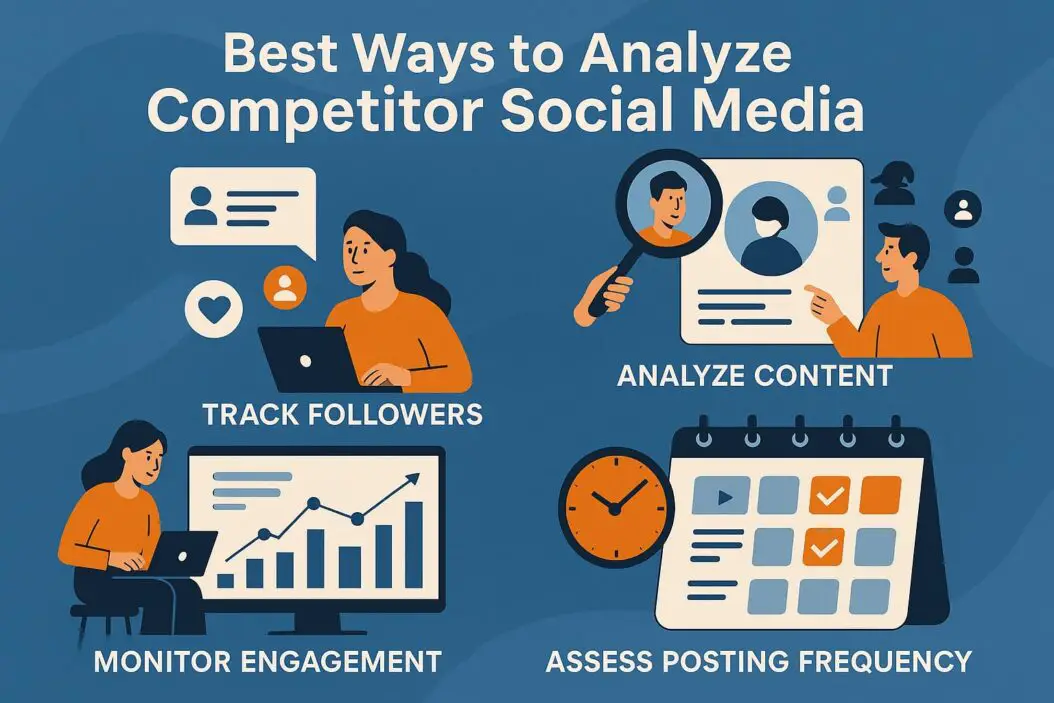
Create a simple spreadsheet. List each competitor and document:
- Which platforms they use
- How often they post
- Their follower counts
- Their engagement rates
- Profile completion (bio, links, contact info)
This overview tells you where they invest their energy. If a competitor ignores Instagram but posts daily on LinkedIn, that’s meaningful data.
Calculate Engagement Rate
Engagement rate matters more than follower count. Here’s the formula:
Engagement Rate = (Likes + Comments + Shares) ÷ Followers × 100
A competitor with 5,000 engaged followers beats one with 50,000 passive followers every time.
| Metric | What It Tells You |
|---|---|
| Follower count | Reach potential |
| Engagement rate | Content relevance |
| Post frequency | Resource investment |
| Response time | Customer service priority |
| Content types | Format preferences |
Step 3: Analyze Their Content Strategy
Now dig into what they actually post.
Content Categories
Track these elements for 20-30 recent posts per competitor:
- Content type: Videos, images, carousels, text posts, stories
- Topic themes: Product launches, tips, behind-the-scenes, user content
- Posting times: When they publish
- Tone: Professional, casual, humorous, educational
- Call-to-actions: What they ask followers to do
Look for patterns. If their educational posts get 3x more engagement than promotional posts, that’s a signal.
Content That Performs Best
Sort their posts by engagement. Study the top 10.
Ask yourself:
- What problem does this content solve?
- Why would someone share this?
- What emotion does it trigger?
- How long or short is it?
- Does it use trending audio or hashtags?
You’re not copying. You’re learning what your shared audience cares about.
Content Gaps
These are topics your audience wants that competitors ignore. Finding gaps gives you opportunities to dominate specific conversations.
Review competitor content and ask:
- What questions aren’t they answering?
- Which customer pain points do they skip?
- What content formats are they missing?
- Which audience segments do they overlook?
Step 4: Study Their Audience
Your competitor’s followers are potential customers for you.
Who Engages With Them?
Look at who comments and shares their posts. Check their profiles. Note:
- Job titles and industries
- Location
- Interests and behaviors
- The language they use in comments
This tells you exactly who finds their content valuable.
What Their Audience Complains About
Read the comments carefully. Negative feedback reveals problems you can solve better.
Common complaint themes:
- Slow customer service
- Missing features
- Confusing messaging
- Poor value
- Lack of educational content
Each complaint is a chance to position yourself as the better option.
Sentiment Analysis
Track whether comments are mostly positive, negative, or neutral. If a competitor has great follower counts but terrible sentiment, their audience is ready to switch.
Step 5: Examine Their Hashtag Strategy
Hashtags extend reach and signal what communities they target.
Create a list of hashtags each competitor uses most. Categorize them:
Branded hashtags – Their own campaign or company tags
Industry hashtags – Broad terms everyone in your field uses
Niche hashtags – Specific subtopics with smaller, engaged communities
Trending hashtags – Current events or viral conversations
Check hashtag performance on platforms like Instagram using the search function. See how many posts use each tag and the engagement levels.
Avoid overused hashtags with millions of posts. Your content gets buried. Target hashtags with 10,000-500,000 posts for better visibility.
Step 6: Track Their Paid Social Strategy
Organic posts tell half the story. Paid ads reveal their priorities.
Finding Their Ads
Facebook/Instagram: Visit the Meta Ad Library. Search any company name. See all their active ads.
LinkedIn: Visit their company page and click “Posts.” Ads show a “Promoted” label.
Twitter/X: Ads appear in feeds but aren’t easily searchable unless you’re targeted.
What to Look For
- Ad copy and headlines
- Images or video styles
- Offers and promotions
- Target audience clues
- Landing pages they link to
- How long ads run
If they run the same ad for months, it’s probably working. If ads disappear quickly, they’re testing or failing.
Step 7: Monitor Their Platform-Specific Tactics
Each platform has unique features. Smart competitors use them differently.
- Story highlights organization
- Reel trends and music choices
- Carousel post structures
- Shopping features
- Collaboration posts with other accounts
- Employee advocacy programs
- Document posts vs. link posts
- Poll frequency
- Newsletter subscriptions
- Thought leadership from executives
- Group communities
- Event promotion
- Live video usage
- Cross-posting from Instagram
- Review management
TikTok
- Sound selection
- Hook patterns in first 3 seconds
- Video length trends
- Hashtag challenges
- Influencer partnerships
Twitter/X
- Thread structures
- Reply engagement tactics
- Retweet vs. original content ratio
- Space usage
- Community notes response
Step 8: Analyze Their Response Strategy
How competitors handle comments, messages, and mentions shows their customer relationship priorities.
Track:
- Average response time
- Response rate percentage
- Tone in responses (helpful, defensive, template-like)
- Escalation handling for complaints
- Crisis management approach
Fast, helpful responses build loyalty. Slow or defensive responses create opportunities for you.
Step 9: Use Social Listening Tools
Manual analysis works but takes forever. Tools automate the process.
Free Tools
Google Alerts – Get notified when competitors are mentioned online
Social platform analytics – Built-in insights on platforms you use
Mention tracking – Search competitor names directly on platforms
Paid Tools
Sprout Social – Comprehensive competitor tracking and reporting
Hootsuite – Multi-platform monitoring with custom streams
BuzzSumo – Content performance analysis across social networks
Brandwatch – Advanced sentiment analysis and trend identification
Pick tools based on your budget and which platforms matter most to your business.
Step 10: Benchmark Against Your Performance
Analysis means nothing without comparison.
Create a competitive benchmark report:
| Metric | You | Competitor A | Competitor B | Competitor C |
|---|---|---|---|---|
| Follower growth rate | ||||
| Average engagement rate | ||||
| Posts per week | ||||
| Video content % | ||||
| Response time | ||||
| Sentiment score |
Update this monthly. Track whether you’re gaining ground or falling behind.
Step 11: Identify Their Influencer Partnerships
Influencer partnerships extend reach quickly.
Look for:
- Tagged accounts in their posts
- Sponsored content mentions
- Brand ambassador programs
- Affiliate link usage
- Co-created content
Research the influencers they work with. Check their engagement rates, audience demographics, and previous partnerships.
If an influencer works repeatedly with competitors, they might be worth approaching. Or they might be exclusive to that competitor.
Step 12: Track Their Social Media Growth
Growth patterns reveal what’s working over time.
Use tools like Social Blade to track:
- Follower count changes
- Posting frequency shifts
- Engagement trend lines
- Viral content spikes
Sudden growth often connects to specific campaigns, viral posts, or external media coverage. Dig into what caused the spike.
Steady growth suggests consistent strategy execution. Declining growth signals problems with content relevance or platform algorithm changes.
Step 13: Document Their Campaign Strategies
Major campaigns reveal priorities and budget allocation.
When competitors launch campaigns, track:
Pre-launch: Teaser content, countdown posts, influencer seeding
Launch: Announcement posts, paid ad spend, platform focus
Mid-campaign: User-generated content, engagement tactics, hashtag adoption
Post-campaign: Results sharing, thank you content, retargeting
Save examples. Build a swipe file of successful campaign elements you can adapt.
Step 14: Create an Action Plan
Analysis without action wastes time.
For each insight, ask:
- Can we do this better?
- Should we do this differently?
- Is there a gap we can fill?
- What resources do we need?
Prioritize actions by potential impact and effort required.
Quick Wins
These need low effort but give fast results:
- Copy successful content formats
- Use their best-performing hashtags
- Post at their optimal times
- Engage with their audience
Long-Term Strategies
These need more resources but create sustainable advantages:
- Build content around their gaps
- Develop superior customer response systems
- Create higher quality versions of their viral content
- Partner with influencers they haven’t reached
Step 15: Repeat the Process Regularly
Social media changes fast. Competitor analysis isn’t a one-time task.
Set a schedule:
Monthly: Quick check of recent content performance and follower growth
Quarterly: Deep dive into strategy changes and campaign results
Annually: Complete competitive landscape review and benchmark reset
Add new competitors as your market evolves. Remove ones who become irrelevant.
Common Mistakes to Avoid
Copying instead of learning: Replicating competitor content exactly makes you a follower, not a leader. Use insights to create something better.
Analyzing too many competitors: Focus beats breadth. Three well-analyzed competitors beat ten surface-level checks.
Ignoring small competitors: Size doesn’t equal strategy quality. Small competitors often innovate faster than big ones.
Forgetting your unique value: Your brand has different strengths. Don’t abandon what makes you special while chasing competitor tactics.
Analysis paralysis: Perfect analysis doesn’t exist. Gather enough data to make informed decisions, then act.
Summary
Competitor social media analysis gives you a proven roadmap. You see what works, what fails, and where opportunities hide.
Start with the basics: identify competitors, map their presence, and study their content. Then go deeper with audience analysis, hashtag strategies, and paid campaigns.
Use tools to automate repetitive work. Create benchmarks to measure your progress. Turn insights into action items.
The competitors winning on social media aren’t necessarily smarter. They test constantly, learn from data, and adapt quickly. Now you can do the same.
Frequently Asked Questions
How often should I analyze competitor social media?
Do a quick monthly check of recent posts and engagement rates. Run a complete analysis quarterly to catch strategy shifts. Annual deep dives help you understand long-term trends and reset your benchmarks.
What’s the minimum number of competitors to analyze?
Three competitors give you enough perspective without overwhelming data. Pick one direct competitor, one indirect competitor, and one aspirational brand. You can add more later as you get comfortable with the process.
Can I analyze competitors without expensive tools?
Yes. Start with manual platform searches, Google Alerts, and native analytics. These free methods work well for basic analysis. Upgrade to paid tools when you need automation, historical data, or multi-platform reporting.
Is it legal to analyze competitor social media?
Completely legal. All public social media posts are accessible to everyone. You’re observing publicly available information, not hacking accounts or stealing private data. Just don’t impersonate competitors or misrepresent yourself to their followers.
What if my competitors aren’t on social media?
That’s your opportunity. Their absence means your audience has unmet needs. Fill the gap with consistent, valuable content. You’ll capture attention they’re ignoring and build authority in your space before they even start.
