
Self-driving car technology benefits include fewer accidents, less traffic congestion, more independence for non-drivers, and lower transportation costs. These autonomous vehicles use sensors, cameras, and AI to navigate without human input, potentially saving over 30,000 lives annually in the US alone.
This guide explains how self-driving cars work and why they matter for your safety, wallet, and daily life.
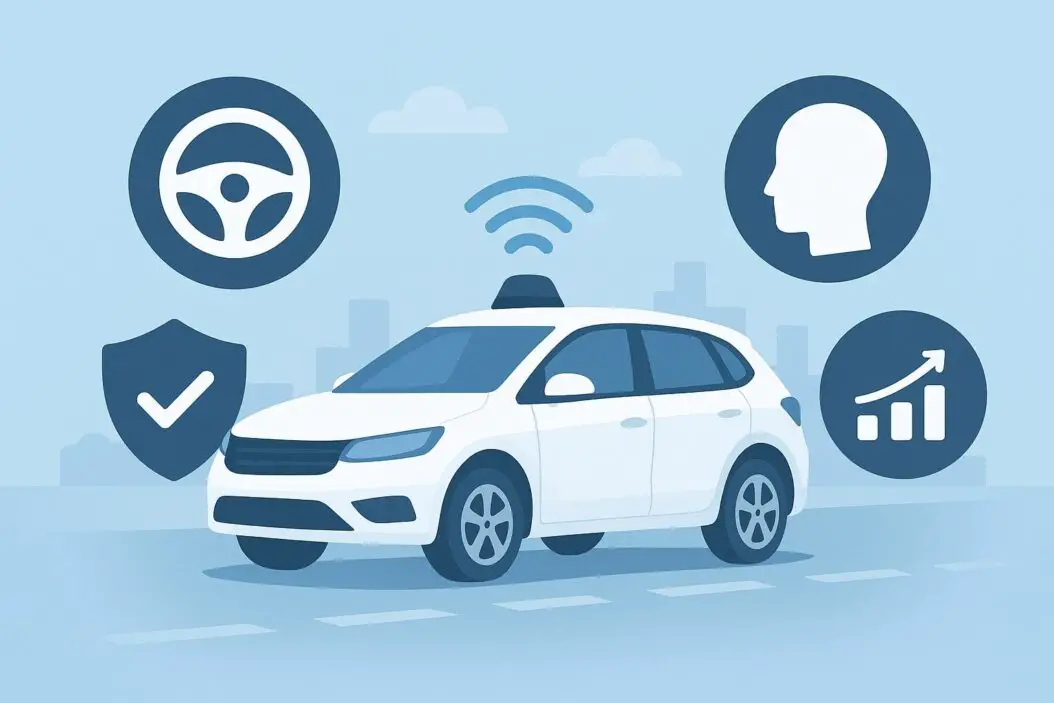
How Self-Driving Cars Actually Work
Self-driving cars combine multiple technologies to replace human drivers:
Core Components:
- LiDAR sensors create 3D maps of surroundings in real-time
- Cameras identify traffic signs, lane markings, and pedestrians
- Radar systems detect distance and speed of nearby objects
- AI processors make driving decisions in milliseconds
The vehicle constantly scans its environment, predicts what other cars and pedestrians will do, and adjusts speed and direction accordingly. Companies like Waymo have logged millions of autonomous miles testing these systems.
The Safety Benefits of Self-Driving Technology
Human error causes 94% of serious crashes, according to the National Highway Traffic Safety Administration. Self-driving cars eliminate the main causes of accidents.
Accidents They Prevent
| Human Error Type | How Autonomous Cars Help |
|---|---|
| Distracted driving | Never check phones or get distracted |
| Drunk driving | No impairment issues |
| Speeding | Follow speed limits exactly |
| Fatigue | Don’t get tired on long trips |
| Blind spots | 360-degree sensor coverage |
Self-driving systems react in 0.1 seconds. Humans need 1-2 seconds. That difference prevents crashes.
Real-World Safety Data
Current semi-autonomous features already show results:
- Tesla’s Autopilot reduces accident rates by 40% when engaged
- Automatic emergency braking prevents rear-end collisions
- Lane-keeping assistance stops drift-related crashes
Full autonomy should improve these numbers significantly.
Economic Benefits: How Self-Driving Cars Save Money
The average American spends $10,000 yearly on car ownership. Self-driving technology changes this calculation.
Lower Insurance Costs
When accidents drop 90%, insurance premiums fall proportionally. Early estimates suggest:
- $500-800 annual savings per driver
- Fleet insurance costs dropping 70-80%
- Faster claim processing through vehicle data logs
Reduced Fuel and Maintenance Expenses
Autonomous vehicles optimize driving patterns:
- Smooth acceleration and braking improve fuel economy by 10-15%
- Less aggressive driving reduces brake and tire wear
- Predictive maintenance catches problems before breakdowns
Increased Productivity
If you’re not driving, that’s 300+ hours yearly for other activities. Commuters can:
- Work during their commute
- Sleep on long trips
- Read, exercise, or relax
This time has real economic value, estimated at $5,000-8,000 per person annually.
Independence for People Who Can’t Drive
Self-driving car technology benefits extend beyond convenience. They provide mobility to millions who currently can’t drive.
Who Gains Independence:
- Elderly adults who’ve lost driving privileges
- People with disabilities that prevent operating vehicles
- Young people under driving age
- Anyone without a license due to medical conditions
This isn’t hypothetical. Waymo already operates robotaxi services in Phoenix and San Francisco, giving these groups new freedom. A 2023 survey found that 68% of non-drivers would use autonomous vehicles regularly if available.
Environmental Benefits of Autonomous Vehicles
Self-driving technology improves environmental outcomes in several ways.
Reduced Emissions
Optimized driving patterns cut fuel consumption:
- Smooth acceleration/braking reduces waste
- Route optimization finds shortest paths
- Platooning (vehicles traveling close together) reduces air resistance by 20%
Electric self-driving cars double these benefits by eliminating tailpipe emissions entirely.
Less Urban Sprawl and Parking
Autonomous vehicles can drop you off and park themselves elsewhere, or return home. This means:
- 30-50% less parking space needed in cities
- More room for parks, housing, and businesses
- Reduced urban heat island effect from black asphalt
One study by the International Transport Forum found shared autonomous vehicles could replace 90% of private cars in cities while meeting the same transportation needs.
Traffic Flow and Congestion Reduction
Self-driving cars communicate with each other and traffic systems to move more efficiently.
How They Improve Traffic
Vehicle-to-Vehicle Communication:
- Cars share speed and position data
- Coordinated merging eliminates bottlenecks
- Smooth traffic flow prevents stop-and-go patterns
Optimized Intersection Management:
- Traffic lights adjust to real-time vehicle flow
- Reduced idling at red lights
- 30-40% increase in intersection capacity
Time Savings
The average American wastes 54 hours yearly in traffic congestion. Autonomous vehicles could cut this by 60% through better coordination and route selection.
Current Limitations and Challenges
Self-driving technology isn’t perfect yet. Understanding the limitations helps set realistic expectations.
Technical Challenges
- Weather interference: Heavy rain and snow still confuse sensors
- Complex urban environments: Construction zones and unusual situations are difficult
- Cybersecurity risks: Connected vehicles need protection from hacking
- High costs: Current autonomous systems add $50,000-100,000 to vehicle price
Regulatory and Legal Issues
- Unclear liability in accidents
- Varying state and national regulations
- Insurance framework still developing
- Ethical programming decisions (who to prioritize in unavoidable crashes)
Social Acceptance
Many people don’t trust autonomous vehicles yet. A 2024 survey found only 40% of Americans would ride in a fully self-driving car. This will change as the technology proves itself.
The Timeline: When Will Self-Driving Cars Become Common?
Industry experts predict:
2026-2027:
- Expanded robotaxi services in major cities
- Highway autopilot becomes standard in new cars
- Limited self-driving delivery vehicles
2028-2032:
- Self-driving cars available for purchase (expensive)
- Broader geographic coverage for autonomous services
- Most new vehicles have advanced driver assistance
2033-2040:
- Mainstream adoption of autonomous vehicles
- Significant accident rate reduction
- Infrastructure adapts to support autonomous traffic
Full replacement of human-driven cars will take decades. Both will coexist for a long time.
Summary: Key Takeaways on Self-Driving Benefits
Self-driving car technology offers substantial benefits across safety, economics, accessibility, and environment:
- 90% reduction in traffic accidents by eliminating human error
- $5,000+ annual savings per person through lower costs and productivity gains
- Mobility for 25+ million Americans who can’t currently drive
- 40% less traffic congestion through coordinated vehicle communication
- Significant environmental improvements from optimized driving and reduced parking needs
The technology isn’t perfect yet, but the benefits are compelling enough that major automakers and tech companies are investing billions in development.
Frequently Asked Questions
Are self-driving cars safer than human drivers?
Current data suggests yes, by a significant margin. Autonomous systems don’t get distracted, tired, or impaired. They react faster and have 360-degree awareness. While not flawless, they’re projected to prevent 90% of current accidents once fully deployed.
How much will self-driving cars cost?
Today’s autonomous technology adds $50,000-100,000 to vehicle costs. As the technology matures and scales, experts predict this will drop to $5,000-10,000 by 2035. Many people will access autonomous vehicles through ride-sharing rather than ownership, making them affordable immediately.
Can self-driving cars work in bad weather?
Not reliably yet. Heavy rain, snow, and fog interfere with sensors and cameras. Engineers are improving this, but current systems often require human takeover in severe weather. This is one of the main technical challenges still being solved.
What happens if the technology fails while driving?
Modern autonomous systems have multiple redundancies. If one sensor fails, others compensate. The vehicle can safely pull over if systems are compromised. Most designs keep a human driver ready to take control during the transition period. As technology improves, these systems will become more reliable than human attention spans.
Will self-driving cars eliminate driving jobs?
Eventually, yes. Truck drivers, taxi drivers, and delivery drivers will face displacement over 10-20 years. However, history shows technology creates new jobs while eliminating others. The transition period will be long enough for workforce adaptation, and new roles in fleet management, remote monitoring, and vehicle maintenance will emerge.

- How to Improve Wi-Fi Signal on My Phone (2026 Guide) - March 17, 2026
- How to Enable MMS Messaging on iPhone (2026 Guide) - March 15, 2026
- 9 Best Software for Web Development in 2026 - March 15, 2026