
NFT integration ideas for brands have moved far beyond the hype of 2021. Today, brands using NFTs are solving real business problems: loyalty, authentication, community, and customer retention.
If you run a brand and want to know exactly how NFTs can work for you, this article covers seven practical ideas with real examples and clear steps.
Why Brands Are Still Betting on NFTs in 2026
The noise died down. The speculation faded. What remained are brands that found genuine utility in NFTs.
NFTs are now being used as digital ownership tools, not just collectibles. They verify authenticity, gate exclusive content, power loyalty programs, and create new revenue streams. The technology matured. The use cases got smarter.
Brands that integrate NFTs now are not chasing trends. They are building infrastructure for digital-first customer relationships.
What Makes a Good NFT Integration for a Brand
Before jumping into ideas, understand what separates a gimmick from a good integration.
A useful NFT integration:
- Solves a real problem the brand or customer has
- Adds value beyond the token itself
- Does not require the customer to be a crypto expert
- Has a clear reason for existing on a blockchain
Keep this checklist in mind as you read through the ideas below.
Top 7 NFT Integration Ideas for Brands
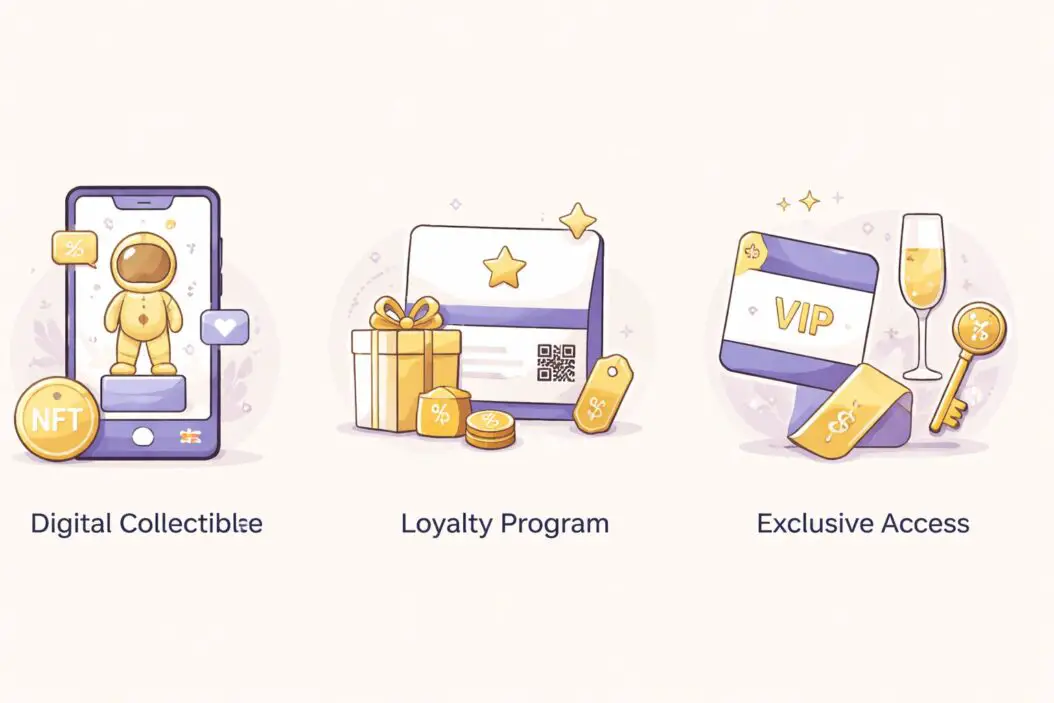
1. NFT-Based Loyalty and Rewards Programs
This is the most practical entry point for most brands in 2026.
Traditional loyalty points expire, get forgotten, and feel worthless. NFT-based loyalty tokens are different. Customers own them. They can hold, trade, or redeem them. The brand controls the rules. The customer controls the asset.
How it works:
- Customers earn NFT tokens for purchases, referrals, or actions
- Each token unlocks a tier of benefits: discounts, early access, exclusive events
- Tokens can be upgraded as the customer earns more
- Brands can add time-limited perks to specific token batches
Example: A fashion brand issues NFT membership cards. Tier 1 gives 10% off. Tier 3 gives access to private sales and custom product drops. As customers spend more, their NFT upgrades automatically.
Why it works: Customers feel ownership. They are not just earning points in a database they do not control. This increases brand attachment and repeat purchases.
Step-by-step to launch:
- Choose a loyalty NFT platform (Hang, Venly, or Alchemy are good starting points)
- Define your tier structure and rewards
- Create a simple onboarding flow that abstracts the wallet setup
- Launch with a founding member drop to generate buzz
- Track redemption data and adjust rewards every quarter
2. Product Authentication and Anti-Counterfeiting
Counterfeiting costs brands billions every year. NFTs solve this with a verifiable digital certificate tied to a physical product.
Every item gets a unique NFT at the point of manufacture. When a customer buys it, the NFT transfers to them. If the product is resold, the NFT moves too. The entire chain is visible and tamper-proof.
Best fit for: Luxury goods, streetwear, electronics, pharmaceuticals, wine, and art.
What the brand gains:
- Full visibility into secondary market sales
- Ability to earn royalties on resales
- Real-time data on where products are in the world
- Customer trust built on verifiable proof
What the customer gains:
- Proof the product is genuine
- A digital passport for resale value
- History of the product’s ownership
Implementation note: Pair the NFT with a physical tag, QR code, or NFC chip. When the customer scans it, they see the full ownership history and can claim their digital certificate.
LVMH and their Aura Blockchain Consortium already does this at scale. Smaller brands can replicate the model without the same infrastructure cost using platforms like Arianee or Legitimate.
3. Exclusive Content and Community Access
Some of your best customers want more than products. They want to belong to something.
NFT-gated communities give brands a way to reward their most engaged customers with exclusive access. The NFT acts as a membership key.
Access examples:
- Private Discord servers with direct brand team access
- Early access to new product launches
- Behind-the-scenes content, factory tours, design process videos
- Exclusive webinars or Q&A sessions with founders
- Members-only podcasts or newsletters
Why this beats traditional VIP programs: The NFT is transferable. If a customer no longer wants their membership, they can sell it. This creates a secondary market around your brand community, and other people will pay to get in. That is organic marketing you did not have to buy.
For media brands and creators: This model works especially well. A newsletter brand can issue 1,000 NFT subscriptions. Each holder gets premium access. If the newsletter grows, the NFT value grows. Holders become advocates because they are financially aligned with the brand’s success.
4. NFT Ticketing for Events
Event ticketing is broken. Scalpers buy bulk. Resale markets inflate prices. Fake tickets are everywhere. Brands that run events, whether product launches, concerts, or conferences, can fix all of this with NFT tickets.
What NFT ticketing changes:
- Each ticket is unique and verifiable on-chain
- Brands can cap resale prices in the smart contract
- Royalties flow back to the brand on every secondary sale
- Ticket data (who attended, how often) feeds directly into CRM
Post-event utility: The ticket NFT does not have to disappear after the event. It can become a collectible, a proof of attendance, or unlock future perks. This keeps the customer relationship alive long after the event ends.
Real use case: A consumer tech brand launches a new product at an invite-only event. Attendees receive NFT tickets. After the event, those tickets become early adopter badges that unlock exclusive after-sale support and next-year event priority access.
Platforms to explore: GET Protocol, Tokenproof, and YellowHeart are built specifically for NFT ticketing at scale.
5. Digital Twins for Physical Products
A digital twin is a virtual version of a physical product. When a customer buys your sneakers, they also receive an NFT that represents those sneakers in digital environments, games, or virtual spaces.
This is not about the metaverse hype of 2021. It is about owning a digital identity layer tied to your physical purchases.
Why brands should care in 2026:
- Gaming and virtual environments are mainstream. Millions of customers spend time in digital spaces
- Digital twins create a second revenue stream from the same customer
- They extend brand presence into spaces that advertising cannot easily reach
- Customers who use digital twins in games become walking brand ambassadors
Practical approach:
- Start with your top-selling physical product
- Design a digital version optimized for 3D environments
- Issue an NFT that links the physical and digital versions
- Partner with one or two platforms where your customers already spend time
Nike’s .SWOOSH platform and their Cryptokicks line showed exactly how to execute this. They linked physical shoes to digital wearables that work across gaming and virtual environments.
6. Collaborative and Co-Created NFT Drops
This idea turns customers into creators, which is the most powerful form of brand engagement.
Instead of the brand creating all the NFT content, they invite their community to participate in the creation process. Customers submit designs, vote on concepts, or contribute elements that get minted into the final collection.
Benefits:
- Customers feel deep ownership over something they helped make
- User-generated content becomes monetizable for both brand and creator
- Community engagement spikes during the collaboration process
- The resulting collection has built-in demand from participants
How to structure a co-creation drop:
- Define the theme or product the community will help design
- Open a submission window with clear creative guidelines
- Let the community vote on top submissions
- Mint the winning designs as NFTs with royalty splits for the creators
- Launch the collection with full attribution to community contributors
This works for: Apparel brands, gaming companies, music labels, food and beverage companies running limited edition packaging, and any brand with an active online community.
7. NFT-Powered Subscription and Membership Models
Subscriptions are everywhere. But NFT-based subscriptions offer something traditional subscriptions cannot: ownership and exit value.
A standard Netflix subscription disappears the moment you cancel. An NFT subscription can be sold, gifted, or held as an asset. This fundamentally changes how customers think about subscribing.
Structure for a brand:
- Issue a fixed number of NFT memberships (for example, 5,000 tokens)
- Each token grants full subscription benefits for as long as it is held
- Customers who want to leave can sell their token instead of just cancelling
- The brand benefits from a stable, committed subscriber base
- Secondary sales earn the brand royalties
Revenue model: The brand earns from the initial mint sale and from every resale. A 10% royalty on secondary sales means the brand keeps earning as long as people value the membership.
Best fit for: Media companies, SaaS products, wellness brands, sports clubs, and content creators with engaged audiences.
This model reduces churn because cancelling means losing an asset. Customers think twice before walking away from something they could also sell.
Comparing the 7 NFT Integration Ideas
| NFT Integration Idea | Best For | Difficulty | Key Benefit |
|---|---|---|---|
| Loyalty and Rewards | Retail, eCommerce | Low | Retention and repeat purchase |
| Product Authentication | Luxury, Fashion, Electronics | Medium | Trust and anti-counterfeiting |
| Exclusive Content Access | Media, Creators, DTC Brands | Low | Community and engagement |
| NFT Ticketing | Events, Live Experiences | Medium | Revenue and data capture |
| Digital Twins | Fashion, Gaming, Footwear | High | New revenue stream |
| Co-Created NFT Drops | Any brand with a community | Medium | Deep engagement and UGC |
| NFT Subscriptions | Media, SaaS, Content Brands | Medium | Retention and royalties |
How to Choose the Right NFT Integration for Your Brand
Do not try to do all seven at once. Pick one based on where your brand has the most friction today.
Start here:
- If you have a loyalty program that is underperforming, start with idea 1
- If counterfeiting is hurting your sales or reputation, go with idea 2
- If your community engagement is low, try idea 3 or idea 6
- If you run events, idea 4 is a direct upgrade to your current process
- If your products have digital appeal, explore idea 5
- If you run a subscription business with high churn, idea 7 is built for you
Three questions to ask before you build:
- What problem does this solve for the customer?
- Does the customer need to understand crypto to benefit from this?
- Can we sustain this past the first 90 days?
If you cannot answer all three clearly, go back to the drawing board.
Technical Considerations Before You Launch
You do not need to build everything from scratch. The NFT infrastructure space has matured significantly.
Key decisions:
- Blockchain choice: Ethereum remains the most trusted for brand use. Polygon offers lower fees. Flow is built for consumer apps. Choose based on your customer base and cost tolerance
- Wallet abstraction: Most customers do not want to manage a crypto wallet. Use platforms that offer email-based or social login wallets so the NFT experience feels like any other digital product
- Smart contract audits: If your NFT has financial value, get your smart contract audited before launch
- Legal clarity: In most jurisdictions, NFTs that behave like securities need legal review. Consult a Web3-experienced lawyer before launch
For a deeper technical overview of NFT standards and smart contract options, the Ethereum Foundation documentation at ethereum.org/en/developers is the most reliable starting point.
Common Mistakes Brands Make with NFT Integrations
Learning from failure saves time and money.
Mistakes to avoid:
- Launching without utility: An NFT that does nothing except exist is not a product. Define the utility first
- Ignoring the customer experience: If customers need a MetaMask wallet and gas fees to participate, most will drop off. Simplicity wins
- One-and-done drops: Brands that mint once and disappear lose community trust fast. Plan for ongoing engagement
- Overpromising: Do not tell customers their NFT will appreciate in value. Focus on real utility and let value take care of itself
- Skipping education: Many customers still do not understand NFTs. Build education into your onboarding flow
The Role of NFTs in Brand Strategy in 2026
NFTs are now a data layer as much as they are an ownership layer. Every transaction, transfer, and interaction is logged on-chain. Brands that integrate NFTs gain access to customer behavior data that is more transparent and verifiable than anything a third-party cookie could provide.
With third-party cookies phased out across major browsers, NFT-based interactions give brands a compliant, first-party data channel. You know exactly who your most engaged customers are, what they hold, and how they interact with your brand’s digital assets.
For a broader look at how blockchain is reshaping brand marketing, the Harvard Business Review has published useful research on digital ownership and customer trust at hbr.org.
Conclusion
NFT integration is not about speculation or hype anymore. It is about solving real problems for your brand and your customers.
The top 7 NFT integration ideas for brands in 2026 are:
- NFT-based loyalty and rewards programs
- Product authentication and anti-counterfeiting
- Exclusive content and community access
- NFT ticketing for events
- Digital twins for physical products
- Collaborative and co-created NFT drops
- NFT-powered subscription and membership models
Pick the one that fits your biggest current challenge. Start small. Test with a real segment of your customer base. Measure what changes. Then scale what works.
Frequently Asked Questions
Do customers need to understand crypto to use brand NFTs?
Not anymore. Modern platforms like Venly, Stardust, and Thirdweb offer embedded wallets that work with email or social login. Customers never need to touch a crypto wallet directly. The NFT experience can feel identical to any other digital product sign-up.
How much does it cost to launch an NFT integration for a brand?
Costs vary widely. A basic NFT loyalty pilot using an existing platform can cost between $5,000 and $20,000 to set up. A custom smart contract with a full product authentication system can run $50,000 or more. The biggest variable is whether you build custom or use existing infrastructure.
Can small brands benefit from NFT integration or is it only for large companies?
Small brands often benefit more because they can move faster and build tighter communities. The co-creation model and NFT-gated community ideas work exceptionally well for niche brands with passionate audiences. You do not need scale to start.
Are NFTs legal for brand use in 2026?
In most countries, yes, for utility-focused NFTs. The legal grey area is around NFTs that look or behave like securities, meaning they are sold with an expectation of profit. Utility NFTs tied to products, memberships, or access are generally on solid legal ground. Always consult a Web3-familiar legal advisor before launch.
What blockchain should a brand use for NFT integration?
For most brands, Polygon is the practical choice in 2026. It is Ethereum-compatible, has very low transaction fees, and has strong support from major NFT platforms. Ethereum mainnet is better for high-value luxury or collectible applications where the prestige of the chain matters to buyers. Flow is worth considering for brands targeting gaming or younger consumer audiences.

- How to Fix Overscan on Windows 11/10: Stop Your Screen Getting Cut Off (2026) - April 1, 2026
- How to Disable Lock Screen on Windows 11/10 in 2026 - April 1, 2026
- Top 7 NFT Integration Ideas for Brands in 2026 - March 31, 2026