
Finding a specific NFT in a sea of millions is harder than it sounds. You want to search by trait, creator, price history, rarity, or even visual style. Traditional databases crawl. Manual filtering wastes hours. That is exactly where AI-based NFT indexing steps in and solves the problem fast.
This article explains what AI-based NFT indexing is, how it works, why it matters in 2026, and how you can use it practically whether you are a collector, developer, or marketplace builder.
What Is AI-Based NFT Indexing for Rapid Discovery?
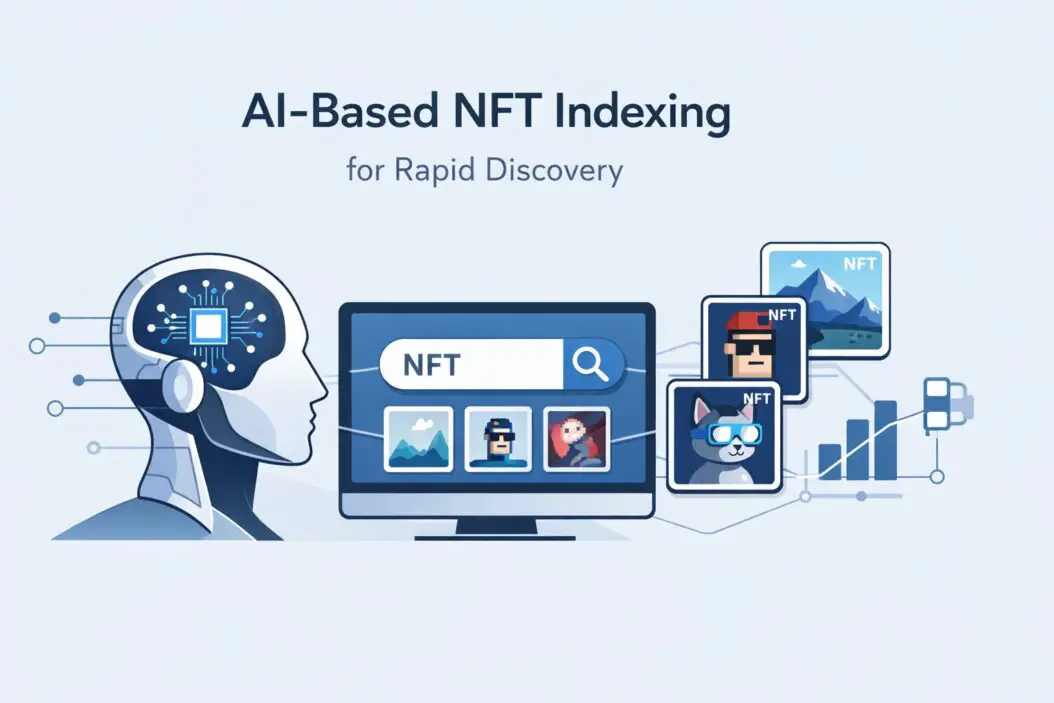
AI-based NFT indexing means using machine learning and AI models to automatically catalog, tag, classify, and retrieve NFTs at scale. Instead of relying on manual metadata or simple keyword search, AI reads the actual content of NFTs, understands visual patterns, detects traits, and maps relationships between collections.
The result is a searchable, structured index where users can find NFTs in seconds based on what they actually look like or mean, not just what the creator labeled them.
Traditional NFT indexing relied on static metadata stored in JSON files. If the creator wrote “blue background” in the metadata, you could find it. If they did not, good luck. AI indexing removes that bottleneck entirely.
Why Traditional NFT Search Fails
Before AI, here is how NFT discovery worked:
You opened a marketplace. You typed a keyword. The platform searched metadata fields. If the NFT lacked proper tags, it never appeared in results.
Problems were obvious:
- Metadata is inconsistent across creators and collections
- Rarity scores required manual trait counting
- Visual similarity search was impossible without AI
- Provenance and on-chain history were siloed from search
- Cross-chain discovery meant jumping between multiple platforms
In 2026, with over 500 million NFTs minted across Ethereum, Solana, Polygon, Base, and newer chains, broken search is not just annoying. It costs buyers money and sellers visibility.
How AI Makes NFT Indexing Smarter
Computer Vision for Visual Indexing
AI models, specifically convolutional neural networks and vision transformers, scan NFT images and extract visual features automatically. This allows platforms to index NFTs by:
- Color palette and dominant tones
- Art style (pixel art, generative, photography, 3D)
- Facial features in PFP collections
- Object detection (weapons, backgrounds, accessories)
- Visual similarity to other assets
If you want every NFT that looks like a sunset painted in impressionist style, a well-trained vision model can surface those results even without any written metadata.
Natural Language Processing for Metadata Enrichment
Large language models read existing metadata, descriptions, and community tags. They then infer missing information, correct inconsistencies, and generate standardized tags.
For example, if a creator described an NFT as “a wandering samurai under a blood moon,” an NLP model understands this involves a warrior, a night scene, and a specific mood. It tags accordingly. Now that NFT appears in searches for “warrior,” “night,” “red,” and “Japanese aesthetic” even though none of those words appeared exactly in the original metadata.
Embedding Models for Semantic Search
This is the real breakthrough. Embedding models convert NFTs (and user queries) into high-dimensional vectors. Similar items sit close together in vector space. When a user types “futuristic robot with neon colors,” the system finds NFTs whose vector embeddings are closest to that query vector.
This powers semantic search, meaning the system understands intent, not just keywords. You can read more about how vector search works in practice at Pinecone’s documentation on vector databases, which covers similarity search architectures well.
Graph Models for Relationship Mapping
Some AI indexers build knowledge graphs connecting NFTs to:
- Their collection
- Creator wallet history
- Past buyers and sellers
- Connected utility (games, events, memberships)
- On-chain activity patterns
This helps surface NFTs based on provenance and social signals, not just visual or textual content.
Architecture of an AI NFT Indexing System
Understanding the technical structure helps both developers building indexers and users evaluating platforms.
| Layer | Function | Technology Used |
|---|---|---|
| Data Ingestion | Pull NFT data from blockchain nodes and IPFS | Indexers like The Graph, custom crawlers |
| Media Retrieval | Fetch images, animations, audio from IPFS or Arweave | Content-addressed storage fetchers |
| AI Processing | Run vision and NLP models on raw media and metadata | PyTorch, Hugging Face, CLIP models |
| Embedding Generation | Convert processed data into vector representations | OpenAI embeddings, open-source alternatives |
| Vector Storage | Store and index embeddings for fast retrieval | Pinecone, Weaviate, Qdrant, Milvus |
| Search Interface | Accept user queries and return ranked results | REST APIs, GraphQL, frontend layers |
| Re-ranking | Improve result relevance using feedback signals | Fine-tuned ranking models |
Each layer feeds the next. Remove one and the system breaks down. The magic happens at the AI processing and embedding generation stages.
Real Use Cases in 2026
Marketplace Search That Actually Works
Platforms like OpenSea, Blur, and newer entrants have integrated AI-powered search that goes beyond trait filters. Users type natural language queries. Results feel curated. Engagement rates on those results are significantly higher because users find what they actually wanted.
Rarity Scoring Without Manual Trait Counting
AI models analyze entire collections, identify trait distributions automatically, and compute rarity scores without human intervention. This is especially useful for generative collections where traits are programmatically assigned but not always cleanly documented.
Cross-Chain Discovery
AI indexers that ingest data from multiple chains (Ethereum, Solana, Sui, Base, Arbitrum) create unified indexes. A collector can search for “animated dragons” and see results from every chain in a single interface. This was nearly impossible before AI-powered normalization.
Fraud and Wash Trade Detection
Graph-based AI models track wallet relationships and trading patterns. They flag NFTs involved in wash trading or identify counterfeit collections that clone legitimate ones. Marketplaces use these signals to demote suspicious assets in search results.
Portfolio Analysis for Collectors
AI indexers that understand your existing collection can recommend NFTs likely to complement it, predict floor price movements based on on-chain signals, or alert you when a target NFT enters your price range.
Key Technologies Powering AI NFT Indexers in 2026
CLIP (Contrastive Language-Image Pretraining)
Originally developed by OpenAI, CLIP maps images and text into the same embedding space. This means a text query and a relevant image end up near each other in vector space. NFT platforms use CLIP-based models to power image-to-text and text-to-image search across collections.
Multimodal Models
In 2026, multimodal models handle images, text, audio, and video in a single architecture. This matters for NFTs that include animation, music, or interactive elements. A single model indexes all media types.
On-Chain Data Fusion
AI systems now fuse on-chain transaction data with off-chain media data. An NFT that has been sold 50 times, held by known collectors, and used in 3 different games gets weighted differently in search than a freshly minted NFT with zero history.
Federated Indexing
Some newer protocols run decentralized AI indexing where multiple nodes contribute to building a shared index. This improves censorship resistance and avoids single points of failure. Projects like The Graph have moved toward incentivized indexing where node operators earn tokens for maintaining accurate, up-to-date indexes.
For a deeper technical dive into decentralized indexing protocols, The Graph’s documentation at thegraph.com is one of the clearest resources available in the space.
How to Build a Simple AI NFT Indexing Pipeline
If you are a developer, here is a practical starting point:
Step 1: Collect NFT data Use a blockchain API (Alchemy, Moralis, or QuickNode) to pull NFT metadata for a collection. You get token IDs, metadata URIs, and owner data.
Step 2: Retrieve media Resolve IPFS URIs and download images. Handle failures gracefully since IPFS can be slow or incomplete.
Step 3: Run CLIP embeddings Pass each image through a CLIP model. Store the resulting vector alongside the token ID.
Step 4: Store in a vector database Upload vectors to Qdrant, Weaviate, or Pinecone. Include metadata as filterable fields.
Step 5: Build a search interface Accept a text query from the user. Convert it to a CLIP text embedding. Query the vector database for the nearest neighbors. Return results ranked by similarity score.
Step 6: Add metadata filters Let users narrow results by price, chain, collection, or rarity tier. This hybrid search approach (semantic plus filter) outperforms pure keyword or pure vector search.
This pipeline works end to end. You can prototype it in a weekend using open-source tools.
Challenges Still Worth Knowing About
AI-based NFT indexing is not perfect. Honest coverage means acknowledging the real problems:
IPFS availability: A large percentage of NFT media is stored on IPFS without persistent pinning. If the creator stops pinning, the image disappears. AI cannot index what it cannot access.
Dynamic NFTs: NFTs that change over time (evolving game characters, for example) require re-indexing on a schedule. Static indexes go stale fast.
Cross-chain normalization: Different chains use different metadata standards. Normalizing these for a unified index requires constant maintenance as standards evolve.
Compute costs: Running vision models on millions of NFTs requires significant GPU resources. This cost gets passed to users through marketplace fees or subscription models.
Adversarial metadata: Some creators intentionally obscure traits to manipulate rarity scores. AI systems need adversarial training to handle these cases robustly.
Bias in training data: If the AI model was trained mostly on Ethereum PFP collections, it may perform poorly on Solana art NFTs or on-chain SVG projects. Diverse training data is essential.
Comparing AI Indexing Approaches
| Approach | Speed | Accuracy | Cost | Best For |
|---|---|---|---|---|
| Keyword metadata search | Very fast | Low | Very low | Simple collections |
| Trait filter search | Fast | Medium | Low | PFP collections |
| CLIP semantic search | Fast | High | Medium | Cross-collection discovery |
| Graph-based indexing | Medium | Very high | High | Provenance and fraud detection |
| Multimodal AI indexing | Medium | Highest | Very high | Full-featured platforms |
Most production platforms combine multiple approaches. Keyword and trait filters handle quick lookups. Semantic search handles exploratory discovery. Graph models handle trust and provenance signals.
What to Look for in an AI NFT Indexing Platform
If you are evaluating tools rather than building from scratch, check for these qualities:
- Cross-chain support including newer chains like Base, Sui, and Aptos
- Update frequency (how often the index refreshes for new mints)
- Search quality (test it with obscure queries, not just popular collections)
- API access for developers to query programmatically
- Metadata completeness (does it handle missing or malformed metadata gracefully)
- Transparency about AI model decisions (can you understand why a result was returned)
The Future Direction of AI NFT Indexing
In the next two to three years, expect:
Real-time indexing: New mints appear in search results within seconds of hitting the blockchain, not hours.
Intent-based discovery: Instead of searching for specific traits, users describe what they want (“something moody and dark with a floor under 1 ETH that has strong holder retention”) and AI interprets the full intent.
Personalized indexes: AI systems learn your taste from your wallet history and surface relevant NFTs proactively, without you needing to search at all.
On-chain AI models: As blockchain compute improves, lightweight AI inference runs on-chain, enabling trustless, verifiable indexing without centralized servers.
Audio and video NFT indexing: As NFT formats expand beyond images, AI indexers will handle music, video, and interactive experiences with equal sophistication.
Conclusion
AI-based NFT indexing for rapid discovery solves a real problem. With millions of NFTs spread across dozens of chains, manual browsing and keyword search are not enough. AI, specifically vision models, NLP, embedding-based semantic search, and graph models, makes NFT discovery fast, accurate, and genuinely useful.
In 2026, the best platforms use a combination of these approaches. Collectors find what they want faster. Developers build better experiences. Creators get more visibility even without perfect metadata.
If you are building in this space, start with CLIP embeddings and a vector database. If you are a user, look for platforms that support natural language search. The technology is mature enough to deliver real value today.
Frequently Asked Questions
What exactly does AI-based NFT indexing do?
It automatically catalogs NFTs using machine learning models that analyze images, text, and on-chain data. The result is a searchable index where users find NFTs through natural language queries, visual similarity search, or semantic matching rather than keyword-only filters.
Is AI NFT indexing only for large platforms?
No. Developers can build lightweight pipelines using open-source models like CLIP and affordable vector databases like Qdrant. A small team can index a single collection over a weekend and expose it through a search API.
How does semantic NFT search differ from trait filters?
Trait filters only match exact metadata fields a creator defined. Semantic search understands meaning and context. A query for “lonely astronaut” finds visually and thematically relevant NFTs even if no creator wrote those exact words in their metadata.
Can AI indexing work across multiple blockchains?
Yes. Multi-chain indexers ingest data from Ethereum, Solana, Polygon, Base, and others. AI normalizes inconsistent metadata formats across chains, creating a unified, searchable index regardless of where the NFT was minted.
What is the biggest limitation of AI NFT indexing today?
Missing or broken media is the biggest problem. When NFT images are stored on IPFS without reliable pinning, they disappear over time. An indexer cannot analyze media it cannot access. Persistent storage solutions like Arweave reduce but do not eliminate this problem.

- How to Uninstall Apps from the Start Menu in Windows 11/10 (2026 Guide) - April 2, 2026
- How to Fix Overscan on Windows 11/10: Stop Your Screen Getting Cut Off (2026) - April 1, 2026
- How to Disable Lock Screen on Windows 11/10 in 2026 - April 1, 2026