
If you run a bridging aggregator or use one, you already know the problem: liquidity gets lopsided fast. One chain drains. Another overflows. Fees spike. Users leave. AI-based DeFi rebalancing is how the best bridging aggregators in 2026 are solving this in real time, without manual intervention.
This guide explains exactly what it is, how it works, and how to use it, whether you are building, integrating, or just trying to understand why your cross-chain experience keeps improving.
What Is AI-Based DeFi Rebalancing for Bridging Aggregators?
A bridging aggregator routes assets between blockchains. It pools liquidity from multiple bridges, like Stargate, Across, Hop, and others, and finds the cheapest, fastest path for each transaction.
The problem is that liquidity across these bridges is never balanced. Heavy trading on one route empties one pool while another sits idle. Slippage rises. Routes become unavailable. Users get bad rates.
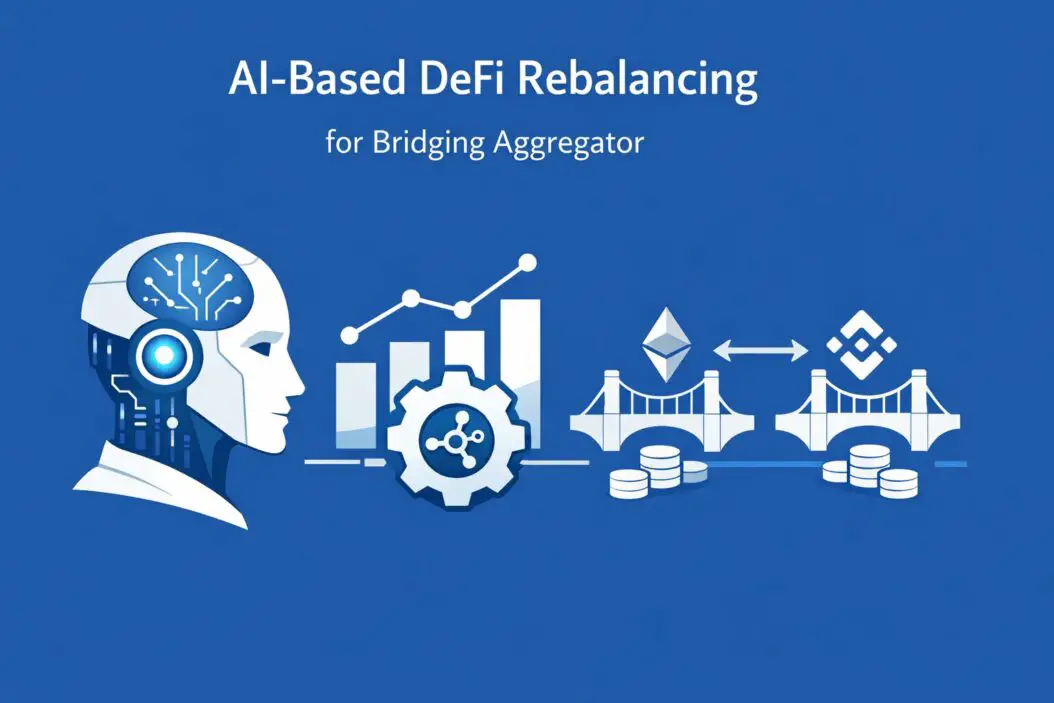
AI-based DeFi rebalancing uses machine learning models to monitor these pools continuously, predict where liquidity will be needed next, and move funds proactively before imbalances cause problems. Instead of reacting after users already suffer, the system acts in advance.
In short: it is predictive liquidity management for cross-chain infrastructure.
Why Traditional Rebalancing Falls Short
Rule-based rebalancing has been around for a while. Set a threshold, say “move funds when pool drops below 20%,” and trigger a transfer. Simple. But it breaks down in real DeFi conditions.
Threshold-based systems are always behind. By the time a pool hits 20%, users have already experienced slippage for hours. You are reacting, not preventing.
They ignore correlated flows. A meme coin launch on Arbitrum will drain ETH bridges from Ethereum to Arbitrum across multiple protocols simultaneously. Rule-based systems treat each bridge in isolation. AI sees the correlation.
Gas timing is ignored. Moving liquidity during a gas spike costs 10x more than moving it two hours earlier. A trained model learns historical gas patterns and times rebalancing moves accordingly.
They can’t handle flash events. An airdrop, a major liquidation cascade, a new farm launch, these create volume spikes that no static threshold anticipates. AI models trained on similar past events can identify the signature early and respond.
How AI Rebalancing Actually Works in a Bridging Aggregator
Step 1: Data Ingestion
The system pulls real-time and historical data from multiple sources. This includes:
- Liquidity pool depths across all supported bridges per chain
- Transaction volume per route, per hour
- Gas prices on origin and destination chains
- Token prices and volatility indices
- On-chain signals like large wallet movements and protocol TVL changes
- External signals: social sentiment, governance votes, upcoming token unlocks
This data gets normalized and fed into a feature pipeline that runs every few seconds.
Step 2: Demand Forecasting
A time-series model, often a transformer-based architecture or LSTM hybrid, forecasts transaction volume per route over the next 1 to 24 hours. It learns seasonal patterns (weekends vs. weekdays, Asia hours vs. US hours) and event-driven spikes.
If the model expects 3x normal volume on the ETH to Base route in the next 4 hours, it flags that route for pre-emptive liquidity injection.
Step 3: Optimization Engine
The forecasts feed into an optimization layer. This component solves a constrained allocation problem: given expected demand across N routes, what is the minimum liquidity movement needed to keep slippage below a target threshold, while minimizing gas costs and rebalancing frequency?
This is essentially a portfolio optimization problem applied to cross-chain liquidity. The solver accounts for:
- Cost to move liquidity (gas, bridge fees)
- Opportunity cost of idle liquidity
- Risk of over-concentration
- Time to execute each move
Step 4: Execution
When the optimizer outputs a rebalancing plan, an execution layer carries it out. This layer handles:
- Smart contract calls to move liquidity
- MEV protection to prevent front-running of large rebalancing transactions
- Batching to reduce gas costs
- Fallback logic if a bridge route is congested
Some systems use intent-based execution where solvers compete to fulfill the rebalance at the best price.
Step 5: Feedback Loop
Every executed rebalance gets logged. The model sees the outcome: did the predicted demand materialize? Did slippage stay within target? This feedback continuously improves model accuracy over weeks and months.
Key Components of an AI Rebalancing System
| Component | Purpose | Common Tech |
|---|---|---|
| Data Pipeline | Ingest on-chain and off-chain signals | Kafka, Subgraph, custom RPC indexers |
| Forecasting Model | Predict future liquidity demand | LSTM, Transformer, Prophet |
| Optimization Solver | Compute efficient rebalancing plan | Linear programming, RL agent |
| Execution Layer | Execute cross-chain moves | Smart contracts, intent protocols |
| Monitoring Dashboard | Track performance metrics | Grafana, custom dashboards |
| Feedback System | Retrain models on outcomes | MLflow, custom training pipelines |
Real-World Example: ETH to Arbitrum Route
Imagine your aggregator supports five bridges for ETH to Arbitrum: Stargate, Across, Hop, Orbiter, and a native bridge.
Monday morning, 9 AM UTC. The AI model detects:
- A governance vote on a major Arbitrum DeFi protocol ends in 6 hours
- Three large wallets holding $2M in ETH have been active on Ethereum in the past hour
- Historical data shows volume on ETH to Arbitrum spikes 40% around major governance events
The model predicts a 60% volume increase on this route within 8 hours. The optimizer calculates that moving $500K from the Hop ETH pool on Optimism (which is currently oversupplied) to the Arbitrum side would keep slippage under 0.1% even at peak demand. Gas is currently low. The move costs $180 in gas and takes 22 minutes to confirm.
The system executes the rebalance at 9:14 AM. By 2 PM, volume spikes as predicted. Users see no slippage increase. Without the AI rebalance, the Stargate pool would have drained by 11 AM and users would have faced 0.4% slippage or route unavailability.
Benefits for Aggregator Operators
Lower slippage for users means higher retention. Users compare routes. If your aggregator consistently offers better rates, they come back.
Reduced emergency rebalancing costs. Reactive rebalancing during high-gas periods is expensive. Proactive moves during low-gas windows can cut rebalancing costs by 40% to 60% according to internal data from protocols using predictive systems.
Better capital efficiency. Idle liquidity earns nothing (or earns less). AI rebalancing keeps capital flowing where it generates fees.
Competitive differentiation. As the cross-chain space matures, execution quality separates winners from losers. An aggregator with AI rebalancing has a structural edge.
Challenges and Limitations
AI rebalancing is not magic. There are real limitations to understand.
Model drift. DeFi evolves fast. A model trained on 2024 data may not handle 2026 market structures well without continuous retraining.
Black swan events. A major protocol hack, a regulatory announcement, or a stablecoin depeg can create liquidity flows no historical model has seen. These require human override capabilities.
Cross-chain execution latency. Moving liquidity cross-chain takes time. A forecast with a 4-hour horizon is useful. A 20-minute spike is hard to preempt.
MEV exposure. Large, predictable rebalancing transactions can be front-run. Good systems use private mempools, batching, and randomized timing to mitigate this.
Data quality. Garbage in, garbage out. If your RPC data has latency or your bridge liquidity snapshots are stale, the model makes bad decisions.
How to Integrate AI Rebalancing Into an Existing Aggregator
If you are building or operating a bridging aggregator and want to add AI rebalancing, here is a practical path.
Phase 1: Instrument everything. You cannot optimize what you cannot measure. Log every transaction, every pool state snapshot, every rebalancing event, and every instance of slippage. This data is the foundation of any future model.
Phase 2: Build a baseline. Start with simple statistical models. A moving average demand forecast plus a basic threshold optimizer will already outperform naive rule-based systems. This also validates your data pipeline before you invest in complex ML.
Phase 3: Train and validate a forecasting model. Use your historical data to train a time-series model. Validate out-of-sample. Focus on precision for high-volume routes first, where errors are most costly.
Phase 4: Build the optimization layer. Start simple. A linear program that minimizes expected slippage subject to gas cost constraints is a good first version. Add complexity as you learn.
Phase 5: Shadow-run before going live. Run the AI system in simulation alongside your existing system for 2 to 4 weeks. Compare outcomes. Only promote to production when you have clear evidence of improvement.
Phase 6: Monitor, alert, and retrain. Set up monitoring for model performance. Alert when prediction error exceeds thresholds. Schedule regular retraining cycles (monthly at minimum).
For teams that want to go deep on the ML side, the work from Gauntlet Network on DeFi risk and optimization provides strong foundational thinking: Gauntlet Network Research.
AI Rebalancing vs. Manual Liquidity Management
| Factor | Manual Management | AI Rebalancing |
|---|---|---|
| Response time | Hours to days | Seconds to minutes |
| Gas timing | Unpredictable | Optimized |
| Scalability | Degrades with more routes | Scales automatically |
| Consistency | Human error risk | Deterministic execution |
| Cost | High ops overhead | High upfront, low ongoing |
| Adaptability | Fast for novel events | Slower (requires retraining) |
Current State in 2026
By 2026, several leading aggregators have moved from fully reactive to partially or fully predictive rebalancing. The competitive gap between aggregators that use AI liquidity management and those that do not is becoming visible in on-chain data: lower average slippage, higher route availability, and lower rebalancing gas costs.
The trend is toward tighter integration between intent-based bridging protocols and AI rebalancing systems. Protocols like Across and Connext have published research on solver optimization that overlaps closely with the techniques described here. For a deeper technical dive, the Across Protocol documentation covers solver incentive structures that work well alongside predictive rebalancing: Across Protocol Docs.
Multi-chain liquidity management is also converging with cross-chain yield optimization. The same AI system that rebalances bridge liquidity can be extended to allocate idle liquidity to yield sources when it predicts low demand, then pull it back before a volume spike. This is the next frontier for 2026 aggregators.
Conclusion
AI-based DeFi rebalancing for bridging aggregators is not a nice-to-have in 2026. It is becoming a core piece of cross-chain infrastructure. The aggregators that deliver consistently low slippage and high route availability are the ones using predictive, data-driven liquidity management rather than reactive rules.
The core idea is simple: predict where liquidity is needed before it is needed, move it cheaply, and keep improving the model with every transaction. The execution is complex, but the value is clear.
If you are building a bridging aggregator, start instrumenting your data today. If you are a user, look for aggregators that show consistently low slippage across volatile market conditions. That is usually the signature of AI rebalancing working in the background.
Frequently Asked Questions
What is the difference between AI rebalancing and traditional threshold-based rebalancing?
Threshold-based rebalancing triggers when a pool falls below a set level. It is reactive. AI rebalancing uses forecasting models to predict demand before it arrives and moves liquidity proactively. The result is fewer slippage events, lower gas costs from better-timed moves, and higher capital efficiency.
Does AI rebalancing work for all blockchain networks?
It works best on chains with reliable, low-latency RPC data. Chains with frequent reorganizations or poor data infrastructure make model inputs noisy. In 2026, EVM-compatible chains with mature indexing (Ethereum, Arbitrum, Base, Optimism, Polygon) are the best candidates. Non-EVM chains can be included but require additional data engineering.
How much liquidity do you need before AI rebalancing makes sense?
The minimum threshold where the cost savings outweigh the infrastructure investment is roughly $5M to $10M in total bridge liquidity under management. Below that, a well-configured rule-based system with manual oversight is often more cost-effective. Above that, the ROI of AI rebalancing becomes clear within a few months.
Can AI rebalancing be gamed or exploited by MEV bots?
Yes, if the rebalancing transactions are predictable and visible in the public mempool. Mitigations include using private relay networks (like Flashbots Protect), randomizing execution timing, batching small moves, and occasionally splitting large moves across multiple transactions. A well-designed system treats MEV protection as a first-class concern.
What metrics should I track to evaluate AI rebalancing performance?
Track these five: average slippage per route (lower is better), route availability percentage (time a route is functional vs. constrained), rebalancing gas cost as a percentage of TVL (lower means better timing), capital utilization rate (percentage of liquidity actively earning), and prediction error on demand forecasts (mean absolute percentage error). Improving all five simultaneously is the goal.

- How to Uninstall Apps from the Start Menu in Windows 11/10 (2026 Guide) - April 2, 2026
- How to Fix Overscan on Windows 11/10: Stop Your Screen Getting Cut Off (2026) - April 1, 2026
- How to Disable Lock Screen on Windows 11/10 in 2026 - April 1, 2026